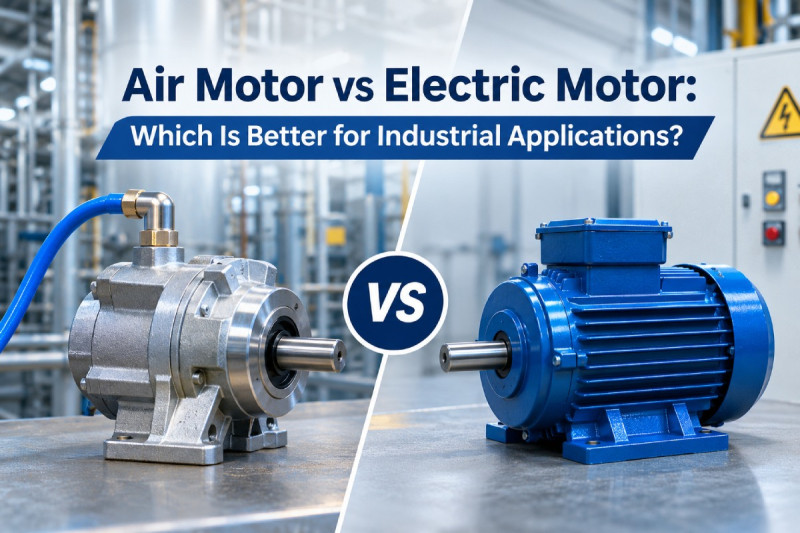
Neither is better across the board.
- An electric motor is usually the better choice for continuous, high-power duty where energy efficiency matters and electrical power is easy to supply.
- An air motor is usually the better choice where the motor must stall, reverse, or overload without damage, stay compact and light, run without electrical parts at the point of use, or work in hot, wet, or potentially explosive environments.
The question is less "which motor is better" and more "which motor suits this machine, this environment and this duty cycle". The air motor vs electric motor comparison helps manufacturers identify the right drive based on operating conditions, performance requirements and long-term costs.
Electric motors drive most of industry for good reasons: they are efficient, widely available, and easy to control with a variable-frequency drive. Air motors fill the gaps where those strengths matter less than ruggedness, safety and simplicity. Understanding the air motor vs electric motor differences is essential when selecting a suitable drive for industrial machinery.
This guide compares the two honestly:
- Power source, speed control and torque
- Starting, overload and heat
- Maintenance, installation and operating environment
- Energy cost, where air motors are at a clear disadvantage
It ends with a decision table. For the basics of how air motors work, see what a pneumatic air motor is.
How each motor works
Air motor (pneumatic motor)
An air motor, also called a pneumatic motor or air powered motor, turns compressed air into rotation. Air pressure acts on vanes or pistons and drives the output shaft, and the air is then exhausted to the atmosphere. The motor's speed settles where its torque balances the load, so speed falls as load rises.
Torque is highest at stall. An air powered motor is particularly useful in industrial machinery where compressed air is available and frequent starting or reversing is required.
The main types are:
- Vane motors, generally faster
- Piston motors, generally slower, with strong low-speed torque
- Geared motors, which add a gearbox for low output speed
These configurations support different pneumatic motor applications, ranging from high-speed equipment to low-speed, high-torque industrial machinery. Our comparison of vane and piston air motors explains the difference.
Electric motor
An electric motor turns electrical energy into rotation through the interaction of magnetic fields. Most industrial drives use AC induction motors. On a fixed supply, these run close to a set speed regardless of load until they are overloaded.
Speed and torque can be controlled precisely with a variable-frequency drive (VFD). Servo and brushless DC motors give tighter speed and position control. The pneumatic motor vs electric motor difference becomes clearer when comparing their energy sources, torque characteristics, and speed control capabilities.
The practical difference
- An air motor is a simple device fed by a compressor elsewhere. The energy conversion, and most of the losses, happen at the compressor.
- An electric motor converts energy right at the shaft, usually with much less loss. However, it brings electrical parts, heat, and wiring to the machine.
In an air motor vs electric motor evaluation, these differences influence installation requirements, operating safety, and overall machine performance.
Air motor vs electric motor: side-by-side comparison
The table compares pneumatic and electric motors factor by factor. The comparison is between typical industrial designs; individual products vary. This air motor vs electric motor comparison highlights the key differences in efficiency, torque, speed control, and industrial applications.
|
Factor |
Air motor |
Electric motor |
|
Power source |
Compressed air from a compressor system |
Mains electricity, directly or through a drive |
|
Speed control |
Simple, using a flow valve or regulator; speed varies with load unless closed-loop control is added |
Precise with a VFD or servo drive; speed holds steady under changing load |
|
Torque |
Highest at stall; rises as the motor slows under load |
Depends on motor type and drive; a VFD can give high torque at low speed |
|
Starting characteristics |
Can start and stop very frequently; full torque available quickly |
Frequent starts can overheat a motor not rated for them; soft starters and VFDs reduce this |
|
Heat generation |
Expanding air cools the motor; it runs cool |
Generates heat; it needs cooling and can overheat in high ambient temperatures |
|
Overload behaviour |
Stalls safely and restarts when the load eases |
Overload protection trips, or the motor overheats if unprotected |
|
Maintenance |
Air preparation, vane or piston wear, and lubrication where required |
Bearings and cooling; the drive electronics need a clean, dry enclosure |
|
Installation |
Air supply, hose, filter, regulator, and lubricator; no wiring at the motor |
Power cabling, starter or drive, and earthing; an enclosure suited to the environment |
|
Operating environment |
Tolerates heat, moisture and washdown well with suitable materials |
Needs an enclosure rating suited to dust, water and temperature |
|
Hazardous environments |
No electrical parts at the motor; often specified for potentially explosive areas, subject to certification |
Needs a certified explosion-protected motor and installation |
|
Variable speed |
Inherent; adjusted by air flow or pressure |
Needs a VFD or servo drive, which adds cost |
|
Size and weight |
Typically smaller and lighter for the same power |
Typically larger and heavier, especially in explosion-protected versions |
|
Energy considerations |
Low overall efficiency, because generating compressed air is energy-intensive |
High efficiency; usually much lower running cost for continuous duty |
|
Typical applications |
Mixers, agitators, pumps, winches, hoists, tools, and drives in hazardous or wet areas |
Pumps, fans, conveyors, compressors, machine tools, and most continuous process drives |
In short, the air motor wins on ruggedness, safety, and simplicity at the point of use. The electric motor wins on efficiency, precise control, and running cost.
What the differences mean in practice
Speed control and variable speed
An air motor gives variable speed with nothing more than a flow control valve or regulator. That is cheap and simple, but the speed drifts as the load changes. When comparing a pneumatic motor vs electric motor, consider how accurately the machine needs to maintain speed under changing loads. An electric motor on a VFD holds a set speed much more precisely, and it can be integrated into PLC control.
If the process needs exact, repeatable speed, an electric drive is usually the better fit. If rough adjustment is enough, an air motor is simpler. A pneumatic air motor vs electric motor comparison also highlights the difference between simple airflow adjustment and electronically controlled speed regulation. Our guide to air motor speed control covers the options in detail.
Torque, starting and overload
This is where air motors stand out:
- Torque rises as the motor slows. It reaches its maximum at stall.
- Stalling is safe. Most air motors can stall under overload without damage and carry on once the load clears.
- They tolerate frequent starts, stops, and reversals.
This suits jam-prone loads, winches, mixers that thicken during the batch, and duties with frequent starts and stops. These characteristics can make the air motor vs electric motor decision easier for machinery operating under unpredictable load conditions.
An electric motor can deliver strong torque, especially on a well-set-up VFD. However, a stalled or repeatedly started electric motor heats up quickly, so it needs protection that will trip the drive. The machine then has to be reset. These characteristics are among the most important air motor advantages for equipment exposed to sudden load changes and frequent reversals.
Heat generation
As compressed air expands through an air motor, it cools. This makes the motor suitable for hot environments and for products that must not be heated by the drive.
An electric motor turns part of its input into heat. In a high ambient temperature or an enclosed space, that heat has to be managed with ventilation, derating or a larger frame.
Operating in hazardous environments
With no electrical parts at the motor, air motors are often chosen for potentially explosive atmospheres, such as solvent handling, paint mixing and some chemical and oil and gas duties. They are also common in wet and washdown areas.
That said, hazardous-area suitability depends on the specific motor's certification and on the whole installation, not just the drive type. Explosion-protected electric motors are a well-established alternative. They are typically heavier and more expensive than a standard motor, but more energy-efficient than an air motor.
Maintenance and installation
- Air motors need clean, dry air at a stable pressure, plus lubrication where the design requires it. Vanes and seals wear over time and are replaceable.
- Electric motors need little routine work beyond bearing care, but their drives and starters need protected enclosures.
On installation, the trade-offs are:
- An air motor needs an adequate compressed-air supply. If the plant has no spare compressor capacity, that cost belongs in the comparison.
- An electric motor needs power cabling and protection at the machine.
Before selecting an air motor or electric motor, check the available utilities, installation space, and maintenance requirements.
Energy considerations: where electric motors clearly win
For continuous duty, an electric motor almost always uses less energy than an air motor delivering the same shaft power. Most of the loss in a pneumatic drive happens before the air reaches the motor: in the compressor, the cooling and drying, the pipework, and the leaks.
This is the air motor's main disadvantage, and it should be part of every comparison. Among the main air motor disadvantages, high compressed-air consumption has the greatest impact on long-term operating expenses.
An illustrative comparison
The figures below are assumptions for illustration, not data for any specific motor. Replace them with your motor datasheet, compressor data, and tariff.
|
Assumption |
Value used |
|
Shaft power needed |
1 kW |
|
Running hours |
2,000 h per year (8 h × 250 days) |
|
Electric motor efficiency |
85–90% (typical for a small industrial motor) |
|
Air motor consumption at that output |
About 1,000 L/min of free air (check the motor datasheet) |
|
Compressor input power |
About 6–8 kW per 1,000 L/min (rough estimate; check compressor data) |
|
Electricity tariff |
₹8 per kWh |
With those assumptions:
- Electric motor: 1 kW ÷ 0.85–0.90 is about 1.1–1.2 kW input. That gives about 2,200–2,400 kWh a year, or roughly ₹18,000–₹19,000.
- Air motor: about 6–8 kW at the compressor. That gives about 12,000–16,000 kWh a year, or roughly ₹96,000–₹1,28,000.
In this example, the air motor uses roughly five to seven times as much energy. The real ratio depends heavily on the motor, the compressor, the pressure setting, and air leaks. However, the direction is consistent for continuous duty.
When the energy gap matters less
- Short or intermittent duty. A motor that runs a few minutes per hour uses little air in total.
- Existing compressed air with spare capacity, where no new compressor is needed.
- Costs that energy alone doesn't capture. Examples are the price of an explosion-protected electric motor and drive, downtime from overload trips, or the weight of a heavy motor on a portable machine.
Compare total cost of ownership for the actual duty, not purchase price or energy alone.
Air motor advantages and disadvantages
Businesses evaluating an electric motor alternative should compare safety requirements, energy consumption, and maintenance costs before selecting a drive.
|
Air motor advantages |
Air motor disadvantages |
|
Stalls under overload without damage, then restarts |
Much lower overall energy efficiency than an electric motor |
|
Tolerates frequent starting, stopping and reversing |
Needs a compressed-air supply with enough capacity, and clean, dry air |
|
Simple variable speed with a valve or regulator |
Speed varies with load unless closed-loop control is added |
|
Runs cool; suits hot environments |
Exhaust noise, which usually needs a silencer |
|
No electrical parts at the motor; often used in hazardous and wet areas |
Hazardous-area suitability still depends on certification and the installation |
|
Compact and light for its power |
Vanes and seals wear; output falls if the air supply drops |
Pneumatic motor applications
Where air motors are commonly used
An air powered motor can provide reliable rotational movement in equipment exposed to demanding operating conditions. An industrial air motor is commonly selected for mixing, pumping and material-handling equipment that requires dependable operation under variable loads.
- Mixers, agitators and drum stirrers for paints, inks, solvents, adhesives and chemicals, often in flammable areas
- Pumps for transferring flammable or viscous liquids
- Hoists, winches and tensioning drives, where stall and reverse duty are routine
- Rotating parts of process equipment, where heat, moisture or washdown would challenge an electric motor
- Portable and handheld equipment, where lightweight matters
- Machine drives that jam or overload often, such as feeders, screw drives and conveyors handling sticky products
An air motor can be a practical electric motor alternative for portable equipment, frequent-reversal applications and machinery exposed to moisture. Understanding different pneumatic motor applications helps determine whether a vane, piston or geared motor is appropriate.
Where electric motors are usually the right default
- Continuous, high-power process drives: pumps, fans, compressors and conveyors running long hours
- Precise speed or position control: packaging, machine tools and servo-driven automation
- Plants without spare compressed-air capacity
- Energy-sensitive operations, where running cost is a major selection factor
Air motor or electric motor? A decision table
Use the table as a starting point. If you have conditions on both sides, weigh them against the duty cycle and the cost of compressed air. The choice of air motor or electric motor should reflect both immediate operating needs and long-term ownership costs.
|
Choose an air motor when… |
Consider an electric motor when… |
|
The atmosphere may be explosive, or you want no electrical parts at the drive |
The area is safe, or certified explosion-protected electric equipment is acceptable and justified |
|
The load can jam, stall, or overload, and the drive must survive it |
The load is steady and predictable |
|
The duty involves frequent starts, stops or reversals |
The motor runs continuously for long hours |
|
Simple, adjustable speed is enough |
The process needs precise, repeatable speed or position control |
|
The environment is hot, wet, or washed down |
The environment is clean and dry, or an enclosure handles it |
|
Size and weight at the drive must be small |
Size and weight are not critical |
|
Compressed air is already available with spare capacity |
There is no spare compressed-air capacity |
|
The duty is short or intermittent, so energy use is modest |
Energy cost over the motor's life is a major factor |
An example: mixing solvent-based paint in drums
The atmosphere may be flammable, the paint thickens as pigment is added, and operators move the mixer between drums. An air motor drive suits all three: no electrical parts at the drive, safe stall if the paint thickens, and a light unit to move.
Now consider a large water-based tank running a single steady agitation duty for 16 hours a day. Here, a properly specified electric geared motor is likely to cost much less to run.
Where SAN's range fits
If the decision table points to an air motor, the next step is choosing the type and size. SAN's industrial air motor range covers the main families. The figures below are as published by SAN at 6 bar, and they vary by model. Choosing the right industrial air motor involves matching the required output torque, rotational speed, and available air pressure.
|
If you need… |
SAN air motor family |
Published range |
|
Higher speed, light to moderate torque |
0.45–9.50 hp, 2,000–10,000 RPM, 0.31–34 Nm |
|
|
Lower speed, strong starting torque |
SPM Polymer Piston Air Motor and metal piston range |
About 0.11–1.5 hp, 360–1,200 RPM, 0.64–28 Nm |
|
Low output speed with high torque |
Geared Compact Pneumatic Motor – AM and SAN Series geared motors |
Depends on model and ratio |
|
A replacement for an installed Atlas Copco motor |
Matched on performance and mounting |
To size the motor, use our air motor selection guide. To decide whether you need gearing, see geared air motor vs direct drive.
Mixing drums and IBCs: both options are available
For drum and IBC mixing, SAN offers both drive technologies, so the choice can follow the application rather than the catalogue:
- Pneumatic stirrers, such as the SAN AIR geared drive stirrer for drum plate mounting, suit flammable or variable-load duties.
- Electric stirrers, such as the SAN AIR electric geared drive stirrer and the SANMIX electric closed drum stirrer, suit safe-area, steady-duty mixing.
Common mistakes when choosing between them
- Comparing purchase price only. For continuous duty, energy cost over a few years can far exceed the price of either motor.
- Assuming spare compressed air. A new air motor on a fully loaded compressor can force a compressor upgrade.
- Assuming air motors are automatically safe in hazardous areas. Certification and the whole installation still need checking.
- Using an electric motor where the load jams often. Repeated overload trips and reset downtime can cost more than an air motor's energy use.
- Expecting precise speed from a simple air valve. If speed must be exact, plan closed-loop control or use an electric drive.
Frequently asked questions
Is a pneumatic motor better than an electric motor?
Neither is better overall. In the pneumatic motor vs electric motor choice, the pneumatic motor wins on overload tolerance, frequent starts and stops, heat, and use in hazardous or wet areas. The electric motor wins on energy efficiency, precise speed control, and running cost for continuous duty.
What is the main disadvantage of an air motor?
Energy efficiency. Producing compressed air takes far more energy than the air motor delivers at its shaft, so for continuous duty an air motor typically costs several times more to run than an equivalent electric motor.
Is an air motor a good electric motor alternative in explosive atmospheres?
Often, yes. A pneumatic air motor vs electric motor comparison in a potentially explosive area usually favours the air motor, because it has no electrical parts at the drive and is light and simple. Suitability still depends on the specific motor's certification and the whole installation, and certified explosion-protected electric motors are also an option.
Can an air motor run continuously?
Yes, many air motors are designed for continuous duty, given clean, dry air and correct lubrication where required. The main drawback of running continuously is energy cost, not the motor's ability to run.
Why do air motors not overheat when stalled?
When an air motor stalls, airflow almost stops and no heat is generated in windings, because there are none. Expanding air also cools the motor in normal running. An electric motor at stall draws high current and heats quickly.
How do I start an air motor selection?
Start with the output speed and torque the machine needs, the pressure available at the motor, and the duty cycle. Our air motor selection guide walks through the steps.
Next step
If you are deciding between air and electric for a specific machine, send SAN's team the following:
- The application
- Required speed and torque
- Duty cycle
- Operating environment, including any hazardous-area classification
- Available compressed air or electrical supply
They can suggest whether a pneumatic or electric drive suits the duty, and which model to consider.