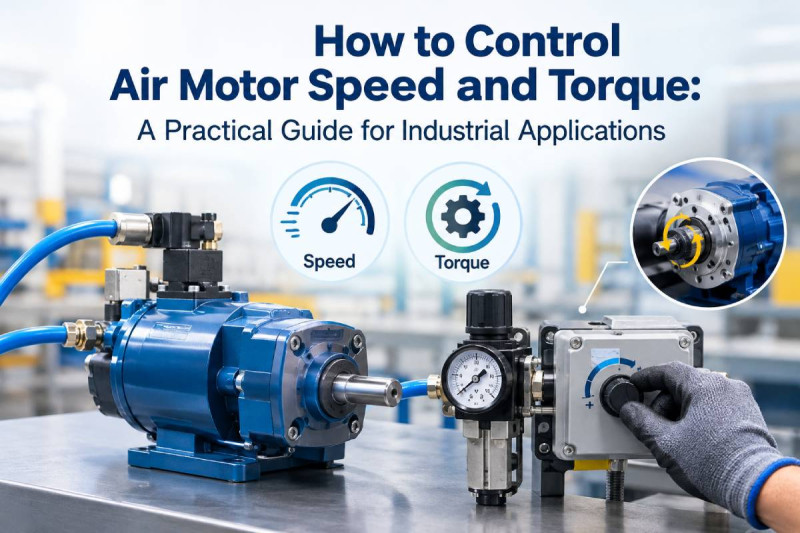
Air motor speed control is usually done by limiting the airflow into or out of the motor. Torque is controlled mainly through the pressure at the motor inlet. For a large, fixed change in speed and torque, the practical answer is gearing or a different motor type, not throttling.
An air motor does not run at a fixed speed the way a synchronous electric motor does. Its speed settles wherever the torque it produces balances the load. That makes it easy to adjust, but it also means speed changes whenever the load or the air supply changes. Effective air motor speed control accounts for changes in load and air supply rather than attempting to eliminate this natural behaviour.
This guide covers:
- What sets air motor speed and torque
- The practical ways to reduce speed or increase available torque, and what each one costs you
- How pressure, speed and torque relate on a typical performance curve
- How to turn a required RPM and torque into a motor choice
For the basics of how these motors work, see what a pneumatic air motor is.
What determines air motor speed?
Air motor speed is set by the balance between the torque the motor produces and the torque the load demands. Seven factors move that balance. The response of a compressed air motor also depends on the stability of the air supply under load.
Air pressure at the inlet
Higher pressure gives more torque at any given speed, so the motor runs faster against the same load. The pressure that matters is the pressure at the motor while it runs, not the compressor setting.
Airflow
Speed depends on how much air the motor can pass. A restrictive hose, fitting, filter or valve limits flow and caps the speed, even when the static pressure looks fine.
Load
As the load torque rises, the motor slows. At no load it reaches its free speed, and at enough load it stalls. This speed-droop is the main difference from a fixed-speed electric motor.
Motor type
Vane motors are generally the faster type, often running in the thousands of RPM. Piston motors typically run slower, with strong torque at low speed. SAN's published ranges illustrate this: about 2,000–10,000 RPM for the SAM vane motor, and about 360–1,200 RPM for the SPM polymer piston motor, depending on model.
Internal design
The motor's displacement and internal leakage shape its speed-torque curve. In a vane motor, these include the number of vanes and the rotor size. In a piston motor, they include the number and bore of the pistons.
Gearing
A gearbox divides the motor speed by the gear ratio. For example, a 3,000 RPM motor with a 10:1 reduction gives 300 RPM at the output shaft.
Exhaust restriction
A clogged silencer, a long exhaust line or a deliberately throttled exhaust raises the back pressure, which reduces both speed and power.
What determines air motor torque?
Air motor torque control depends on air pressure acting on the vanes or pistons, along with the motor's displacement and operating speed. It depends on two things: the pressure at the inlet and the motor's displacement, which is the volume of air it takes per revolution. At a given pressure, the torque the motor delivers rises as the load slows it down.
The torque-load relationship works like this:
- At free speed (no load), torque is close to zero.
- As load increases, the motor slows, and its torque rises to match the load.
- At stall, the motor stops and delivers its maximum (stall) torque. Most air motors can stall under overload without damage and restart once the load eases.
- Power is torque × speed, so it is zero at both ends. On a vane motor, it typically peaks around half of free speed.
Three practical points follow.
- Pneumatic motor torque is set by the load, not chosen. You can only set the maximum available torque by limiting pressure, and the speed at which the motor will carry a given load.
- Starting torque differs from stall torque. Vane motors can have a lower starting torque than their stall torque suggests, because the vanes need to seal before full torque develops. Piston motors often start heavy loads more readily. Check the manufacturer's starting-torque figure where the load is hard to start.
- Torque, speed and power are linked. Use Torque (Nm) = 9550 × Power (kW) ÷ RPM to convert catalogue power figures to torque at your working speed. For example, 0.5 kW at 1,000 RPM is about 4.8 Nm.
How to reduce air motor speed
There are five practical ways to reduce air motor speed. Each one changes torque and power differently, so choose based on what the load needs at the lower speed.
1. Throttle the inlet airflow
A flow control valve on the supply line limits airflow to the motor, providing a simple method of pneumatic motor speed control. It is the simplest method of air motor speed control and is widely used where basic, adjustable speed regulation is sufficient.
A useful side effect is that if the load increases and the motor slows, less air flows through the valve. The pressure at the motor then rises back towards line pressure, so high torque is still available near stall. The drawback is that speed varies noticeably with load, because a throttled motor has a "softer" speed-torque curve.
2. Throttle the exhaust
Restricting the exhaust also reduces speed by raising the back pressure inside the motor. On reversible motors with a common exhaust port, a single exhaust valve controls speed in both directions.
The trade-off is that a heavily restricted exhaust reduces available power and torque. So what happens if you throttle the exhaust? The motor slows, but it also loses useful output. Use exhaust throttling for moderate trimming rather than large reductions. Keep silencers clean, because a clogged silencer is unintended exhaust throttling.
3. Lower the inlet pressure with a regulator
An air motor regulator reduces the pressure supplied to the motor, limiting the available torque and lowering free speed. Lower pressure reduces torque at every speed, including stall torque, and the free speed also falls.
This is the method to choose when you want to cap the maximum torque, for example, to protect a mechanism or avoid overloading a product. It is less precise for setting a speed, because speed still changes with load.
4. Add a gearbox
A gearbox reduces output speed by a fixed ratio and multiplies output torque by roughly the same ratio, minus gearbox losses. The motor keeps running in its efficient speed range while the output turns slowly.
For a large, permanent speed reduction, gearing is usually better than throttling. Throttling a motor down to a fraction of its speed wastes much of its capacity. A gearbox does not create power; it trades speed for torque.
5. Choose a lower-speed motor type
If the application needs low RPM with high torque, a piston motor may suit it better than a heavily throttled vane motor. Our comparison of vane and piston air motors covers that choice.
Closed-loop speed control
For applications requiring consistent air motor speed control as the load changes, an open-loop valve alone is not sufficient. A proportional pressure or flow valve connected to an encoder or sensor can automate pneumatic air motor control by adjusting the air supply in response to measured speed. This adds cost and complexity, so it is normally reserved for processes where speed variation affects quality.
|
Method |
Effect on speed |
Effect on torque |
Best used for |
|
Inlet throttling |
Reduces it; varies with load |
High torque still available near stall |
Simple, adjustable speed control |
|
Exhaust throttling |
Reduces it |
Power and torque fall as back pressure rises |
Moderate trimming; reversible motors |
|
Pressure regulation |
Reduces it |
Reduces torque at every speed, including stall |
Limiting maximum torque |
|
Gearbox |
Fixed reduction by the ratio |
Output torque multiplied, less gearbox losses |
Large, permanent speed reduction |
|
Lower-speed motor type |
Lower natural speed range |
Strong torque at low speed (often piston) |
Low-RPM, high-torque duties |
How to increase available torque
To get more torque from an air motor, you have three options: raise the effective pressure acting on it, operate it lower on its speed curve, or multiply its output through gearing. "Increase the pressure" is only one of these, and often not the first to try.
In practical order:
Recover lost pressure first
Undersized hoses, quick couplings, filters, regulators and long supply lines can each take away pressure while the motor runs. If a motor rated at 6 bar sees only 5 bar under flow, it loses roughly a sixth of its torque as a first approximation. Fixing the supply raises air motor operating pressure without touching the compressor setting.
Free the exhaust
Back pressure from a clogged silencer or a restrictive exhaust line reduces the pressure difference across the motor, and with it the torque.
Accept a lower working speed
The same motor at the same pressure gives more torque at a lower speed, because torque rises as the motor slows. If the process can run slower, the motor may already have the torque you need.
Add gearing
Output torque is roughly motor torque × gear ratio × gearbox efficiency. For example, a motor giving 2 Nm through a 5:1 gearbox at an assumed 85% efficiency delivers about 8.5 Nm at one-fifth of the speed. The 85% is for illustration; use the gearbox maker's figure.
Raise pressure, within the motor's rating
Raising pressure within the motor's rated limits increases pneumatic motor torque roughly in proportion to pressure, although air consumption and wear may also increase. Never exceed the manufacturer's maximum operating pressure.
Use a larger motor or a different type
If the steps above aren't enough, the motor is undersized. A larger displacement, or a piston motor for heavy low-speed loads, is the correct fix.
Also check the motor's condition. Worn vanes, poor lubrication and internal leakage all reduce air motor torque gradually, and the loss is often mistaken for a sizing problem.
Air pressure vs speed vs torque
Pressure sets the height of the whole speed-torque curve. Load decides where on that curve the motor runs.
The chart reads in three ways:
- Torque falls as speed rises. At any pressure, torque is highest at stall and falls to zero at free speed.
- Power peaks in the middle. Power is the product of torque and speed, so it peaks near half of free speed. That is typically the most efficient working region for a vane motor.
- Lower pressure lowers everything. Dropping from 6 to 4 bar lowers stall torque roughly in proportion and reduces free speed. Peak power falls by more than the pressure ratio.
Actual motors may deviate from these straight-line relationships, so always use the manufacturer's performance curves to assess air motor performance and select the correct model.
|
Change you make |
Speed |
Torque |
Power |
Air consumption |
|
Raise inlet pressure (within rating) |
Rises at the same load |
Rises roughly in proportion |
Rises more than in proportion |
Rises |
|
Lower pressure with a regulator |
Falls |
Falls at every speed, including stall |
Falls more than in proportion |
Falls |
|
Throttle the inlet |
Falls; varies more with load |
High torque still available near stall |
Falls at the working speed |
Falls |
|
Throttle the exhaust |
Falls |
Falls as back pressure rises |
Falls |
Falls |
|
Increase the load |
Falls |
Rises to match the load |
Rises up to about half free speed, then falls |
Usually falls as speed drops |
|
Add a gearbox (ratio i) |
Output speed ÷ i |
Output torque × i, less gearbox losses |
Slightly lower (losses) |
Unchanged at the same motor operating point |
How to select an air motor for a required RPM and torque
Effective pneumatic motor sizing starts by matching the required speed and torque to the motor's performance curve at the lowest expected operating pressure. Then use speed control to trim within that range, not to make up for a wrong size.
- Fix the operating point. Define the required output RPM and running torque, including starting torque where necessary, before selecting an appropriate motor for air motor RPM control.
- Use the lowest realistic pressure. Use the lowest realistic air motor operating pressure, measured at the motor under flow rather than at the compressor.
- Leave control headroom. If the speed must be adjustable, size for the highest speed and the highest torque needed at the same time. A working point near the middle of the curve leaves room to throttle down and to absorb load changes. For accurate air motor RPM control, choose a motor that provides sufficient torque at the required operating speed while allowing adjustments for changing load conditions.
- Decide the configuration from the speed band. A large gap between the motor's natural speed and the output speed points to gearing rather than throttling.
- Check air consumption at the operating point, and confirm that the supply can deliver the necessary flow for accurate pneumatic motor sizing.
Our air motor selection guide covers pneumatic motor sizing step by step, with a worked example.
|
Required output |
Configuration to investigate |
SAN range (published at 6 bar; depends on model) |
|
Higher speed, roughly 2,000 RPM and above |
Direct-drive vane motor |
SAM Vane Air Motor: 2,000–10,000 RPM, 0.31–34 Nm |
|
Moderate speed, roughly 360–1,200 RPM, with strong torque |
Piston motor |
SPM Polymer Piston: 360–1,200 RPM, 0.64–28 Nm. Metal piston range: 360–1,100 RPM, 0.64–28 Nm |
|
Low output speed, or high torque at low RPM |
Geared motor |
Geared Compact Pneumatic Motor – AM and SAN Series geared motors |
|
Replacing an existing Atlas Copco motor |
Equivalent motor matched on performance and mounting |
You can browse all families in SAN's industrial air motor range.
Common speed and torque control mistakes
- Throttling to fix a sizing error. A motor throttled to a small fraction of its speed wastes capacity. Gearing or a lower-speed motor type is usually the better answer.
- Measuring pressure at the compressor. The motor's performance depends on the pressure at its inlet while it runs.
- Over-restricting the exhaust. Heavy exhaust throttling, or a clogged silencer, reduces power and torque, not just speed.
- Raising pressure above the motor's rating to get torque. This shortens motor life. Use gearing or a larger motor instead.
- Expecting constant speed under a varying load from a simple valve. Open-loop throttling cannot hold speed steady when the load changes. That needs feedback control.
- Neglecting air preparation. Dirty or wet air and poor lubrication, where the design needs it, reduce air motor performance over time. Moist air expanding through the motor can also cause exhaust icing on some duties.
Frequently asked questions
How do I control the RPM of an air motor?
For effective air motor speed control, fit a flow control valve on the inlet and adjust it until the motor reaches the required RPM under its normal load. For a large, fixed reduction, use a gearbox or a lower-speed motor type. For constant speed under changing loads, use a proportional valve with feedback as part of a pneumatic motor speed control system.
How does air pressure affect air motor torque?
Torque rises roughly in proportion to the pressure at the motor inlet. Lowering the pressure from 6 to 4 bar reduces available torque to roughly two-thirds. Speed and power also fall, with power falling the most.
How do I get lower speed and higher torque from an air motor?
Use a gearbox, or move to a motor type with a lower natural speed, such as a piston motor or a geared air motor. A gearbox reduces speed and multiplies torque by roughly the gear ratio,with less loss. Throttling reduces speed but does not multiply torque.
What happens if I throttle the exhaust of an air motor?
The motor slows because back pressure rises inside it. Available power and torque also fall. Moderate exhaust throttling is useful for trimming speed, especially on reversible motors with a common exhaust, but heavy restriction wastes the motor's output.
What is the best method for air motor torque control?
For air motor torque control, use an air motor regulator to set the inlet pressure and limit the maximum torque available at stall. Because torque follows pressure, a regulator caps the maximum torque the motor can deliver, including at stall. This is useful for protecting a mechanism or a product.
How can a compressed air motor be controlled electronically?
Yes. Pneumatic air motor control can use electronic proportional pressure or flow valves, with or without speed or torque feedback. The motor itself stays pneumatic; only the valve control is electronic.
Why does my air motor slow down under load?
An air motor's speed depends on load: as load torque rises, the motor slows until its torque matches the load.
If it slows more than it used to, check the following:
- Supply pressure at the motor
- Restrictions in the hose and fittings
- Clogged silencers
- Worn vanes
Next step
If you need help matching a motor to a required speed and torque, contact SAN's team with the following details:
- Output RPM
- Running torque, and starting torque if the load is hard to start
- Pressure available at the motor
- Duty cycle
- Whether the speed must be adjustable