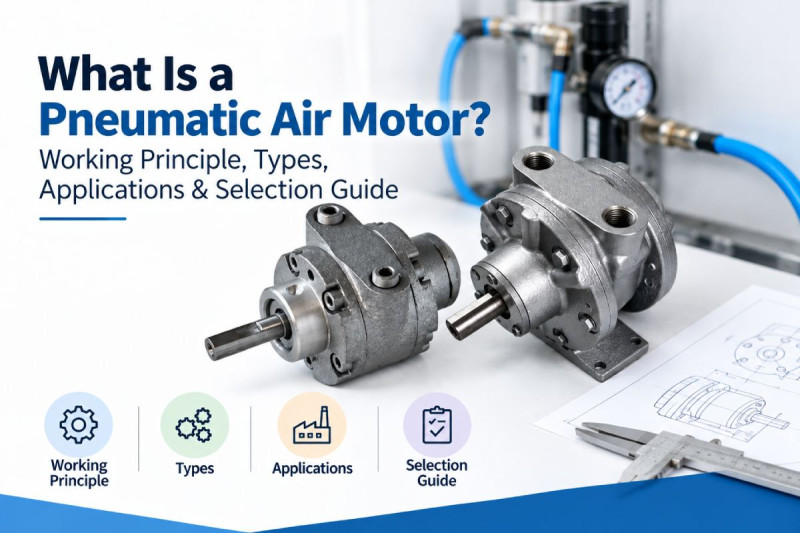
A pneumatic air motor converts energy from compressed air into rotary mechanical motion. Unlike an electric motor, it does not use electrical power to produce rotation. Instead, compressed air enters the motor, acts on internal components such as vanes or pistons, and produces continuous or controlled shaft rotation.
This makes an air motor useful where variable speed, compact construction, frequent starting and stopping, or compatibility with compressed-air systems are important. But choosing an air motor is not simply a matter of matching horsepower. The application also determines the required RPM, torque, air consumption, operating pressure, motor type and transmission arrangement.
This guide explains how a pneumatic motor works, the main types available, where they are used, and what to consider before selecting one for an industrial application.
What Is a Pneumatic Air Motor?
A pneumatic air motor, also called a compressed air motor, is a mechanical device that uses compressed air as its power source and converts pneumatic energy into rotary motion.
The basic energy path is:
Compressed air → internal motor mechanism → rotary motion → shaft output
An industrial pneumatic motor is commonly used to drive equipment such as pumps, mixers, conveyors, material-handling systems and other rotating machinery. The term air powered motor is often used interchangeably with pneumatic motor or air motor. In industrial equipment specifications, however, the important details are the motor's operating pressure, speed, torque, power and air consumption.
For applications requiring a compact source of rotary power, an industrial air motor can be considered where an electrical drive is unsuitable or where compressed air is already available.
How Does a Pneumatic Air Motor Work?
The pneumatic air motor working principle is based on the controlled expansion of compressed air. Compressed air enters the motor through an inlet. The pressure and airflow act against the motor's internal working mechanism, generating a force that rotates the shaft. After transferring energy to the moving components, the air leaves through the exhaust.
The exact mechanism depends on the type of motor. For a vane motor, compressed air acts against vanes mounted on a rotor. For a piston motor, compressed air drives reciprocating pistons, and that motion is converted into rotary shaft movement. In both cases, the result is the same: compressed-air energy is converted into mechanical rotation.
Main components of an air motor
Depending on the design, an air motor can include:
- Motor housing
- Air inlet
- Exhaust port
- Rotor or piston assembly
- Vanes or pistons
- Bearings
- Drive shaft
- Seals
- Lubrication system or lubrication provisions
- Gearbox in geared configurations
The housing contains the working mechanism and directs compressed air through the motor. The shaft transfers the resulting rotary motion to the driven equipment.
How Does Compressed Air Produce Rotary Motion?
The conversion can be understood in three stages.
1. Air enters the motor
Compressed air supplied from the plant pneumatic system enters the motor at the required operating pressure.
2. Air creates mechanical force
The air acts against vanes, pistons or another internal mechanism. The geometry of the motor converts this force into movement.
3. The shaft delivers rotary power
The internal movement produces shaft rotation. The shaft can then drive a pump, mixer, conveyor, tool or other mechanical load.
The actual output depends on the motor design and operating conditions. Increasing or reducing airflow, pressure or load can change the operating point of the motor.
What Are the Main Types of Pneumatic Motors?
The most common pneumatic motor types used for industrial applications include vane, piston and geared air motors.
1. Vane Air Motor
A vane air motor uses a rotor fitted with sliding vanes. The rotor is positioned within the housing so that compressed air creates a pressure difference across the vanes and causes the rotor to turn. Vane motors are widely used when continuous rotary motion and variable operating speed are required.
San Industries' current Vane Air Motor - SAM range lists operating pressure of 6 bar, power from 0.45 to 9.50 hp, speeds from 10,000 to 2,000 rpm, torque from 0.31 to 34 Nm and air consumption from 20.7 to 275 CFM across its variants.
Typical applications include:
- Conveyor systems
- Pump drives
- Material handling equipment
- Packaging machinery
- Assembly lines
- Automated production systems
- Industrial machinery
2. Piston Air Motor
A piston air motor uses reciprocating pistons instead of sliding vanes. Compressed air moves the pistons, and the resulting reciprocating motion is converted into rotary output. Piston motors can be useful when the application requires particular torque and speed characteristics.
San Industries offers both polymer piston and metal piston air motor ranges. Its polymer-piston range currently covers 0.11–1.5 hp, 1,200–360 rpm, 7–35 CFM air consumption and up to 28 Nm torque at 6 bar. The metal-piston range covers 0.12–1.5 hp, 1,100–360 rpm, 7.1–34.88 CFM and up to 28 Nm torque at 6 bar.
3. Geared Air Motor
A geared air motor combines an air motor with a gear arrangement to provide a different output speed and torque relationship. This is useful when the motor's direct output speed does not match the speed required by the driven machine.
San Industries has a dedicated Geared Compact Pneumatic Motor category and a SAN Series geared motor range, including multiple series and product configurations. The correct gear ratio should be selected according to the required output speed, torque and load characteristics rather than simply choosing the largest motor available.
Air Motor Performance: RPM, Torque, Power and Air Consumption
Four specifications should receive particular attention when selecting a industrial pneumatic motor.
RPM
RPM indicates how fast the motor shaft rotates. A high-speed application may require a direct-drive vane motor, while an application requiring slower shaft rotation may benefit from a geared configuration.
Torque
Torque determines the motor's ability to produce rotational force against a load. A motor that has adequate free-running RPM but insufficient torque may slow significantly when connected to the actual machine.
Power
Power represents the rate at which the motor can perform mechanical work. Horsepower is commonly used in air motor specifications. Power should be considered alongside operating speed and torque rather than as an isolated number.
Air consumption
Air consumption indicates how much compressed air the motor requires under specified operating conditions. This is particularly important because the available compressor capacity and plant air system must be able to supply the motor without excessive pressure drop.
For example, San's SAM vane motor range lists air consumption from 20.7 to 275 CFM depending on model, while its polymer piston range lists 7–35 CFM.
What Affects Air Motor Performance?
An industrial air motor's performance can change considerably depending on the operating conditions.
Important factors include:
1. Air pressure
The motor must receive air at the pressure specified for its operating range. Pressure changes can affect available torque and speed.
2. Airflow
Insufficient airflow can prevent the motor from reaching its expected operating point. The compressor may have sufficient pressure on paper but still fail to supply the required flow through restrictive piping, valves, filters or undersized connections.
3. Load
The motor behaves differently under no-load and loaded conditions. A motor running at high free speed may operate at a substantially different RPM once it drives the actual machine.
4. Motor design
Vane and piston motors have different operating characteristics. Geared motors introduce another variable through their gear ratio.
5. Air quality and lubrication
Water, contamination and unsuitable lubrication practices can affect pneumatic equipment. The air preparation system should therefore be appropriate for the motor and manufacturer's operating requirements.
What Are Pneumatic Motors Used For?
Industrial pneumatic motor applications cover many industrial environments where compressed air is already part of the plant infrastructure.
Common pneumatic motor applications include:
- Material handling
- Conveyors
- Pumps
- Mixers and agitators
- Packaging machinery
- Assembly equipment
- Automated production systems
- Industrial tools
- Chemical processing equipment
- Equipment requiring variable-speed rotary drives
San Industries' own product information identifies conveyor systems, material handling, mixing and agitation, industrial automation and related machinery among applications for its air motor ranges. The correct motor, however, depends on the machine's actual load and operating requirements. Application similarity alone is not enough for final selection.
How to Select the Right Pneumatic Air Motor
The best way to select a pneumatic motor is to start with the driven equipment rather than the motor catalogue.
Step 1: Determine required RPM
Establish the required shaft speed at the driven equipment. If the required output speed is lower than the available motor speed, consider whether a geared air motor is appropriate.
Step 2: Determine required torque
Identify the torque required during normal operation and, where applicable, during starting or peak load conditions. Do not select a motor based only on free-running speed.
Step 3: Check available air pressure
Confirm the pressure available at the motor inlet under actual operating conditions. San Industries' published vane and piston examples use 6 bar as the stated operating pressure.
Step 4: Check available airflow
Compare the motor's specified air consumption with the capacity of the compressed-air system. Consider pressure losses through piping, regulators, filters and valves.
Step 5: Select the motor type
A simplified starting point is:
|
Requirement |
Motor type to investigate |
|
Variable-speed rotary drive |
Vane air motor |
| Specific piston-driven applications | Piston air motor |
| Lower output speed / geared drive | Geared air motor |
| High-speed rotary requirement | Direct-drive vane motor |
| Application requiring specific torque-speed output | Compare motor curves/specifications |
This is a starting framework, not a substitute for application-specific sizing.
Step 6: Consider installation
Check:
- Shaft configuration
- Mounting arrangement
- Available space
- Air connection size
- Rotation direction
- Gear ratio where applicable
- Environmental conditions
- Maintenance requirements
A technically suitable motor can still be the wrong choice if it cannot be integrated properly into the machine.
Air Motor Maintenance
An air motor generally requires less complex maintenance than many larger mechanical drive systems, but it should not be treated as maintenance-free.
A basic maintenance programme should include:
- Checking air lines and connections for leakage
- Maintaining suitable air quality
- Inspecting filters and regulators
- Following the manufacturer's lubrication requirements
- Checking bearings and seals
- Monitoring unusual noise or vibration
- Inspecting shaft and coupling alignment
- Checking changes in operating speed or torque
For motors operating continuously or in demanding environments, maintenance intervals should be based on operating hours, load and manufacturer recommendations.
When Is an Air Motor Better Than an Electric Motor?
An air powered motor can be a strong option when the production environment already has compressed air and the application benefits from pneumatic drive characteristics.
Potential advantages include:
- Variable speed control
- Compact installation
- Frequent start/stop operation
- Compatibility with pneumatic systems
- No electrical motor at the point of drive
- Suitability for certain industrial environments
However, an air powered motor is not automatically better than an electric motor. If compressed air motor is expensive, unavailable or inefficient for the application, an electric motor may be more appropriate. The decision should consider the complete system, including energy source, operating cycle, required speed, torque, controls, installation environment and maintenance.
San Industries Air Motor Range
San Industries' current Air Motor category includes Vane Air Motor, Geared Compact Pneumatic Motor, Piston Air Motor with Polymer Pistons, Piston Air Motor with Metal Pistons, Geared Compact Pneumatic Motor SAN Series and an Atlas Copco Equivalent Air Motor Range. The company's sitemap also lists individual vane, piston and geared air motor products, giving the category a substantial product architecture that this pillar article can connect to.
As an industrial air motor manufacturer, San Industries can use this technical content to help engineers move from understanding the technology to comparing the appropriate motor family for their application. Explore the San Industries Air Motor range to compare vane, piston and geared pneumatic motor options based on your required speed, torque, power and air supply.
Frequently Asked Questions
What is a pneumatic air motor?
A pneumatic air motor converts compressed-air energy into mechanical rotary motion. It can be used to drive equipment such as pumps, conveyors, mixers and other rotating machinery.
How does an air motor work?
Compressed air enters the motor and acts on an internal mechanism such as vanes or pistons. This produces mechanical movement that is converted into rotary shaft output.
What are the types of pneumatic motors?
The main types include vane air motors, piston air motors and geared air motors. Each has different speed, torque and application characteristics.
What are pneumatic air motors used for?
Pneumatic air motors are used in material handling, conveyors, pumps, mixing, packaging, automation and other industrial machinery where compressed-air power is suitable.
How do I choose an air motor?
Start with the required RPM and torque, then check available air pressure, air consumption, power, mounting arrangement, operating environment and whether direct or geared output is required.