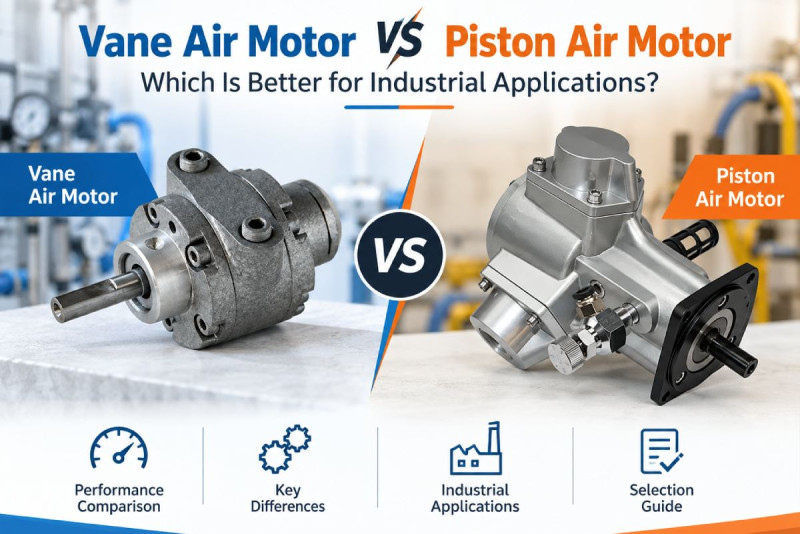
Choosing between a vane air motor and a piston air motor is not simply a question of which design is more powerful. The better choice depends on the required speed, torque, starting behaviour, air consumption, duty cycle, load, and the way the motor will be connected to the driven equipment.
A pneumatic vane motor is generally attractive for applications requiring high rotational speed, compact construction, and adjustable operation, while a piston motor can be a better fit where the application calls for lower operating speeds and a different torque-speed characteristic. San Industries manufactures and supplies both types, including polymer piston and metal piston air motor ranges. Its Air Motor category also includes geared pneumatic motors, allowing the motor selection to be matched more closely to the required output.
This guide compares the two designs from an engineering and application perspective so you can determine which pneumatic motor is appropriate for your equipment.
Vane Air Motor vs Piston Air Motor: Quick Answer
Neither a vane air motor nor a piston air motor is universally better. A vane air motor is generally a strong choice when you need higher rotational speed, a compact rotary drive, and straightforward variable-speed operation. A piston air motor is worth considering when the application calls for a lower-speed pneumatic drive, and the torque-speed characteristics of a piston design better match the load.
The final selection should be based on RPM, torque, power, available compressed-air pressure, air consumption, starting load, duty cycle, and installation requirements.
|
Factor |
Vane Air Motor |
Piston Air Motor |
|
Operating principle |
Rotor and sliding vanes |
Reciprocating pistons |
|
Typical speed characteristic |
Generally suited to higher speeds |
Generally suited to lower-speed operation |
|
Torque behaviour |
Strong rotary output; application dependent |
Strong torque characteristics at lower speeds; application dependent |
|
Speed control |
Variable through air supply/control |
Variable through air supply/control |
|
Construction |
Compact rotary mechanism |
Piston-based mechanism |
|
Air consumption |
Depends on model and operating point |
Depends on model and operating point |
|
Starting performance |
Good when correctly sized |
Good, particularly where starting torque is important |
|
Typical applications |
High-speed drives, stirrers, pumps, machinery |
Lower-speed drives, mixing, automation, material handling |
|
Best selection method |
Match RPM, torque and airflow to load |
Match RPM, torque and airflow to load |
The important point is that motor type alone does not determine performance. The model, operating pressure, and actual load all matter.
What Is a Vane Air Motor?
A vane air motor converts compressed-air energy into rotary motion using a rotor fitted with sliding vanes. Compressed air enters the motor housing and acts on the vanes. The pressure difference produces a force on the rotor, causing it to rotate. The shaft transfers this rotation to the connected equipment.
Because the mechanism produces direct rotary motion, a pneumatic vane motor can provide high rotational speed in a relatively compact package. San Industries' SAM Vane Air Motor range is specified at 6 bar and covers 0.45–9.50 hp, 2,000–10,000 rpm, 0.31–34 Nm torque, and 20.7–275 CFM air consumption, depending on model.
This range illustrates why specifications should always be considered model by model. A small high-speed motor and a larger lower-speed motor can both be classified as vane motors while having very different operating characteristics.
What Is a Piston Air Motor?
A piston air motor uses compressed air to move one or more pistons. The reciprocating piston movement is converted into rotary motion and delivered through the output shaft. Instead of relying on a rotating vane assembly, the motor generates its mechanical movement through pistons.
Piston motors are useful where the required operating point favours their particular torque and speed characteristics.
San Industries offers two dedicated piston air motor families:
The metal-piston range, for example, is specified at 6 bar with 0.12–1.5 hp, 360–1,100 rpm, 0.64–28 Nm torque and 7.1–34.88 CFM air consumption, depending on model. That is substantially different from the speed range of the SAM vane motors, which is one reason the application should be defined before choosing the motor type.
Vane Air Motor vs Piston Air Motor: How Do They Work?
Vane Motor Working Principle
The rotor of a vane motor contains slots in which vanes can move. When compressed air enters the working chamber, it applies force to the vanes. Because the rotor is positioned eccentrically within the housing, the air pressure acting on the vanes generates rotational force.
The sequence is essentially:
Compressed air → vane force → rotor rotation → shaft output
The continuous rotary mechanism makes the vane design particularly suitable for applications where a rotating shaft is required at relatively high speed.
Piston Motor Working Principle
In a piston motor, compressed air acts on pistons and produces reciprocating movement. That movement is converted into rotary motion through the motor's internal mechanical arrangement.
The sequence is:
Compressed air → piston movement → mechanical conversion → shaft rotation
The difference between these mechanisms directly influences their operating characteristics, which is why a pneumatic motor comparison should look beyond horsepower.
Speed: Which Is Better for High RPM?
For high-speed applications, a vane air motor is generally the first type to investigate. San Industries' SAM range illustrates this clearly, with listed speeds reaching 10,000 rpm on the smallest model and 2,000 rpm on the largest listed model. The piston range is positioned at substantially lower speeds. San's metal piston models range from 360 to 1,100 rpm. Therefore, if the machine requires a high shaft speed without substantial external speed multiplication, a pneumatic vane motor may be more appropriate.
For lower-speed applications, a pneumatic piston motor or geared vane motor may be considered depending on the torque and load requirements. A high RPM requirement points toward a vane design, but the final motor still has to meet the load torque requirement.
Torque: Which Air Motor Has More?
This question needs more care than simply comparing maximum torque numbers. A piston air motor vs vane comparison should consider the torque required at the actual operating RPM, not just the maximum torque listed in a catalogue.
For example, San Industries' published SAM vane range reaches 34 Nm, while its metal piston range reaches 28 Nm.
So it would be incorrect to state that every pneumatic piston motor produces more torque than every vane motor.
Instead, the important question is:
Which motor provides sufficient torque at the RPM required by the machine?
A piston pneumatic motor may be appropriate for an application where its lower-speed torque characteristics match the load. A vane motor can also provide substantial torque, particularly in larger models. For a final selection, compare the manufacturer's performance data at the intended operating point.
Air Consumption: Vane vs Piston
Compressed-air consumption is one of the most important operating considerations.
A motor's air consumption depends on:
- Motor size
- Operating pressure
- Speed
- Load
- Motor design
- Operating point
- Control method
San Industries' published ranges demonstrate that consumption varies considerably between individual models. The SAM vane range lists 20.7–275 CFM, while the metal piston range lists 7.1–34.88 CFM. These figures should not be interpreted as saying that every pneumatic piston motor consumes less air than every vane motor. The ranges contain different motor sizes, power outputs, and operating speeds.
When selecting an industrial air motor, compare the air consumption of the specific candidate models at their intended operating conditions. This is also important for compressor sizing. A motor that cannot receive sufficient airflow may not deliver the expected speed or power.
Starting Characteristics
Starting behaviour matters when a motor has to start against a load rather than run freely.
Applications involving:
- pumps,
- mixers,
- agitators,
- conveyors,
- material handling,
- or equipment with variable loads
should be evaluated based on the starting torque required. A motor may look suitable based on running RPM but fail to start reliably if the available starting torque is insufficient.
For this reason, the selection process should identify:
- Starting load
- Normal running torque
- Peak torque
- Required operating RPM
- Available air pressure and flow
This is more reliable than choosing between a vane motor and piston motor based solely on their names.
Speed Control: Vane Motor vs Piston Motor
One of the useful characteristics of pneumatic drives is the ability to adjust operating speed by controlling the compressed-air supply. However, speed control does not mean the motor will maintain the same torque at every RPM. As the load changes, the motor's operating point changes as well.
For applications such as mixing or agitation, this distinction is particularly important. San Industries uses air motor drives in pneumatic stirrer configurations, including direct-drive and geared-drive arrangements. The appropriate approach is therefore to specify the required speed range and torque range, rather than simply asking for a “variable-speed air motor.”
Maintenance: Which Requires More?
Neither motor type should be selected solely because it appears easier to maintain.
Maintenance requirements depend on:
- operating hours,
- air quality,
- lubrication,
- load,
- speed,
- installation,
- contamination,
- and manufacturer recommendations.
A practical maintenance programme should include:
- Checking air lines and fittings
- Inspecting for air leakage
- Maintaining appropriate filtration
- Following lubrication requirements
- Checking bearings and seals
- Monitoring abnormal noise or vibration
- Inspecting the drive shaft and coupling
- Checking for changes in speed or torque
San Industries specifically identifies regular lubrication and inspection as maintenance tasks for its piston motor range.
Vane Air Motor vs Piston Air Motor: Application Comparison
The right choice becomes easier when the actual machine is considered.
|
Application requirement |
Better starting point |
|
High rotational speed |
Vane air motor |
|
Lower-speed rotary drive |
Piston or geared air motor |
|
Compact high-speed drive |
Vane air motor |
|
Mixing and agitation |
Depends on required speed, viscosity and torque |
|
Material handling |
Depends on load and speed |
|
Pump drive |
Depends on pump torque and speed |
|
Variable-speed rotary equipment |
Both can be considered |
|
High starting-load application |
Evaluate piston and vane performance curves |
|
Need for specific low output RPM |
Consider piston or geared configuration |
|
Existing pneumatic system |
Both can be suitable if air supply is adequate |
This table should be treated as a selection starting point, not a universal rule.
When Should You Choose a Vane Air Motor?
Consider a vane air motor when the application requires:
- High rotational speed
- Compact rotary drive
- Variable-speed operation
- Direct rotary output
- Integration with existing pneumatic equipment
- A motor suited to pumps, stirrers or other rotary machinery
San Industries' SAM range provides multiple vane motor models covering different power, speed, torque, and air-consumption requirements. For high-speed applications, the vane design is often the logical first option to evaluate.
When Should You Choose a Piston Air Motor?
A piston air motor should be considered when:
- The required operating speed is relatively low
- The application's torque-speed requirement fits a piston design
- A piston motor is compatible with the available air supply
- The machine has a demanding starting or variable-load condition
- The application benefits from a piston-based drive arrangement
San Industries provides both polymer and metal piston configurations, giving users different product families to evaluate according to their equipment requirements. The choice between polymer and metal piston versions should also be based on the actual application and manufacturer specifications rather than assuming one material is universally better.
How to Choose Between a Vane and Piston Air Motor
Use this five-step process before selecting an industrial air motor.
1. Define the required RPM
What shaft speed does the driven equipment actually need?
2. Calculate the required torque
Determine normal, starting, and peak torque where applicable.
3. Check the compressed-air supply
Confirm:
- operating pressure,
- available airflow,
- pipe size,
- filtration,
- regulator capacity,
- and pressure drop.
4. Compare motor performance at the operating point
Don't compare only maximum horsepower. Compare RPM + torque + air consumption + power together.
5. Select the motor configuration
Choose between:
- vane air motor,
- piston air motor,
- geared air motor,
based on the required output and installation. San Industries' Air Motor architecture includes all three major configurations, with separate categories for vane, polymer piston, metal piston and geared pneumatic motors.
San Industries Vane and Piston Air Motor Range
San Industries has developed a dedicated Air Motor product structure covering Vane Air Motors, Geared Compact Pneumatic Motors, Polymer Piston Air Motors, Metal Piston Air Motors, and SAN Series geared motors. Its current product range provides a useful basis for application-specific comparison rather than forcing every application into one motor technology.
For example:
- SAM Vane Air Motor: 0.45–9.50 hp, 2,000–10,000 rpm, 0.31–34 Nm, depending on model.
- SPM Metal Piston Air Motor: 0.12–1.5 hp, 360–1,100 rpm, 0.64–28 Nm, depending on model.
- Geared Compact Pneumatic Motor: available as a separate San Industries product family for applications where geared output is required.
For an equipment manufacturer or plant engineer, these specifications provide the starting point for matching the motor to the machine.
Final Verdict: Vane or Piston Air Motor?
So, is a vane or piston air motor better?
There is no universal winner.
- Choose a vane air motor when high rotational speed, compact rotary operation, and adjustable speed are central to the application.
- Choose a piston air motor when the required operating speed and torque characteristics better match a piston-based drive.
And if neither direct-drive configuration provides the required output speed, investigate a geared air motor rather than selecting an oversized motor simply to obtain a different RPM.
The correct engineering approach is:
Required RPM → Required torque → Available air → Motor type → Specific model → Installation
That sequence prevents one of the most common air-motor selection mistakes: choosing the motor first and trying to make the application fit afterward. If you are comparing vane and piston air motors for a specific machine, provide the required RPM, torque, operating pressure, duty cycle, and application. Those parameters are enough to narrow down the appropriate motor family.
Frequently Asked Questions
Is a vane or piston air motor better?
Neither is universally better. Vane motors are generally well suited to higher-speed rotary applications, while piston motors can be appropriate for lower-speed applications where their torque-speed characteristics match the load.
What is the difference between vane and piston air motors?
A vane air motor generates rotary motion using a rotor and sliding vanes. A piston air motor uses compressed air to drive pistons and converts their reciprocating motion into rotary shaft output.
Which air motor has higher torque?
It depends on the specific motor and operating point. A larger vane motor can produce more torque than a smaller piston motor, and vice versa. Compare torque at the required RPM rather than comparing motor type alone.
Which pneumatic motor is better for high speed?
A vane air motor is generally the first option to evaluate for high-speed applications. San Industries' SAM range, for example, includes models rated up to 10,000 rpm.
When should you use a piston air motor?
A piston air motor can be appropriate when the application's required speed, torque, starting characteristics, and air supply align with a piston motor's operating characteristics.
Do vane and piston air motors use the same compressed-air supply?
Both use compressed air, but their air-consumption requirements vary by motor size, design, pressure, speed, and load. The specific motor's air-consumption specification should be checked before selection.