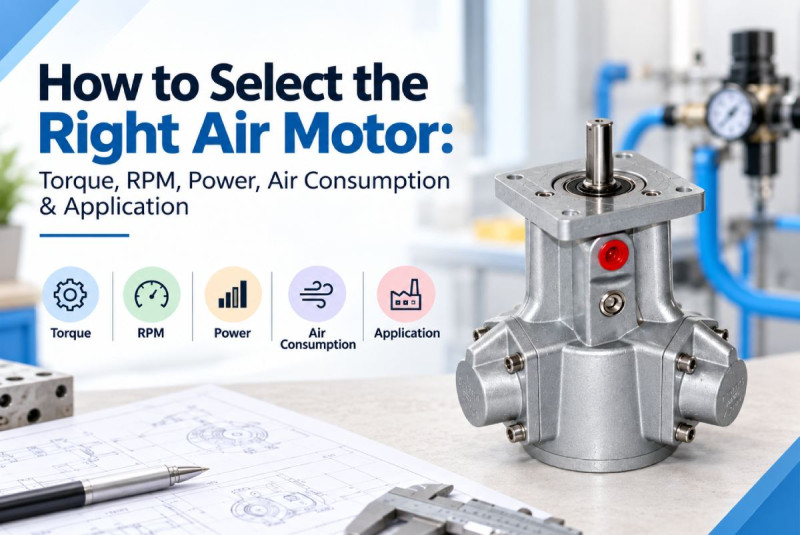
Choosing an air motor should start with the machine it has to drive, not with the motor catalogue. To select an air motor, first determine the required output speed, torque, power, operating pressure, duty cycle, and available compressed-air supply. Once these requirements are known, the correct motor type and size become much easier to identify.
An undersized motor may stall or run continuously at an overloaded operating point. An oversized motor may consume more compressed air than necessary and increase system cost. The right selection is therefore the one that delivers the required torque and speed at the actual operating conditions, with sufficient margin for the application.
This guide explains the practical process for air motor selection, including torque, RPM, power, air consumption, pressure, motor type, and application requirements.
How Do You Select an Air Motor?
For most industrial applications, follow this sequence:
- Determine required RPM
- Determine required torque
- Calculate or confirm power
- Check operating pressure
- Check air consumption
- Choose vane, piston, or geared configuration
- Check environmental and application requirements
Do not select a motor simply because its maximum horsepower or maximum RPM appears suitable. The important question is:Can the motor deliver the required torque at the required operating speed using the compressed air actually available at the machine?
1. Determine the Required Air Motor RPM
The first step in industrial air motor sizing is determining the speed required at the driven equipment.
Ask:
- What RPM does the machine actually need?
- Is the speed fixed or variable?
- Is the motor directly connected to the load?
- Is a gearbox already present?
- Does the load require high speed during part of the cycle and low speed during another?
- Will the motor experience significant load changes?
For a direct-drive application, the motor's operating RPM needs to match the equipment's required shaft speed.
For example, if a stirrer requires approximately 750 RPM, selecting a motor simply because it has a maximum rating of 3,000 or 10,000 RPM does not make it the right motor. You need to consider the loaded operating speed, not just the headline maximum.
Air motor speed is controllable
One of the advantages of pneumatic motors is variable-speed operation. SAN's vane and piston motors, for example, are specified across different RPM ranges rather than around one fixed speed. The published SAN vane range extends from 2,000 to 10,000 RPM, while its polymer piston range covers 360 to 1,200 RPM.
Speed can be controlled through the compressed-air supply, but the effect on torque and power must also be considered.
2. Determine the Required Air Motor Torque
After RPM, determine the air motor torque required by the driven equipment.
Torque is the turning force available at the shaft. It becomes particularly important when the motor must:
- start a loaded machine,
- overcome friction,
- accelerate a rotating assembly,
- drive a pump,
- turn a mixer or stirrer,
- handle changing loads, or
- operate at relatively low speed.
τ=rFsin(θ)\tau = rF\sin(\theta)
τ=(3)(6)sin(90∘)=18 N m\tau=(\text{3})(\text{6})\sin(\text{90}^{\circ})=\text{18}\,\text{N m}τ=(3)(6)sin(90∘)=18N m
Only the perpendicular part of F turns the lever.
FFF
N
FFF
rrr
m
rrr
θ\thetaθ
°
θ\thetaθ
pivotr = 3 mθ = 90°F⊥ = 6 NFτ = 18 N m
Give feedback
A common relationship between power, torque, and speed is:
Power (kW) = Torque (N·m) × RPM / 9550
Therefore:
Torque (N·m) = 9550 × Power (kW) / RPM
This relationship explains an important point in pneumatic motor sizing: power alone does not tell you whether a motor is suitable. Two motors may have similar power ratings but produce that power at very different RPMs. The lower-speed motor will generally need substantially more torque to deliver the same power.
Don't select based only on maximum torque
Industrial air motor specifications often show torque values at particular operating conditions. SAN's published vane motor range, for example, spans 0.31–34 Nm, while its polymer and metal piston ranges both reach 28 Nm.
The correct selection depends on the torque available at your required RPM and pressure, not simply the largest torque number in a catalogue.
3. Calculate or Confirm Air Motor Power
Once the required torque and RPM are known, calculate the required shaft power.
For example, suppose a machine requires:
- 8 Nm torque
- 1,000 RPM
The approximate mechanical power requirement is:
Power = 8 × 1,000 / 9550 ≈ 0.84 kW
That is approximately 1.13 hp.
This gives you a starting point for selecting the motor.
However, do not select a motor with exactly the calculated minimum and assume the job is finished. Actual machinery can experience:
- starting loads
- friction
- process resistance
- acceleration requirements
- pressure fluctuations
- transmission losses
- variations in the driven load
The final motor should therefore be selected using the manufacturer's performance data and an appropriate engineering margin.
4. Check the Operating Air Pressure
Air motor performance depends on the compressed-air conditions available at the installation.
Before finalising an industrial air motor, confirm:
- normal operating pressure,
- minimum available pressure,
- pressure drop through the piping,
- hose and fitting restrictions,
- regulator settings,
- compressor capacity, and
- whether other equipment shares the same air supply.
This is important because the pressure stated on an air motor's specification table is not necessarily the pressure that will actually reach the motor during operation.
SAN's published SAM vane motor specifications, for example, are given at 6 bar, as are the published SPM polymer and metal piston motor specifications.
So if your plant normally operates around 6 bar but the motor sees a significant pressure drop under peak demand, the real operating point needs to be considered.
5. Check Air Motor Air Consumption
This is one of the most commonly overlooked parts of air motor selection. A motor does not consume compressed air according to horsepower alone. Air consumption varies with motor design, speed, load, and operating conditions.
The question is not simply:
"How much air does this motor consume?"
Instead, ask:
"Can my compressed-air system continuously supply the required air at the pressure and operating point where this motor will run?"
SAN's published specifications illustrate the range involved. Its SAM vane motor range is listed at 20.7–275 CFM, while the SPM polymer piston range is listed at 7–35 CFM and the metal piston range at 7.1–34.88 CFM. This makes air motor air consumption an important part of operating cost and compressor-capacity calculations.
Check the complete air circuit
Don't evaluate the motor in isolation. Check:
Compressor → receiver → filter → regulator → piping → hose → valve → motor
A restriction anywhere in this chain can reduce the pressure available at the motor.
6. Choose the Right Air Motor Type
Once the required RPM, torque, power, pressure, and air supply are established, choose the motor configuration.
SAN's air motor power range includes:
- Vane Air Motors
- Geared Compact Pneumatic Motors
- Piston Air Motors with Polymer Pistons
- Piston Air Motors with Metal Pistons
- Geared Compact Pneumatic Motor SAN Series
- Atlas Copco equivalent air motor range
The choice should be driven by the application's operating point rather than by motor type alone.
Vane air motor
A vane air motor is often appropriate where higher rotational speed and variable-speed operation are important. SAN's SAM direct-drive vane range is published from 2,000 to 10,000 RPM, with power from 0.45 to 9.50 hp and torque from 0.31 to 34 Nm at 6 bar.
This makes the range relevant to applications where direct rotary drive and relatively high speed are required.
Piston air motor
A piston air motor can be appropriate where the required operating speed is lower and the application benefits from the characteristics of a piston mechanism. SAN offers both polymer-piston and metal-piston configurations. Its published polymer range covers 360–1,200 RPM, while the metal-piston range covers 360–1,100 RPM. Both ranges extend to 1.5 hp and 28 Nm.
SAN states that the polymer-piston version can operate without lubrication, although lubrication is recommended for better performance and reduced friction.
Geared air motor
If the application requires lower output speed and higher output torque, a geared configuration may be more appropriate than trying to operate a direct-drive motor far below its preferred speed.
SAN's catalogue includes geared compact pneumatic motor torque as well as SAN Series geared motors, with multiple series and configurations listed in the site's air motor structure.
7. Match the Motor to the Application
The final step in pneumatic motor sizing is often the most important: understand what the motor is actually driving. A motor driving a lightly loaded conveyor is very different from one driving a mixer full of high-viscosity material.
Consider:
Starting load
Does the motor have to start with the machine already loaded?
Continuous or intermittent duty
Will it run for seconds at a time, or continuously for several hours?
Variable load
Does the torque requirement change during operation?
Direction
Does the application require reversible rotation?
Space
Is there a strict envelope for motor diameter and length?
Environment
Consider dust, moisture, temperature, washdown requirements, hazardous areas, and other environmental conditions.
Mounting
Check shaft dimensions, mounting arrangement, orientation, and connection requirements before final selection.
These details can eliminate otherwise attractive motors from consideration.
Practical Air Motor Selection Workflow
Here is the complete decision process in a form an engineer can use before requesting a quotation.
|
Selection step |
What to determine |
Why it matters |
|
1. RPM |
Required operating speed |
Determines motor operating point |
|
2. Torque |
Continuous and starting torque |
Prevents stalling and overload |
|
3. Power |
Required shaft power |
Confirms overall motor capacity |
|
4. Pressure |
Available pressure at motor |
Directly affects performance |
|
5. Air consumption |
Available CFM and motor demand |
Confirms compressor/system capacity |
|
6. Motor type |
Vane, piston, or geared |
Matches speed/torque/application characteristics |
|
7. Application |
Duty, environment, mounting, load |
Determines final configuration |
This is a much better approach to air motor sizing than choosing a motor from horsepower alone.
Example: Selecting an Air Motor for a Stirrer
Consider a mixing application requiring approximately:
- 750 RPM
- 7 Nm operating torque
- continuous operation
- 6 bar compressed air
First, calculate power:
Power = 7 × 750 / 9550 ≈ 0.55 kW
or approximately 0.74 hp.
Now the selection moves beyond horsepower.
You would check:
- Which SAN motors can operate around 750 RPM?
- What torque do they provide at that speed?
- What air consumption occurs at the actual operating point?
- Is 6 bar available at the motor under load?
- Is the motor direct-drive or geared?
- What starting torque is required when the vessel is loaded?
- What duty cycle and environmental conditions apply?
A motor with a nominal 0.75 hp rating is not automatically the correct choice. The performance curve or detailed manufacturer's specification at the required RPM and pressure should determine the final selection.
This is where air motor specifications become more useful than a simple horsepower comparison.
SAN Air Motor Range: Matching the Selection to a Product
SAN's current air motor structure provides several paths for different operating requirements. The website lists separate categories for vane, geared compact, polymer-piston, and metal-piston motors, along with a SAN Series geared range.
For example:
For higher-speed direct-drive requirements:
The SAN SAM vane range covers 2,000–10,000 RPM and 0.45–9.50 hp at its published 6-bar conditions.
For lower-speed direct-drive requirements:
SAN's SPM polymer and metal piston ranges cover approximately 360–1,200 RPM and extend to 1.5 hp / 28 Nm.
For applications requiring geared output:
SAN provides geared compact pneumatic motors and a SAN Series geared range, with multiple product families listed in its catalogue.
The correct choice should ultimately be made against the application's required torque, RPM, power, pressure, and air consumption, rather than by motor category alone.
Common Air Motor Selection Mistakes
1. Selecting by horsepower only
Horsepower does not tell you whether the motor will deliver the required torque at your operating RPM.
2. Using maximum RPM as the operating RPM
A motor rated for 10,000 RPM does not mean the application should operate at 10,000 RPM.
3. Ignoring starting torque
A machine may require considerably more torque to start than it needs once it is running.
4. Ignoring compressor capacity
A correctly sized motor is still a poor choice if the plant cannot supply its required air volume.
5. Selecting from catalogue numbers alone
Always compare the motor's performance at the actual pressure, RPM, and load.
6. Forgetting the gearbox
If the application needs low speed and high torque, a geared motor may be more appropriate than a high-speed direct-drive motor.
Frequently Asked Questions
What is the most important factor in air motor selection?
There is no single universal parameter. Start with the required RPM and torque, then confirm power, pressure, air consumption, and duty cycle. The motor should be evaluated at the actual operating point.
How do I calculate air motor torque?
If power and speed are known:
Torque (N·m) = 9550 × Power (kW) / RPM
For final selection, use the manufacturer's torque data at the required operating pressure and speed.
How does air motor RPM affect torque?
For a given power level, lower RPM requires higher torque. However, the actual torque-speed relationship depends on the motor design and operating conditions.
How much air does an air motor consume?
It depends on motor type, size, pressure, speed, and load. For example, SAN publishes 20.7–275 CFM for its SAM vane range and 7–35 CFM for its SPM polymer piston range.
Should I choose a vane or piston air motor?
Choose based on the required operating point and application. SAN's vane range covers substantially higher speeds, while its piston ranges are positioned at lower operating speeds.
When should I consider a geared air motor?
Consider a geared configuration when the application requires a lower output speed, increased output torque, or a compact geared drive arrangement. SAN offers both geared compact pneumatic motors and a SAN Series geared range.
Final Selection Checklist
Before ordering an air motor, have these numbers ready:
Required output RPM: ______
Continuous torque: ______ Nm
Starting torque: ______ Nm
Required power: ______ kW / hp
Available air pressure: ______ bar
Available air capacity: ______ CFM
Duty cycle: ______
Rotation: ______
Motor type: Vane / Piston / Geared
Environment: ______
Mounting/shaft requirements: ______
If these parameters are clearly defined, air motor power selection becomes an engineering matching exercise rather than guesswork.
For a manufacturer such as SAN, the next step should be to compare the application's operating point against the detailed specifications of the appropriate industrial air motor series and then confirm the final model with the manufacturer.
Need help selecting an air motor? Share your required RPM, torque, operating pressure, duty cycle, and available compressed-air supply with SAN Industrial. Our team can help match the application to the appropriate air motor power configuration and model.