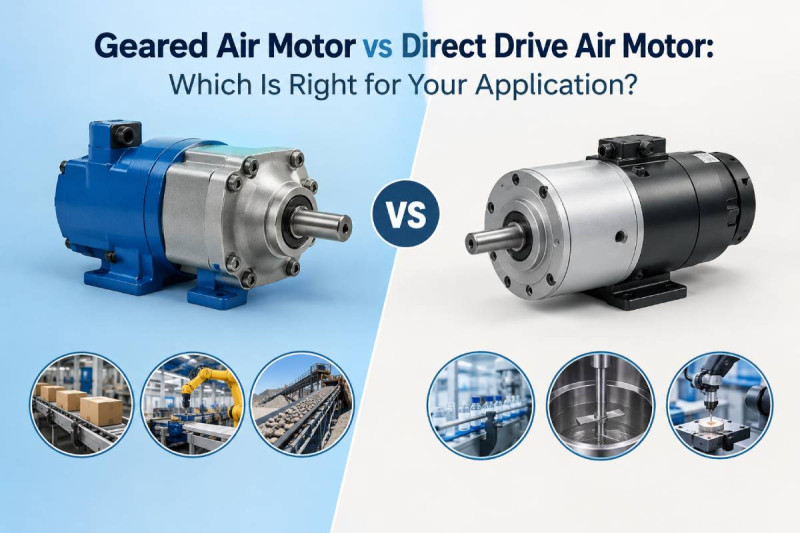
Choosing between a geared air motor and a direct-drive air motor is primarily a question of output speed, torque, power transmission, and application requirements. A direct-drive air motor transfers the motor's rotary output directly to the driven equipment, without an integrated gearbox. This can provide a relatively simple transmission arrangement and is often suitable when the motor's available speed closely matches the machine's required shaft speed.
A geared air motor, on the other hand, combines an air motor with a gearbox. The gearbox changes the relationship between motor speed and output speed, allowing the machine to operate at a lower output RPM while providing higher output torque than the motor shaft would provide at the same power level without reduction.
The important point is that gearing does not create additional power. It changes speed and torque at the output, while some power is lost through gearbox efficiency. So, should you choose a geared pneumatic motor or direct drive? The answer depends on the actual operating point of the machine.
Geared Air Motor vs Direct Drive: Quick Answer
Use a direct-drive air motor when the required machine speed is reasonably close to the motor's practical operating speed and a simple transmission arrangement is desirable.
Consider a geared air motor when the application needs a substantially lower output speed, higher output torque at that lower speed, or a specific controlled output speed that does not match the air motor's direct shaft speed.
|
Factor |
Geared Air Motor |
Direct-Drive Air Motor |
|
Output speed |
Lower than motor speed |
Motor speed |
|
Output torque |
Higher at reduced output speed |
Motor's direct shaft torque |
|
Gearbox |
Integrated |
Not required |
|
Speed reduction |
Built in |
Requires external arrangement if needed |
|
Power |
Reduced slightly by gearbox losses |
No gearbox transmission loss |
|
Transmission |
More components |
Simpler |
|
Best suited for |
Lower-speed, higher-torque drives |
Higher-speed rotary drives |
|
Installation |
Application dependent |
Often simpler |
|
Maintenance |
Motor + gearbox considerations |
Motor-focused maintenance |
This is a starting comparison rather than a universal rule. The correct configuration depends on the required RPM, torque, pressure, air consumption, duty cycle and load.
What Is a Geared Air Motor?
A pneumatic geared motor combines a pneumatic motor with a mechanical gearbox. An air motor with a gearbox converts compressed-air energy into rotary motion and modifies the output before it reaches the driven machine.
The basic arrangement is:
Compressed air → Air motor → Gearbox → Output shaft → Machine
The gearbox can reduce the output speed and increase the available output torque, subject to transmission efficiency.
For example, suppose an air motor rotates at 3,000 RPM, but the driven machine requires approximately 750 RPM. A suitable reduction gearbox can provide an output speed close to the required range.
The reduction ratio is approximately:
Gear ratio = Motor speed ÷ Required output speed
So: 3,000 ÷ 750 = 4:1
A 4:1 reduction means the gearbox reduces the motor speed by approximately four times. The output torque increases correspondingly in an ideal mechanical calculation, but the actual output torque will be lower than the ideal value because of gearbox losses. That distinction is important when performing real-world pneumatic motor sizing.
How Does a Gearbox Change Air Motor Output?
The fundamental trade-off is: Higher speed → lower torque and, through reduction gearing: Lower output speed → higher output torque
Consider a simplified example.
Suppose the air motor produces:
- 3,000 RPM
- 2 Nm torque
Ignoring losses for the moment,
its mechanical power is approximately:
- Power = Torque × RPM ÷ 9550
- Power = 2 × 3,000 ÷ 9550
- Power ≈ 0.63 kW
Now introduce a 4:1 reduction. The approximate output speed becomes: 3,000 ÷ 4 = 750 RPM In an ideal gearbox, the output torque would be approximately: 2 × 4 = 8 Nm
In a real pneumatic motor gearbox arrangement, output torque will be lower than 8 Nm because of transmission losses. This is why it is more accurate to think of gearing as trading speed for torque, rather than multiplying the motor's power.
Why Would You Use a Geared Air Motor?
A direct-drive air motor can become inefficient from an application standpoint when its natural operating speed does not match the machine.
For example, imagine a mixing application that needs: 600-800 RPM, but the available direct-drive motor operates most effectively at a considerably higher speed.
You have several choices:
- Use an external gearbox
- Use belts or pulleys
- Use another transmission arrangement
- Select a lower-speed motor
- Use a geared air motor
A pneumatic geared motor integrates the speed-reduction function into the motor assembly. This can simplify the drive arrangement and make it easier to obtain the required output speed and torque.
SAN's current Air Motor category includes a dedicated Geared Compact Pneumatic Motor family and a separate SAN Series geared range. SAN describes geared air motors as suitable for applications requiring higher torque and controlled output speed.
Geared Air Motor vs Direct-Drive Air Motor
The geared air motor vs direct drive comparison becomes clearer when the two configurations are considered from the machine's perspective.
Direct-Drive Air Motor
A direct-drive arrangement looks like:
Compressed air → Air motor → Machine
The motor shaft directly drives the load, usually through an appropriate coupling or mounting arrangement. The main advantage of a direct drive air motor is its simple transmission arrangement. There is no integrated gearbox between the motor and machine.
This can be useful when:
- The required machine RPM matches the motor's operating range
- High rotational speed is required
- Additional torque multiplication is unnecessary
- A simple transmission is preferred
- Space or mechanical complexity needs to be minimised
SAN's SAM vane air motor range, for example, is published from approximately 2,000 to 10,000 RPM, depending on model. For applications operating within that speed range, direct drive may be worth evaluating before introducing a gearbox.
Geared Air Motor
A geared arrangement looks like:
Compressed air → Air motor → Gearbox → Machine
The gearbox changes the motor's output characteristics.
This can be useful when:
- Machine RPM is lower than the motor's practical operating speed
- Higher output torque is required at reduced speed
- A controlled reduction ratio is needed
- The machine has a high starting or process load
- An integrated geared drive is more practical than an external gearbox
SAN's Geared Compact Pneumatic Motor is specifically positioned as a separate product family within its Air Motor range.
Torque, RPM and Power: The Most Important Difference
The decision between geared and direct drive should ultimately come down to the machine's required torque and speed.
For mechanical power: Power (kW) = Torque (N·m) × RPM ÷ 9550
This relationship explains why a lower-speed shaft can produce more torque for the same power. For example, assume a drive has approximately 1 kW available.
At 3,000 RPM:
- Torque ≈ 9550 × 1 ÷ 3000
- Torque ≈ 3.18 Nm
At 750 RPM:
- Torque ≈ 9550 × 1 ÷ 750
- Torque ≈ 12.73 Nm
The power has not magically increased. The lower speed allows the same mechanical power to be associated with a higher torque value. In a real geared air motor, the gearbox introduces efficiency losses, so actual output torque must be calculated using the manufacturer's gearbox and motor specifications.
When Should You Use a Geared Air Motor?
A geared air motor is particularly worth investigating when a pneumatic motor for high torque applications must deliver the required output at a speed significantly lower than the available air motor speed.
Low-speed, high-torque applications
If the machine needs relatively low RPM but substantial shaft torque, gearing can be useful.
Typical examples include:
- Mixers
- Agitators
- Drum stirrers
- Material-handling equipment
- Certain pumps
- Rotary equipment with high starting resistance
SAN's pneumatic drum-plate-mounted stirrer product information specifically offers a geared air motor option for medium- to high-viscosity solutions, illustrating a real application where the drive arrangement is matched to the mixing load.
Mixing and agitation
Mixing is a good example of why speed alone is not enough. A small, low-viscosity liquid may require relatively high impeller speed. A high-viscosity material can require substantially more torque to maintain rotation.
In such applications, the question is not: “How fast can the air motor rotate?” It is: “What torque and speed does the impeller require under the actual process load?” A geared pneumatic motor can be useful when the required impeller speed is significantly lower than the motor's direct output speed.
Applications with high starting resistance
Some machines require considerably more torque during startup than during steady-state operation.
Examples may include:
- Loaded mixers
- Agitators
- Certain conveyors
- Rotating equipment with high static friction
- Machines handling viscous materials
A pneumatic motor for high torque applications must be evaluated using the actual starting torque requirement. Do not assume that a gearbox automatically solves every starting problem. The motor still needs enough pneumatic power, and the gearbox must be rated for the application's load and starting conditions.
When Is Direct Drive Better?
A direct drive air motor can make more sense when the required machine speed is already compatible with the motor's operating range. For example, consider a machine requiring: 3,000 RPM If an appropriate air motor can deliver the required torque at approximately 3,000 RPM, adding a gearbox simply to reduce and then somehow restore speed would introduce unnecessary mechanical complexity.
Direct drive may therefore be preferable when:
- Required RPM is relatively high
- Motor speed closely matches machine speed
- Required torque is within the direct motor output
- No speed reduction is required
- A simpler transmission is preferred
- Gearbox maintenance is undesirable
SAN's SAM vane air motor range extends to approximately 10,000 RPM, depending on model, making the direct-drive configuration relevant to higher-speed rotary requirements.
Geared Air Motor Applications
The appropriate application depends on the actual torque-speed requirement, and a high torque air motor may be suitable for the following applications:
Mixing and agitation
Especially where the impeller requires lower RPM and higher torque.
Material handling
Where the driven mechanism requires controlled shaft speed and sufficient torque to move the load.
Pumps
Where the required pump speed and torque do not directly match the air motor's natural operating range.
Drum and container mixing
Where speed reduction can help match the motor to the impeller and process load.
Industrial automation
Where the pneumatic drive needs a specific output speed.
Rotary equipment
Where a direct-drive motor would operate too quickly for the machine.
How Do You Select the Right Gear Ratio?
Gear ratio should be calculated from the required output speed, not selected arbitrarily.
The basic relationship is:
Gear ratio = Motor RPM ÷ Required output RPM
For example:
- Motor speed = 3,000 RPM
- Required output = 600 RPM
Then: 3,000 ÷ 600 = 5:1
So a reduction ratio of approximately 5:1 would be the starting point. But this does not mean any 5:1 pneumatic motor gearbox will work for the application.
When evaluating a pneumatic motor for high torque applications, you also need to verify:
- Required output torque
- Starting torque
- Continuous load
- Peak load
- Gearbox efficiency
- Motor operating point
- Available air pressure
- Air consumption
- Duty cycle
- Service conditions
Gear Ratio and Torque: A Practical Example
Suppose an air motor produces:
- 3 Nm torque
- 3,000 RPM
You need approximately:
- 750 RPM output
The approximate reduction ratio is:
3,000 ÷ 750 = 4:1
Ignoring losses:
Output torque = 3 × 4 = 12 Nm
If the gearbox efficiency were, for illustration, 90%, the practical output torque would be approximately: 12 × 0.90 = 10.8 Nm
This is an illustrative calculation. The actual value should come from the selected motor and gearbox performance data. The key engineering principle is: The gearbox changes the torque-speed relationship; it does not create additional input power.
Do You Always Need a High-Torque Air Motor?
Not necessarily; choosing a high torque air motor depends on the required RPM, machine load, starting conditions, duty cycle, available pressure, and required power.
“High torque” should always be considered relative to:
- Required RPM
- Machine load
- Starting conditions
- Duty cycle
- Available pressure
- Required power
For example, a machine requiring 10 Nm at 500 RPM is a very different application from one requiring 10 Nm at 5,000 RPM.
- Using: Power = Torque × RPM ÷ 9550
- 10 Nm at 500 RPM requires approximately: 0.52 kW
- while 10 Nm at 5,000 RPM requires approximately: 5.24 kW
The torque number is identical, but the power requirement is approximately ten times higher. This is why selecting a pneumatic motor for high torque without specifying the required RPM can lead to the wrong motor.
Air Supply and Operating Considerations
For an industrial air motor, gearing changes the mechanical output, but the pneumatic system must still provide sufficient power.
Before selecting a geared air motor, check:
Operating pressure
Confirm the actual pressure available at the motor inlet. SAN's published air motor examples commonly specify performance at 6 bar, but the final selection should be based on the pressure actually available at the installation.
Air consumption
A geared motor still depends on the underlying pneumatic motor's air consumption.
Check:
- Compressor capacity
- Existing plant demand
- Piping size
- Hose size
- Filter capacity
- Regulator capacity
- Valve restrictions
- Pressure drop
Air quality
Follow the manufacturer's requirements for filtration, lubrication, and compressed-air quality.
Speed control
A geared motor may reduce output speed mechanically, but the pneumatic supply can still be used to control motor operating conditions where the motor design permits it.
Always evaluate the resulting torque and power when changing operating pressure or speed.
Maintenance: Geared vs Direct Drive
For an air motor with gearbox, the maintenance requirements of the complete drive should be considered, not just the air motor.
Direct-drive arrangement
The main maintenance considerations may include:
- Air filtration
- Lubrication where required
- Seals
- Bearings
- Shaft
- Coupling
- Air-line leaks
- Mounting
The absence of a gearbox means there is one less mechanical transmission component to maintain.
Geared arrangement
A geared air motor with a pneumatic motor gearbox requires the same basic pneumatic motor checks plus gearbox-related maintenance.
Depending on the gearbox design, maintenance may include:
- Gear inspection
- Lubrication
- Bearing inspection
- Seal inspection
- Checking for abnormal noise
- Monitoring backlash
- Checking output shaft alignment
- Monitoring temperature
The manufacturer's maintenance instructions should determine the actual service interval and lubrication requirements.
Geared Air Motor vs Direct Drive: Decision Guide
Use this as an initial selection framework:
|
Application requirement |
Configuration to investigate |
|
High output RPM |
Direct drive |
|
Motor RPM closely matches machine RPM |
Direct drive |
|
Low machine RPM |
Geared |
|
Higher output torque at reduced RPM |
Geared |
|
Simple transmission |
Direct drive |
|
Integrated speed reduction |
Geared |
|
Medium/high-viscosity mixing |
Geared configuration worth evaluating |
|
High-speed rotary equipment |
Direct-drive vane motor worth evaluating |
|
Need for specific output RPM |
Geared |
|
Existing external gearbox |
Compare direct motor + existing gearbox against integrated geared motor |
|
Frequent high starting load |
Evaluate torque-speed curve and starting torque; gearing may be appropriate |
|
Lowest mechanical complexity |
Direct drive |
This table is a starting point. The actual motor should be selected from its performance data at the required operating point.
Geared Air Motor Selection Checklist
Before ordering an industrial air motor, define the following operating and application requirements.
Machine output
- Required output RPM
- Normal operating RPM
- Minimum/maximum RPM
- Required running torque
- Starting torque
- Peak torque
- Required power
Gearbox
- Required reduction ratio
- Continuous torque rating
- Peak torque rating
- Gearbox efficiency
- Output shaft configuration
- Mounting arrangement
Pneumatic system
- Operating pressure
- Minimum pressure
- Available airflow
- Compressor capacity
- Pressure drop
- Hose/piping size
- Air preparation
Application
- Continuous/intermittent duty
- Starting load
- Ambient temperature
- Dust/moisture exposure
- Required direction of rotation
- Available installation space
- Maintenance access
Once these values are known, air motor selection becomes a comparison of actual operating requirements rather than a simple horsepower choice.
SAN Geared Compact Pneumatic Motor
SAN Industries has a dedicated Geared Compact Pneumatic Motor - AM product family within its industrial air motor range. The current product page lists multiple AM configurations, including variants identified by different nominal RPM/power combinations and reversible versions.
The broader SAN Air Motor category also separates:
- Vane Air Motors
- Geared Compact Pneumatic Motors
- Polymer Piston Air Motors
- Metal Piston Air Motors
- SAN Series Geared Compact Pneumatic Motors
- Atlas Copco Equivalent Air Motor ranges
This gives engineers several motor configurations to compare rather than treating every pneumatic drive application in the same way.
For an application requiring lower output speed or a different torque-speed relationship, the Geared Compact Pneumatic Motor range is a logical product family to investigate. The final model should be selected against the application's actual RPM, torque, pressure, air consumption, duty cycle, and mounting requirements.
Geared Air Motor vs Direct Drive: A Simple Selection Workflow
For effective air motor selection, work through these questions in order if you are unsure which configuration to choose.
What RPM does the machine require?
If the required RPM is already close to the air motor's practical operating range, investigate direct drive. If the required RPM is substantially lower, evaluate whether a pneumatic geared motor can provide the necessary output speed and torque.
What torque does the machine require?
Calculate normal and starting torque. If the direct-drive motor cannot provide the required torque at the required speed, evaluate a geared configuration.
What power is required?
Use: Power = Torque × RPM ÷ 9550
Then account for transmission losses.
What gear ratio is required?
Calculate: Gear ratio = Motor RPM ÷ Required output RPM
Then verify the available gearbox ratio and output torque.
Can the pneumatic system supply the motor?
Check:
- Pressure
- Air consumption
- Compressor capacity
- Pressure losses
Does the application justify gearing?
If the gearbox provides a useful speed/torque match and simplifies the overall machine design, a geared air motor may be appropriate. If the motor already matches the required machine speed and torque, direct drive may be simpler.
Frequently Asked Questions
What is a geared air motor?
A geared air motor combines a pneumatic air motor with a gearbox. The gearbox reduces the output speed and increases output torque relative to the motor shaft, subject to gearbox efficiency.
What is the difference between a geared air motor and a direct-drive air motor?
A direct-drive air motor sends its shaft output directly to the driven equipment. A geared air motor passes that output through a gearbox first, allowing the output speed and torque to be changed.
Does a geared air motor produce more power?
No. A gearbox does not create additional power. It trades speed for torque, and some power is lost through transmission efficiency.
When should I use a geared pneumatic motor?
Consider a geared pneumatic motor when the machine requires a lower output speed, higher torque at reduced speed, or a specific output speed that does not match the air motor's direct output.
When is direct drive better?
Direct drive is worth considering when the required machine speed closely matches the motor's practical operating range and no additional speed reduction is required.
Is a geared air motor better for high-torque applications?
It can be appropriate when high torque is required at a lower output speed. However, the motor, gearbox, and pneumatic supply must all be sized for the actual continuous and starting loads.
How do I calculate the gear ratio for an air motor?
Divide motor speed by required output speed: Gear ratio = Motor RPM ÷ Output RPM
For example, a 3,000 RPM motor driving a 750 RPM machine requires approximately a 4:1 reduction before accounting for the exact gearbox configuration.
Does gearing reduce air motor speed?
The gearbox reduces the mechanical output speed. The air motor itself may still operate at its own higher rotational speed.
Can a geared air motor be used for mixing?
Yes. Geared pneumatic drives can be considered for mixing and agitation applications where the impeller requires lower speed and higher torque. SAN, for example, offers geared-drive pneumatic stirrer configurations and identifies geared air motors as an option for medium- to high-viscosity solutions.
How do I select between a geared and direct-drive air motor?
Start with the machine's required RPM, torque, and power. If the motor can directly provide the required output, direct drive may be appropriate. If the required output speed is significantly lower or the machine needs a different torque-speed relationship, investigate a geared configuration.
Final Takeaway
Air motor selection should begin with the driven machine's requirements-not the motor catalogue. If the machine requires relatively high speed and the air motor can deliver the required torque directly, direct drive can provide a straightforward transmission arrangement.
If the machine requires lower output speed and higher usable torque at that reduced speed, a geared pneumatic motor can provide a more suitable torque-speed relationship.
The basic decision is:
- Direct drive → motor speed is suitable for the machine
- Geared drive → reduce speed to match the machine and increase output torque accordingly
But the final selection still requires checking:
RPM + torque + power + gear ratio + air pressure + air consumption + duty cycle + application load
For SAN Industries, the dedicated Geared Compact Pneumatic Motor range provides a commercial product destination for applications where the required output characteristics call for a geared pneumatic drive.