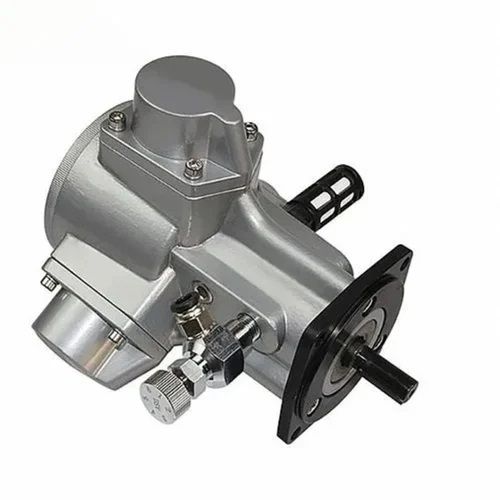
Piston Air Motor - SPM Polymer Piston Series
₹ 12500 INR + GST
Piston Air Motors
What Is a Piston Air Motor?
A piston air motor is a pneumatic drive that converts energy from compressed air into mechanical rotary motion through a reciprocating piston mechanism. Unlike electric drives, it uses an available compressed-air supply to produce controlled movement for industrial machinery. Piston air motors are suitable for applications where variable speed, dependable operation, and compact power transmission are required. A piston type air motor can be selected according to power, speed, torque, air consumption, and operating conditions. San Industrial offers SPM piston motor configurations designed for applications including automation, material handling, mixing, and pneumatic equipment.
How Does a Piston Pneumatic Motor Work?
A piston pneumatic motor converts compressed-air energy into mechanical rotation through a controlled reciprocating movement. The operating process involves several coordinated stages that allow the motor to deliver rotary output for industrial equipment.
- Compressed Air Supply: Compressed air enters the motor through the designated inlet at the required operating pressure. The available air supply influences the motor's operating performance and air consumption.
- Piston Movement: The incoming air acts on the internal pistons, causing them to move in a reciprocating pattern. This repeated movement forms the primary mechanical action inside the motor.
- Conversion of Motion: The reciprocating piston movement is transferred through the motor's internal mechanism to produce rotary movement at the output shaft. This allows the motor to drive connected machinery.
- Speed and Torque Control: Operating speed can be adjusted by regulating the compressed-air supply. The required torque and speed should be considered together with the application's load.
- Continuous Operation: As the air supply continues, the pistons repeat their operating cycle and maintain rotary output. This makes the pneumatic piston motor suitable for machinery requiring controlled mechanical power.
A pneumatic piston motor can therefore provide a practical compressed-air drive for equipment where controlled rotary movement is required.
Key Features of the Piston Air Motor
The SPM motor combines a reciprocating piston mechanism with durable construction for industrial operation. Its piston air motor design supports variable speed control through compressed-air regulation, while the polymer piston option can operate without lubrication when required. The pneumatic motor is also designed for straightforward inspection and maintenance.
- High-Performance Piston Design: Our pneumatic motor boasts a high-performance piston mechanism crafted for smooth and powerful operation. The reciprocating motion of the piston ensures precision in every cycle, making it ideal for applications requiring accuracy and control.
- Versatility in Action: From conveyor systems to material handling and beyond, the San Industrial Goods pneumatic piston motor is versatile enough to handle a wide range of industrial tasks. Its adaptability makes it a valuable asset in various settings, enhancing the efficiency of your operations. SAN INDUSTRIAL has 2 variations in Piston Design. Polymer Piston Air Motors and Metal Piston Air Motors. While both are robust, Polymer pistons are economical and can work without the need for lubrication (though it is recommended for better performance and less friction)
- Durable Construction: Crafted from high-quality materials, our pneumatic piston motor is built to withstand the rigors of industrial environments. The durable construction ensures longevity and reliability, reducing downtime and maintenance costs.
- Variable Speed Control: Tailor the motor's performance to your specific needs with ease. The variable speed control feature allows you to adjust the rotational speed by modulating the compressed air supply, providing flexibility in different applications.
- Easy Maintenance: Simplify your maintenance routine with our user-friendly design. Regular maintenance tasks, such as lubrication and inspection, can be performed quickly and efficiently, ensuring prolonged motor life and consistent performance.
Polymer Piston vs. Metal Piston Air Motors
San Industrial offers separate polymer-piston and metal-piston SPM product series. The polymer version is positioned as an economical option and can operate without lubrication, although lubrication is recommended for improved performance and reduced friction. The metal piston air motor version is a separate direct-drive range with its own specifications.
|
Feature |
Polymer Piston Air Motor |
Metal Piston Air Motor |
|
Piston construction |
Polymer piston design |
Metal piston design |
|
Product positioning |
Economical piston option |
Metal piston configuration |
|
Lubrication |
Can work without lubrication; lubrication is recommended for better performance and less friction |
Maintenance and lubrication according to product requirements |
|
Operating pressure |
6 bar |
6 bar |
|
Power range |
0.11–1.5 HP |
0.12–1.5 HP |
|
Speed range |
360–1200 RPM |
360–1100 RPM |
|
Air consumption |
7–35 CFM |
7.1–34.88 CFM |
|
Torque range |
0.64–28 Nm |
0.64–28 Nm |
|
Product series |
SPM 1 to SPM 7 (SAN-C) |
SPM 1 to SPM 7 |
|
Suitable selection basis |
Cost, lubrication preference, load and application |
Construction preference, load and application |
The two designs should be evaluated according to the equipment requirements rather than assuming that one piston material is suitable for every application. The appropriate piston air motor depends on factors such as operating conditions, required output, maintenance preferences, and application requirements.
Benefits of Using Piston Type Air Motors
A piston type air motor can provide controlled rotary power for machinery that operates from a compressed-air system. Its piston-based mechanism and adjustable operation make it useful across different industrial applications.
- Controlled Operation: A piston pneumatic motor manufacturer can provide regulated rotary output, with operating speed adjusted through the compressed-air supply according to application requirements.
- Compact Power Transmission: The piston motor design provides a practical way to transmit mechanical power where a pneumatic drive is preferred for equipment integration.
- Variable Speed: A compressed air motor can be operated at different speeds by regulating the air supply, giving users greater control over connected machinery.
- Maintenance Flexibility: Depending on the piston design, maintenance requirements can be managed according to the product configuration, operating conditions, and manufacturer's recommendations.
- Industrial Versatility: A pneumatic motor can support applications such as automation, material handling, mixing, conveyors, and pneumatic tools where controlled rotary motion is required.
Applications of Piston Air Motors
Piston air motors can be integrated into industrial equipment where compressed-air-powered rotary motion is required. Their controlled operation makes them suitable for material handling, conveyor systems, mixing and agitation, industrial automation, and selected pneumatic power-tool applications. The appropriate configuration depends on the equipment load and operating requirements.
- Industrial Automation: Integrate San Industrial Goods' pneumatic piston motor into your automated systems for seamless and efficient production processes.
- Material Handling: Enhance your material handling equipment with the power and precision of our pneumatic motor, improving overall productivity.
- Mixing and Agitation: Achieve optimal mixing results in tanks and drums with the controlled reciprocating motion of the San Industrial Goods pneumatic piston motor.
- Power Tools: Power your pneumatic tools, such as drills and grinders, with the reliability of our piston motor for consistent and powerful performance.
Industries Using Piston Air Motors
Piston air motors can support machinery across industries where compressed-air-powered rotary movement is required. A pneumatic motor can be selected according to the equipment, load, operating speed, and available air supply.
- Manufacturing: A piston air motor can support automated production equipment, assembly systems, and machinery requiring controlled rotary movement.
- Automotive: Pneumatic drives can be integrated into selected material-handling, assembly, and production equipment.
- Chemical Processing: A pneumatic motor supplier can provide suitable configurations for machinery where compressed-air operation is part of the process.
- Packaging: The motors can support selected conveyors, handling systems, and automated packaging machinery.
- Material Handling: A compressed air motor can provide rotary power for conveyors and equipment used to move or process materials.
- Mixing and Agitation: Piston-based drives can be integrated with mixers and agitators where controlled mechanical movement is required.
How to Choose the Right Piston Motor
Choosing the right piston motor requires matching the motor's technical characteristics with the equipment and working conditions. Consider the following factors before selecting a suitable configuration:
- Required Power: Determine the mechanical power needed by the connected equipment. San Industrial's polymer SPM series ranges from 0.11 to 1.5 HP, providing several model options for different requirements.
- Operating Speed: Identify the required running speed and whether the application needs variable speed control. The motor should be selected according to the actual working speed rather than only its maximum RPM.
- Torque Requirement: Consider starting and running torque in relation to the connected load. A piston type air motor should provide suitable torque for the machinery throughout its operating cycle.
- Air Pressure and Consumption: Check the available compressed-air pressure and ensure the system can supply the required volume. The SPM polymer series is specified for 6 bar operation with air consumption from 7 to 35 CFM.
- Piston Design: Consider whether a polymer or metal piston configuration better suits the application. San Industrial offers both designs as separate product series.
- Application Conditions: Review the equipment layout, duty cycle, installation space, and operating environment before selecting the model.
- Manufacturer Support: Working with a piston air motor manufacturer can help users identify a suitable model based on the application's technical requirements and product specifications.
Frequently Asked Questions About Piston Air Motors
What is a piston air motor?
A piston air motor converts compressed-air energy into mechanical rotary motion using a reciprocating piston mechanism. It can be used to drive industrial machinery and pneumatic equipment.
How does a piston pneumatic motor work?
A piston pneumatic motor uses compressed air to move internal pistons in a reciprocating cycle. The internal mechanism converts this movement into rotary output for connected equipment.
What is the difference between a piston type air motor and other air motors?
A piston type air motor uses reciprocating pistons to generate mechanical movement, while other designs, such as vane motors, use different internal mechanisms to convert compressed air into rotary motion.
What is the power range of the San Industrial polymer piston series?
The polymer series has a power range of 0.11 to 1.5 HP, with models operating at 6 bar and offering different RPM, torque, and air-consumption values.
What factors should be considered when selecting a piston motor?
Users should consider power, speed, torque, air pressure, air consumption, load, operating conditions, installation requirements, and piston construction before selecting a model.
Where are pneumatic motors commonly used?
A pneumatic motor can be used in applications such as industrial automation, material handling, conveyors, mixing and agitation, packaging, and selected pneumatic equipment.
How should a piston air motor be maintained?
Maintenance should follow the specific product requirements. Regular inspection, appropriate compressed-air conditions, lubrication where recommended, and checking connections and moving components can support reliable operation.
How can I choose a suitable piston air motor manufacturer?
Look for a piston air motor manufacturer that provides clear technical specifications, relevant product configurations, application guidance, manufacturing experience, and after-sales support. A reliable pneumatic motor manufacturer should be able to explain the product's operating requirements and limitations.
What is the difference between polymer and metal piston air motors?
San Industrial offers separate polymer and metal piston series. The polymer series is positioned as an economical option and can operate without lubrication, although lubrication is recommended for better performance and reduced friction. The metal series has its own direct-drive configuration and specifications.
Product Variation
| Image | SKU | air pressure | air consumption | power | rpm | torque | Action |
|---|---|---|---|---|---|---|---|
| 6 bar | 7 cfm | 0.11 hp | 1200 | 0.64 nm | |||
| 6 bar | 7.4 cfm | 0.16 hp | 1200 | 0.95 nm | |||
| 6 bar | 9.2 cfm | 0.25 hp | 1000 | 1.7 nm | |||
| 6 bar | 10.9 cfm | 0.33 hp | 900 | 3.5 nm | |||
| 6 bar | 13.9 cfm | 0.5 hp | 750 | 4.7 nm | |||
| 6 bar | 17.8 cfm | 0.75 hp | 650 | 7.6 nm | |||
| 6 bar | 35 cfm | 1.5 hp | 360 | 28 nm |