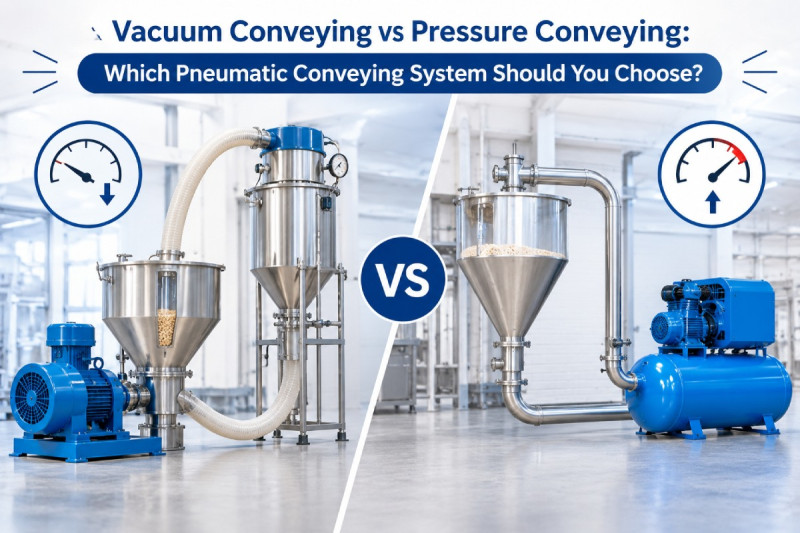
The two options suit different jobs:
- Vacuum conveying usually fits shorter transfers from one or several pickup points into one destination, especially where dust containment and hygiene matter.
- Pressure conveying usually fits longer distances, higher throughputs, and delivery from one source to several destinations.
Both are pneumatic conveying systems: they move bulk material through a pipeline with air. The difference is which side of the line the air mover sits on. A vacuum system pulls material towards the air mover, so the line runs below atmospheric pressure.
A pressure system pushes material away from the air mover, so the line runs above atmospheric pressure. That one difference drives most of the trade-offs in pickup, containment, distance, and cost. The right choice between vacuum conveying vs pressure conveying depends on material characteristics, required transfer distance, throughput, and the level of dust containment needed.
This guide covers:
- How each pneumatic conveying system works
- Where dilute phase and dense phase conveying fit
- A side-by-side comparison
- When each one is the better choice
For the basics of vacuum systems, see what a vacuum conveying system is.
How vacuum and pressure conveying work
The position of the air mover defines the system: at the end of the vacuum line, at the start of the pressure line.
How a vacuum conveying system works
In a vacuum conveying system, the vacuum source draws air through the whole line.
A vacuum source can be:
- A compressed-air ejector
- An electric vacuum pump
- A blower
Material is drawn in at the pickup point, which is open to atmosphere, and carried to a receiver. There, a filter separates it from the air, and it then discharges into the next process step. Because the pickup is at atmospheric pressure, material can be taken from bags, drums, or hoppers without a pressure-tight feeder.
The main limit is physics. A vacuum can never exceed one atmosphere of pressure difference, and practical systems run below that. This caps the conveying distance and throughput a vacuum system can reach.
How a pressure conveying system works
In a pressure conveying system, a blower or compressor pushes air into the line. Material has to be introduced into that pressurised line through a feeder that seals against the pressure, such as a rotary valve or a blow tank. It is then pushed to the destination, where it is separated from the air at a silo, hopper, or filter receiver.
With a pressure conveyor, the available pressure difference is not limited to one atmosphere, particularly with blow-tank systems. A properly designed pressure conveying system can support longer-distance material movement and higher-capacity industrial operations. This allows longer distances and higher throughputs. The trade-off is that any leak pushes air and dust out of the system.
Dilute phase vs dense phase conveying
Vacuum vs pressure describes where the air mover sits. Dilute vs dense phase describes how the material travels through the line. The two choices are separate, although some combinations are far more common than others.
When selecting vacuum conveying vs pressure conveying, understanding dilute phase conveying is equally important because conveying velocity directly affects product handling and system performance.
- Dilute phase conveying carries material suspended in a high-velocity air stream. It is the most common mode, mechanically simple, and used in both vacuum and pressure systems.
- Dense phase conveying moves material at much lower velocity as slugs or a moving bed, with less air and higher pressure. Because it needs a larger pressure difference, it is most often done with pressure, typically using blow tanks. Vacuum dense phase is used for some shorter transfers.
|
Factor |
Dilute phase |
Dense phase |
|
How material moves |
Suspended in the air stream |
Slugs or a slow-moving bed |
|
Conveying velocity |
High |
Low |
|
Air volume |
Higher |
Lower |
|
Line pressure difference |
Lower |
Higher |
|
Attrition and line wear |
Higher; a concern for friable or abrasive materials |
Lower; gentler on product and pipe |
|
Segregation of blends |
More likely |
Less likely |
|
Typical system |
Vacuum or pressure |
Mostly pressure; some short vacuum transfers |
|
Typical materials |
Free-flowing, non-abrasive powders and granules |
Friable, abrasive or blended materials, and longer distances |
Many powder transfer system applications in pharma and food run in dilute or semi-dense phase under vacuum over short distances. Dilute phase conveying is also widely used for pneumatic powder transfer when handling free-flowing powders and granules. The choice of phase has to be confirmed against the material's behaviour, usually through a conveying trial.
Vacuum conveying vs pressure conveying: side-by-side comparison
The two pneumatic conveying systems differ mainly in pickup, containment and reach. Understanding vacuum conveying vs pressure conveying helps manufacturers select the right pressure conveyor or vacuum system based on their material handling requirements.
|
Factor |
Vacuum conveying |
Pressure conveying |
|
Material pickup |
Drawn in at atmospheric pressure from bags, drums, bag dump stations or hoppers; no pressure-tight feeder needed |
Fed into a pressurised line through a rotary valve, blow tank or similar airlock |
|
System pressure |
Below atmospheric; the pressure difference is less than one atmosphere |
Above atmospheric; a higher pressure difference is possible, especially in dense phase |
|
Dust containment |
Strong; the system is under negative pressure |
Depends on the system staying leak-tight; leaks release dust |
|
Air leakage |
Leaks draw air in; this reduces conveying performance but keeps product inside |
Leaks blow air and product out; this affects housekeeping and exposure |
|
Distance |
Usually shorter transfers |
Usually longer distances, including site-wide runs |
|
Throughput |
Low to medium is typical |
Medium to high is typical |
|
Material characteristics |
Suits many powders and granules; very dense, sticky, or long-distance duties may exceed its limits |
Suits a wide range; dense phase suits friable, abrasive and blended materials |
|
Multiple pickup points |
Easy; several pickups can feed one receiver (many to one) |
Harder; each feed point needs its own airlock |
|
Multiple destinations |
Each destination usually needs its own receiver |
Easy; diverter valves route to several destinations (one to many) |
|
Hygiene |
Closed system with inward leakage; compact receivers are easy to dismantle and clean |
Closed system if leak-tight; larger line and feeder components to clean |
|
Pharmaceutical applications |
Common for room-to-machine transfer, such as loading tablet presses, blenders, granulators and sifters |
Used for bulk raw-material handling from silos or large containers |
|
Food applications |
Ingredient transfer, bag-dump-to-mixer and dosing near the process |
Silo filling and long transfers of flour, sugar and similar bulk ingredients |
|
Typical configuration |
Pickups, line, receiver with filter, vacuum source |
Blower or compressor, feeder or airlock, line, receivers at destinations |
In short, vacuum tends to win on containment, hygiene, and flexible pickup over short distances. Pressure tends to win on distance, throughput, and delivering to many points. This comparison makes choosing between vacuum conveying vs pressure conveying easier for manufacturers planning an efficient powder transfer system.
When is each system the better choice?
When is vacuum conveying preferable?
Vacuum conveying is usually preferable for short, contained transfers into one point of use.
It fits well when:
- Dust containment matters: This covers potent or fine pharmaceutical powders, allergens, and anything you don't want released into the room.
- Material comes from several pickup points: For example, it may come from bag dump stations, drums, IBCs or several hoppers into one machine.
- The destination is a process machine: Examples are a blender, tablet press, sifter, mill, reactor, or packing machine fed from above.
- Distances and throughputs are moderate, within a building or room-to-room.
- Hygiene and cleaning are important: Compact receivers can be dismantled and cleaned between products.
When is pressure conveying preferable?
Pressure conveying is usually preferable for long-distance or high-throughput duties.
It fits well when:
- The route is long. For example, material moves from a truck or railcar unloading point to silos, or across a site.
- Throughput is high, beyond what a vacuum system can practically reach. A pressure conveyor is suitable for applications requiring consistent pneumatic powder transfer across longer distances and multiple destinations.
- One source feeds many destinations. Diverter valves send material to several silos or process lines.
- Material needs dense phase handling. Low-velocity transfer protects friable granules or reduces wear from abrasive materials.
Can vacuum conveying be used for powders?
Yes. Vacuum conveying is widely used for powders.
It's including:
- Pharmaceutical powders and APIs
- Milk powder, flour, sugar, cocoa and spicesPigments and chemical powders
- Plastic granules
For fine and cohesive powders, the design points that matter most are:
- Filter area and filter cleaning
- Receiver and discharge design, to avoid bridging
- Conveying velocity, to avoid blockages and limit attrition
A trial with the actual powder is the most reliable way to confirm capacity. Our article on powder transfer systems in pharma covers the containment and hygiene side in more detail.
How to choose: a decision framework
Work through the route first, then the layout of sources and destinations, and finally the material. When evaluating vacuum conveying vs pressure conveying, consider the required capacity, operating conditions and material handling characteristics before selecting a system.
- Map the route: Record the horizontal distance, vertical lift, number of bends, and where the line has to run.
- Count sources and destinations: Many sources into one point favours vacuum. One source to many points favours pressure.
- Set the throughput: Record the kg/h needed, the batch or continuous pattern, and the hours per day.
- Characterise the material: Record bulk density, particle size, flowability, friability, abrasiveness and moisture sensitivity.
- Set the containment and hygiene level: Consider operator exposure, cross-contamination, cleaning method and area classification.
- Choose the phase: Dilute phase suits most free-flowing materials over moderate distances. Dense phase suits fragile or abrasive materials and longer runs.
- Trial with your material: Confirm capacity and product quality on the real route before finalising.
|
If your situation is… |
Start by evaluating |
|
Short transfer from bags, drums or hoppers into one machine |
Vacuum conveying |
|
Potent, fine or allergenic powder where dust release must be minimised |
Vacuum conveying |
|
Several pickup points feeding one receiver |
Vacuum conveying |
|
Long distance or site-wide transfer |
Pressure conveying |
|
High throughput from one source to several silos or lines |
Pressure conveying |
|
Friable or abrasive material over a long route |
Pressure, dense phase |
|
Unloading trucks into silos, then dosing into process machines |
Combined system: pressure for silo filling, vacuum for the final transfer |
Combined vacuum-pressure systems
Many plants use both. Pressure conveying handles bulk receipt and long transfers into silos. Vacuum conveyors then handle the short, contained transfers from silos, IBCs or bag stations to individual process machines. Some systems also combine the two in one line, pulling material up from a pickup and pushing it on to a distant destination.
SAN vacuum conveying systems
SAN's vacuum conveyor range is built for the duties where vacuum conveying is usually preferred: closed, dust-free powder transfer into process equipment. The range comes in two drive types, and the right one depends mainly on throughput, duty cycle, and the utilities available.
|
Vacuum source |
Compressed-air ejector |
Electric vacuum pump |
|
Published capacity |
50–300 kg/h (PVC-1) up to 900–6,000 kg/h (PVC-5) |
400 kg/h (EVC-1) up to 6,000 kg/h (EVC-5) |
|
Utility |
Compressed air at 4–6 bar |
1.5–7.5 kW motor |
|
Contact materials |
SS304 / SS316 |
SS304 or SS316L |
|
Typical integration |
Tablet press, blender, sifter, mill, reactor, packing machine, hopper |
Silo-to-mixer, bag dump stations, packing-machine feeding |
Figures are as published by SAN and depend on model, material, and conveying route. For product details, see the pneumatic vacuum conveyor and electric vacuum conveyor pages.
If you have decided on vacuum and need to choose a drive, our comparison of pneumatic vs electric vacuum conveyors covers that next decision.
Common selection mistakes
- Choosing vacuum for a route that is too long. A vacuum can't exceed one atmosphere of pressure difference, so long or high-throughput duties may need pressure.
- Choosing pressure where containment matters most. A leak in a pressure line releases dust; a leak in a vacuum line draws air in.
- Forgetting the feeder. Pressure systems need an airlock or blow tank at every feed point, which adds cost and maintenance.
- Ignoring material behaviour. Friable, abrasive, cohesive or hygroscopic materials can change the right answer on phase, velocity and filter design.
- Sizing on headline capacity. Capacity depends on distance, lift, bends, line size and the material itself. Confirm it on your route.
Frequently asked questions
What is the main difference between vacuum and pressure conveying?
The difference is the position of the air mover. In vacuum conveying, it sits at the end of the line and pulls, so the line is below atmospheric pressure. In pressure conveying, it sits at the start and pushes, so the line is above atmospheric pressure. The choice between vacuum conveying vs pressure conveying ultimately depends on the required transfer distance, throughput, material properties, and containment requirements.
Is vacuum conveying a type of pneumatic conveying?
Yes. Pneumatic conveying covers any system that moves bulk material with air through a pipeline, and vacuum conveying is the negative-pressure form of it. Pressure conveying is the positive-pressure form.
Which is better for a pharmaceutical powder transfer system?
For room-to-machine transfers in pharma, vacuum conveying is usually preferred for controlled pneumatic powder transfer. It keeps powder inside the system, picks up from drums, bags, and IBCs at atmospheric pressure, and uses compact receivers that are easy to clean.
Is pneumatic powder transfer gentle enough for fragile materials?
It can be, if the conveying mode suits the material. Dense phase conveying moves material slowly and is gentler on friable granules. Dilute phase uses higher velocities that can cause breakage or segregation. Conveying velocity should be set from material trials.
How far can a vacuum conveyor move powder?
It depends on the material, line size, lift, bends, and the vacuum source, so there is no single figure. Vacuum systems are typically used for shorter, in-building transfers, and pressure systems for longer runs. Confirm the achievable distance with the supplier for your specific material and route.
Next step
To find out which system suits a transfer, send SAN's team the following details:
- The material and its bulk density
- Required kg/h
- Conveying distance and lift
- Pickup and discharge equipment
- Hygiene requirements
If vacuum conveying fits, they can recommend a model and arrange a material trial.