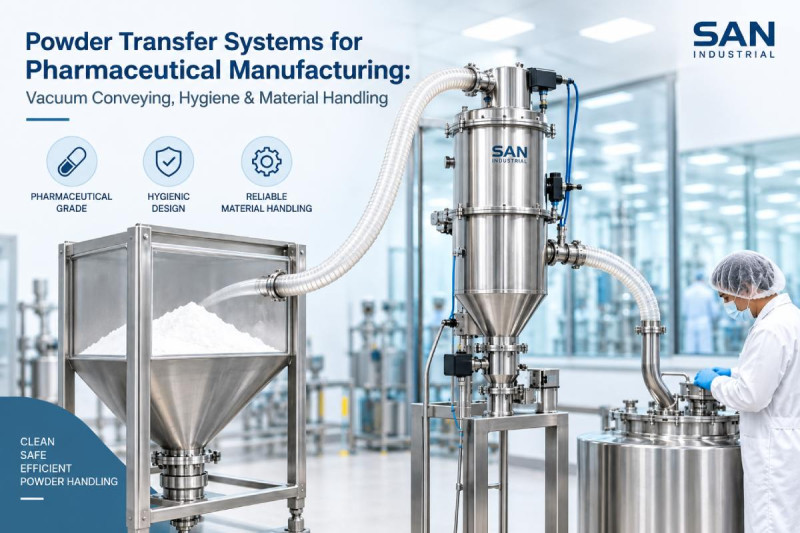
Pharmaceutical powder handling is not simply a matter of moving material from one vessel to another. Powders may be fine, cohesive, moisture-sensitive, abrasive, potent, or difficult to flow, and the transfer method can directly affect containment, product loss, cleaning requirements, and operator exposure.
This is why a powder transfer system in pharma is usually designed around more than conveying capacity. The system must provide controlled material movement while fitting the manufacturing process, equipment layout, and required hygiene standards.
A pharmaceutical powder transfer system based on vacuum conveying is one approach for achieving enclosed and controlled powder movement. Instead of mechanically carrying powder through an open handling route, the material is drawn through a conveying line using a vacuum and separated from the conveying air at the receiving point.
This article explains how pharmaceutical powder transfer works, where vacuum conveying fits, the hygiene and containment considerations that matter, and how to evaluate a system for a particular application. A powder transfer system is equipment used to move powders and dry bulk solids between pharmaceutical process stages. Vacuum conveying uses negative pressure to draw the material through an enclosed pipeline, separate the powder from conveying air at the receiver, and discharge the material into the next process step.
What Is a Powder Transfer System?
A powder transfer system is equipment used to move powders or other dry bulk solids between process points such as storage vessels, hoppers, mixers, blenders, reactors, mills, sifters, and packaging equipment.
In pharmaceutical manufacturing, the transfer route may need to handle materials such as:
- Active pharmaceutical ingredients (APIs)
- Excipients
- Powdered ingredients
- Granulated materials
- Pharmaceutical blends
- Fine chemical powders
- Tablets or capsules in some conveying applications
The objective is not only to achieve the required transfer rate. A properly selected system should also consider:
- Containment
- Dust control
- Product recovery
- Cleaning
- Cross-contamination risk
- Powder characteristics
- Operator exposure
- Material degradation
- Integration with upstream and downstream equipment
A powder vacuum transfer system addresses these requirements by using negative pressure to pull material through an enclosed conveying line.
How Does a Pharmaceutical Powder Transfer System Work?
A typical pharmaceutical vacuum transfer system follows a relatively straightforward sequence.
1. Powder enters the pickup point
The powder is collected from a source such as:
- Bag unloading equipment
- Storage hopper
- Intermediate container
- Blender
- Mixer
- Process vessel
- Silo
The pickup arrangement needs to match the powder's flow characteristics and the equipment from which it is being collected.
2. Vacuum creates the conveying airflow
A vacuum source generates negative pressure within the conveying pipeline. The resulting pressure differential draws powder into the conveying line together with the conveying air. Unlike gravity transfer, the system can move material horizontally or vertically and can route the conveying line around the manufacturing layout.
3. Powder travels through the conveying line
The powder-air mixture moves through the pipeline toward the receiving vessel. The conveying velocity must be appropriate for the material. Too little conveying energy can result in unstable transfer or blockages. Excessive velocity can increase particle impact, dust generation, or product degradation for sensitive materials.
4. Powder is separated from the conveying air
At the receiving unit, the incoming powder is separated from the conveying air. A filtration system retains the conveyed material while allowing the air to pass through the filter. This separation stage is particularly important for pharmaceutical applications because the design of the filter and discharge arrangement affects containment, product recovery, and cleaning.
5. Powder is discharged
Once the conveying cycle is complete, the collected material is discharged into the destination equipment.
Depending on the process, the receiving vessel may feed:
- A tablet press
- Blender
- Sifter
- Mill
- Reactor
- Packaging machine
- Process hopper
- Storage vessel
This creates an enclosed material-transfer route between process stages.
Why Vacuum Conveying Is Used for Pharmaceutical Powders
The attraction of vacuum conveying is not simply that it can transport powder. Its real value comes from how the material is contained and controlled during transfer. A well-designed powder conveying system can help address several common manufacturing problems.
1. Powder containment
Open powder transfer creates opportunities for material to escape into the surrounding workspace. A closed vacuum conveying arrangement can reduce the number of open handling steps by transferring material through enclosed equipment and pipelines.
This is especially important where powders are:
- Fine
- Dusty
- Potent
- Valuable
- Irritating
- Difficult to contain manually
The appropriate containment level still depends on the material and the overall facility design.
2. Dust generation
Fine pharmaceutical powders can become airborne when they are manually poured, tipped, or transferred between open containers. An enclosed pharmaceutical vacuum conveyor can reduce direct exposure of the powder to the surrounding environment.
However, the conveying system should not be viewed in isolation. Dust control also depends on:
- Pickup design
- Filter selection
- Connections
- Seals
- Discharge arrangements
- Cleaning procedures
- Maintenance
- Upstream and downstream equipment
3. Reduced product loss
Pharmaceutical powders can have significant material value, particularly when handling APIs or specialty formulations.
Product loss can occur through:
- Residual material in transfer equipment
- Dust escaping during manual transfer
- Material retained in filters or pipelines
- Spillage during charging
- Incomplete discharge
A correctly configured vacuum transfer system can provide a more controlled material path and improve recovery compared with some open-transfer methods.
Hygiene and Cross-Contamination in Powder Transfer
For pharmaceutical manufacturing, hygienic powder transfer is one of the most important design considerations. It is not enough for equipment to look clean. The design should support the required cleaning and validation approach for the particular process. Several areas deserve attention.
Closed Transfer
A closed transfer path reduces unnecessary exposure between the powder and the surrounding manufacturing environment.
The fewer manual opening and transfer operations required, the fewer opportunities there are for:
- Environmental contamination
- Powder escape
- Operator contact
- Foreign-material ingress
The degree of closure required should be determined from the product, process and facility requirements.
Contact-Surface Materials
Product-contact components may need carefully selected materials based on:
- Chemical compatibility
- Corrosion resistance
- Cleanability
- Surface finish requirements
- Product sensitivity
- Process temperature
- Cleaning chemicals
SAN's published pneumatic vacuum conveyor information specifies SS304/SS316 construction as an available design feature. This is a product-level specification; the appropriate material and finish should still be confirmed for the specific pharmaceutical application.
Cleaning and Inspection
A powder transfer system should be evaluated for how easily product-contact areas can be:
- Accessed
- Inspected
- Cleaned
- Drained where applicable
- Reassembled
- Verified after cleaning
Dead zones, difficult-to-access connections, and unnecessary internal crevices can complicate cleaning. For multi-product manufacturing, these considerations become particularly important because cleaning requirements may be more demanding when changing between products.
What About GMP, FDA and Other Pharmaceutical Requirements?
A common mistake in equipment marketing is to assume that using stainless steel or a closed transfer system automatically makes equipment "GMP compliant" or "FDA compliant." It does not. Compliance depends on the complete equipment design, materials, manufacturing controls, documentation, validation requirements, and intended application.
When evaluating a pharmaceutical powder transfer system, the buyer should establish which requirements apply, such as:
- Applicable GMP expectations
- Product-contact material requirements
- Surface-finish specifications
- Cleaning validation requirements
- Containment requirements
- Documentation requirements
- Electrical classification, where applicable
- Hazardous-area requirements, where applicable
- Site-specific validation requirements
If a certification or regulatory specification is required, it should be confirmed from the equipment manufacturer's documentation for the exact configuration being purchased.
Material Characteristics Matter More Than the Word "Powder"
Not every powder behaves in the same way. Two materials with the same particle size can behave very differently during pneumatic conveying.
Before selecting a pneumatic powder transfer system, consider:
|
Material characteristic |
Why it matters |
|
Particle size |
Influences conveying behaviour and filtration |
|
Bulk density |
Affects loading and conveying capacity |
|
Flowability |
Determines pickup and discharge behaviour |
|
Cohesiveness |
Can cause buildup or bridging |
|
Moisture content |
Can affect flow and filter performance |
|
Abrasiveness |
Influences component wear |
|
Fragility |
High conveying velocity may affect particles |
|
Hygroscopicity |
Moisture exposure can affect product |
|
Electrostatic behaviour |
Can affect powder movement and containment |
|
Potency |
Influences containment requirements |
This is why a published conveying capacity should not automatically be treated as the guaranteed capacity for every pharmaceutical powder. Actual performance depends on the material, conveying distance, vertical lift, pipeline configuration, vacuum conditions, and operating cycle.
Batch Powder Transfer vs Continuous Transfer
Pharmaceutical manufacturing frequently involves batch-based processes. This makes batch vacuum conveying particularly useful for applications where a defined quantity of powder must be transferred from one process stage to another.
For example:
Storage → Vacuum Conveyor → Blender → Vacuum Conveyor → Sifter → Process Hopper
The transfer cycle can be controlled around the production process rather than requiring continuous material flow. Continuous conveying can be more appropriate when material needs to move continuously between process stages.
The choice depends on:
- Required throughput
- Batch size
- Receiving equipment
- Production cycle
- Conveying distance
- Material behaviour
- Automation requirements
Can Vacuum Conveying Cause Powder Segregation?
Yes, potentially, but the risk depends heavily on the material and conveying conditions.
A pharmaceutical formulation may contain particles with different:
- Sizes
- Densities
- Shapes
- Surface characteristics
Differences between these particles can create segregation during handling.
Therefore, when evaluating a vacuum conveying system for powder, manufacturers should consider:
- Conveying velocity
- Pipeline geometry
- Transfer distance
- Number of bends
- Powder properties
- Batch size
- Pickup and discharge behaviour
For sensitive blends, conveying trials may be useful before final equipment selection.
The correct question is not simply "Can this system convey the powder?" It is: "Can it convey the powder at the required rate without creating unacceptable changes to the material?"
Pharmaceutical Powder Transfer System: Where Is It Used?
A powder transfer system in pharma can connect several different stages of pharmaceutical manufacturing.
Common integration points include:
Blender and Mixer Charging
Vacuum conveying can transfer powders into a blender or mixer without requiring manual lifting and pouring.
Tablet Manufacturing
Powder or granulated material can be transferred toward tablet presses through enclosed conveying arrangements.
Sifting and Milling
The transfer system can connect mills, sifters and intermediate hoppers while reducing manual material movement.
Reactor Charging
Where compatible with the process, vacuum conveying can transfer dry ingredients into process vessels or reactors.
Packaging
Bulk powder can be transferred toward packaging equipment through an enclosed material-handling route.
Storage and Intermediate Hoppers
A vacuum conveyor can move material from storage vessels to intermediate process equipment or production lines.
SAN's published pneumatic vacuum conveyor information specifically lists integration with tablet presses, blenders, sifters, mills, reactors, packing machines, hoppers, and storage silos.
What Capacity Does a Vacuum Powder Transfer System Handle?
Capacity is one of the first specifications buyers look for, but it should be evaluated alongside the conveying conditions.
SAN's published specifications for its pneumatic vacuum conveyor range currently show:
|
Model |
Published capacity |
Hopper volume |
Air consumption |
Operating pressure |
|
PVC-1 |
50–300 kg/hr |
1.1 L |
180 LPM |
4–6 bar |
|
PVC-2 |
100–700 kg/hr |
6 L |
360 LPM |
4–6 bar |
|
PVC-3 |
300–1,500 kg/hr |
12 L |
720 LPM |
4–6 bar |
|
PVC-4 |
600–3,000 kg/hr |
42 L |
1,440 LPM |
4–6 bar |
|
PVC-5 |
900–6,000 kg/hr |
60 L |
2,880 LPM |
4–6 bar |
These are published equipment specifications, not a universal guarantee for every powder. For pharmaceutical applications, final selection should account for the actual material and process conditions.
How to Select a Pharmaceutical Vacuum Transfer System
A practical selection process should start with the material and process, not the machine catalogue.
Step 1: Define the material
Provide:
- Powder name
- Particle size
- Bulk density
- Flowability
- Moisture sensitivity
- Abrasiveness
- Cohesiveness
- Temperature sensitivity
- Whether the material is fragile or easily degraded
Step 2: Define the required throughput
Determine:
- kg/hr required
- Batch size
- Number of batches per hour
- Required transfer time
- Peak versus average demand
Do not size the equipment from nominal production output alone.
Step 3: Map the transfer route
Measure:
- Horizontal conveying distance
- Vertical lift
- Number of bends
- Pipeline diameter
- Pickup location
- Destination height
- Required equipment connections
The actual conveying route can significantly affect performance.
Step 4: Establish containment requirements
Determine whether the application requires:
- Closed transfer
- Dust-controlled transfer
- Higher containment
- Operator exposure controls
- Special sealing
- Special filtration
These requirements should be established before equipment configuration.
Step 5: Define cleaning requirements
Ask:
- Is the equipment dedicated to one product?
- Will multiple products use the same system?
- How frequently will cleaning occur?
- What cleaning method will be used?
- Which components require removal?
- What documentation is required?
Step 6: Confirm materials and specifications
Confirm:
- Product-contact materials
- Surface finish
- Gasket/seal materials
- Filter specification
- Connections
- Construction
- Automation requirements
Any required regulatory or hazardous-area certification should be verified for the exact proposed configuration.
Powder Transfer System vs Manual Powder Handling
|
Factor |
Manual transfer |
Enclosed vacuum transfer |
|
Material movement |
Operator dependent |
Equipment controlled |
|
Dust exposure |
Can be higher |
Can be reduced with closed design |
|
Product containment |
Depends on handling method |
Enclosed conveying path |
|
Labour requirement |
Higher for repeated transfer |
Lower for automated transfer |
|
Integration |
Limited |
Can integrate with process equipment |
|
Cleaning |
Depends on containers/process |
Requires designed cleaning access |
|
Scalability |
Limited |
Can be selected for required capacity |
Vacuum conveying does not eliminate all handling risks, but it can substantially change how powder moves through a production environment.
Key Design Considerations for Hygienic Powder Handling
For a pharmaceutical application, evaluate the complete transfer system rather than the conveyor alone.
Important questions include:
Is the powder fully contained during transfer?
Look at the complete path from pickup through discharge.
Can the product-contact areas be cleaned effectively?
Examine filters, seals, valves, receivers, pipelines and discharge mechanisms.
Is the material compatible with the conveying conditions?
Consider degradation, segregation, electrostatic behaviour and particle damage.
Can the system integrate with existing equipment?
The conveyor should work with the production line's:
- Hopper
- Blender
- Mixer
- Sifter
- Mill
- Reactor
- Tablet press
- Packaging machine
Can the required documentation be provided?
Depending on the project, buyers may require documentation for materials, construction, testing, cleaning or validation.
Why Closed Powder Transfer Can Improve Pharmaceutical Material Handling
The biggest advantage of a well-designed powder transfer system in pharma is that it treats material handling as part of the manufacturing process rather than as a separate manual activity.
Instead of:
Bag → Manual lifting → Open vessel → Dust → Manual cleaning
A controlled process may look more like:
Source vessel → Enclosed vacuum transfer → Filter/receiver → Process vessel
This can reduce unnecessary material handling while providing a more controlled route for powder movement. The final system, however, must be engineered around the actual product and manufacturing environment.
SAN Vacuum Conveying Systems for Powder Transfer
SAN Industries offers pneumatic vacuum conveying systems designed for enclosed transfer of powders, granules, tablets, capsules, flakes, pellets, and other bulk solids.
Its published pneumatic system features include:
- Dust-free transfer design
- Closed hygienic transfer
- SS304/SS316 construction
- Compact modular construction
- Easy cleaning
- Low energy consumption
- Gentle material handling
- Automatic filter cleaning
- PLC automation
- Integration with process equipment
The company's published application range includes pharmaceutical powders and APIs, along with food powders, chemicals, pigments, plastic granules, detergents, fertilizers, and other bulk solids.
For pharmaceutical projects, the appropriate construction, filtration, materials, connections, and other specifications should be confirmed against the actual product and site requirements rather than assumed from a standard configuration.
Frequently Asked Questions
What is a powder transfer system in pharma?
A powder transfer system in pharma is equipment used to move pharmaceutical powders and other dry bulk materials between process stages. Vacuum conveying is one method that uses negative pressure to move material through an enclosed conveying line.
What is a pharmaceutical vacuum transfer system?
A pharmaceutical vacuum transfer system uses vacuum to draw powders or bulk solids from a source into a receiving vessel while separating the conveyed material from the conveying air through a filtration system.
Why use vacuum conveying for pharmaceutical powders?
Vacuum conveying can provide an enclosed route for powder movement, helping reduce open handling, dust generation, and unnecessary operator contact. The actual containment and hygiene performance depends on the complete system design.
What powders can be transferred using vacuum conveying?
Potential materials include pharmaceutical powders, APIs, excipients, granules and other dry bulk solids. Suitability depends on particle size, density, flowability, cohesiveness, moisture content, and other material characteristics.
Is a vacuum conveyor automatically GMP compliant?
No. Equipment should not be considered GMP compliant simply because it uses vacuum conveying or stainless-steel construction. Applicable GMP requirements, materials, design, documentation, and validation requirements must be established for the specific application.
What is the difference between a powder vacuum transfer system and pneumatic powder transfer system?
The terms can overlap. A vacuum powder transfer system uses negative pressure to move material, while "pneumatic powder transfer system" is a broader term covering systems that use air movement to convey powders. Vacuum conveying is therefore a type of pneumatic conveying.
Conclusion
A pharmaceutical powder transfer system has to do more than move material from A to B. It must be evaluated in terms of containment, hygiene, cleaning, powder behaviour, product recovery, operator exposure, segregation, throughput and integration with the manufacturing process. Vacuum conveying can be particularly useful where an enclosed transfer route is required for powders and other dry bulk materials. But the correct system cannot be selected from capacity alone.
The most reliable approach is to define the material characteristics, required throughput, conveying route, containment requirements, cleaning strategy, and equipment interfaces first, and then select the vacuum conveyor configuration around those requirements. For pharmaceutical manufacturers evaluating a pharmaceutical vacuum transfer system, the objective should be straightforward: controlled powder movement with a transfer design that supports the product, process, and applicable manufacturing requirements.