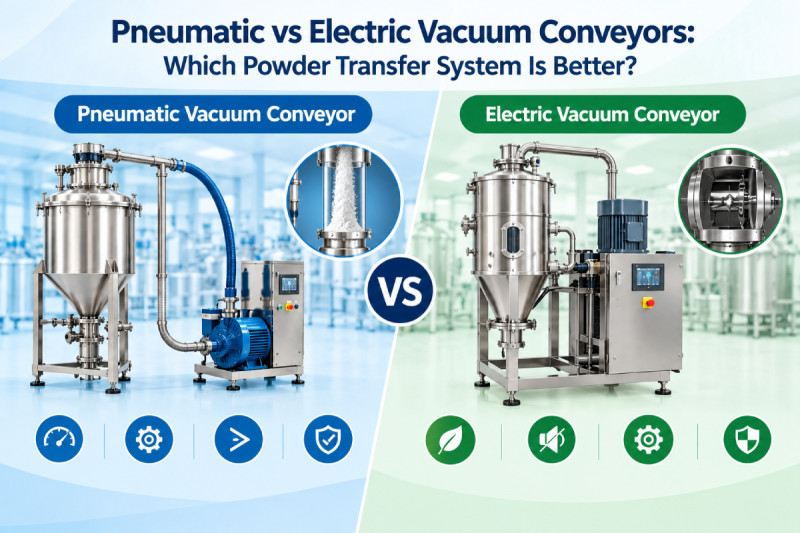
Pneumatic vs Electric Vacuum Conveyors: Which Is Right for Your Application?
Pneumatic vs electric vacuum conveyor selection depends on the application, because neither is better in every case. A pneumatic vacuum conveyor generates vacuum from compressed air. It is usually a good fit when plant air is available, the unit needs to be compact, and the vacuum source can be compressed air rather than an electric motor at the conveyor. An electric vacuum conveyor generates vacuum with a motor-driven pump. It is usually a better fit for higher or continuous throughput where compressed-air capacity or running cost is a constraint.
The right choice depends on:
- The material
- The throughput and duty cycle
- The utilities available at the machine
- The hygiene and area requirements of the process
The drive type matters less than getting those four inputs right.
Pneumatic vs electric vacuum conveyor: which should you choose?
Choose the pneumatic option when compressed air is readily available, batch transfers and mobility are important, and a compact vacuum source is preferred. Consider the electric option when throughput is high or continuous, compressed-air capacity is limited, or you need a fixed automated installation. For the final choice, also weigh material properties, conveying distance, hygiene, area requirements, and lifetime energy cost.
What is a vacuum conveyor?
A powder vacuum transfer system is a closed conveying system that uses negative pressure to draw powders, granules, and other dry bulk materials through a pipe or hose into a receiver. A filter separates the material from the air, and the material then discharges into the next process step, such as a blender, tablet press, reactor, sifter, or packing machine.
Because the line runs under vacuum, any leak draws air in rather than pushing dust out. That is one reason vacuum conveying is widely used for pharmaceutical, food, and chemical powders. For the fundamentals, see our guide to what a vacuum conveying system is.
How pneumatic vacuum conveying works
In a pneumatic vs electric vacuum conveyor comparison, the pneumatic vacuum conveyor creates vacuum with a compressed-air ejector, also called a venturi, rather than a motor. Compressed air passes through a nozzle at high velocity, and that flow draws air out of the receiver to create suction.
Most pneumatic powder transfer systems run in batch cycles:
- Suction. The ejector pulls vacuum in the receiver, and powder is drawn in from the pick-up point, such as a drum, bag station, or hopper.
- Separation. A filter at the top of the receiver keeps the powder in and lets the air pass to the ejector.
- Discharge. The vacuum is switched off, the discharge valve opens, and the batch drops into the process equipment below.
- Filter cleaning. A short reverse pulse of compressed air knocks powder off the filter, ready for the next cycle.
For scale, SAN's pneumatic vacuum conveyor models (PVC-1 to PVC-5) are published with the following figures.
depending on model and material:
- Capacity from about 50–300 kg/h up to 900–6,000 kg/h
- Operating pressure of 4–6 bar
- Air consumption from 180 to 2,880 litres per minute
The figures show the main trade-off. As capacity rises, compressed-air demand rises with it.
Where pneumatic works well
- No motor at the point of use. The unit is compact and light, and has few moving parts to maintain.
- Simple utilities. It needs a compressed-air connection and basic controls.
- Easy to move. It suits batch operations, several pick-up points, and product changeovers where a pneumatic powder transfer system is practical.
- Hazardous areas. Having no electric motor at the conveyor can simplify installation. Confirm the full system's area classification rather than assuming it.
Limitations
- Running cost. Compressed air is expensive to produce, so large or continuous duties can cost more to run than an electric pump.
- Air supply. Performance falls if line pressure or airflow drops, or if other users share the supply.
- Air quality. Filter-cleaned air enters the product side of the system. In pharma and food lines, check that it is dry, filtered, and oil-free.
- Exhaust noise. Ejector exhaust usually needs a silencer.
How electric vacuum conveying works
In a pneumatic vs electric vacuum conveyor comparison, the electric unit creates vacuum with a motor-driven vacuum pump or blower instead of a compressed-air ejector. The conveying cycle is essentially the same: suction, separation, discharge, and filter cleaning. The difference is where the vacuum comes from and what it costs to produce.
An electric vacuum conveyor system usually has these parts:
- A receiver with a filter
- A discharge valve
- An electric vacuum pump, mounted on the unit or located separately and connected by pipework
- A control panel, often with automatic filter cleaning and PLC sequencing
SAN's electric vacuum conveyor models (EVC-1 to EVC-5) are published with the following figures,
depending on model:
- Capacities from 400 to 6,000 kg/h
- Motor options from 1.5 kW to 7.5 kW
- SS304 or SS316L contact parts
- Automatic filter cleaning
- PLC-based control as an option
Where electric works well
- Higher or continuous throughput. It suits applications where compressed air would be costly, or the supply is limited.
- Independent of plant compressed air. An electric vacuum source does not rely on the site's compressed-air pressure or flow capacity. Its performance still depends on the pump, the electrical supply, and the conveying conditions.
- Automation. It integrates easily with automatic, PLC-controlled lines such as silo-to-mixer transfer, bag dump stations, and packing-machine feeding.
- Noise. It is typically quieter than ejector exhaust when the pump is located or enclosed well.
Limitations
- Size and weight. The pump adds weight, footprint, and a motor to maintain.
- Utilities. It needs a suitable electrical supply.
- Hazardous areas. If the atmosphere is flammable, the motor and controls need an appropriate protection rating. Confirm this for the specific model.
- Mobility. It is less convenient to move between workstations than a light pneumatic unit.
Pneumatic vs electric vacuum conveyor: side-by-side comparison
The main difference between a pneumatic powder transfer system and an electric vacuum conveyor system is where the energy comes from: compressed air or electricity. Most of the other differences follow from that.
|
Factor |
Pneumatic vacuum conveyor |
Electric vacuum conveyor |
|
Vacuum source |
Compressed-air ejector (venturi) |
Motor-driven vacuum pump or blower |
|
Power source |
Compressed air |
Electrical power |
|
Installation requirements |
Air supply of adequate pressure, flow, and quality |
Electrical supply; space for the pump |
|
Running cost |
Tied to compressed-air consumption; can be significant at high duty |
Tied to motor power; often lower per kg for continuous duty |
|
Throughput fit |
Small to medium batches; larger models available |
Medium to high and continuous throughput |
|
Weight and mobility |
Light and compact; easy to move |
Heavier; usually a fixed installation |
|
Moving parts at the unit |
Few (valves only) |
Pump and motor |
|
Noise |
Ejector exhaust; usually needs a silencer |
Depends on the pump and enclosure |
|
Hazardous areas |
No motor at the unit, but confirm the full system's classification |
Motor and controls need a suitable protection rating |
|
Control |
Air and process controls; simple timers or PLC |
Electrical controls; PLC sequencing common |
|
Integration |
Depends on the process |
Depends on the process |
|
Suitable applications |
Depends on the material and process |
Depends on the material and process |
|
Selection |
Based on process requirements |
Based on process requirements |
|
Best starting point |
Compressed air is available, and batch transfer or mobility matters |
Continuous duty, with electrical power readily available |
A quick running-cost check
Compressed air is often underestimated as an energy cost. As a rough engineering estimate, a compressed-air system can need several kilowatts of compressor input for every 1,000 L/min of compressed air it delivers. The exact figure depends heavily on compressor type and efficiency, pressure, part-load behaviour, and system losses. For a site-specific calculation, use your compressor manufacturer's power-versus-flow data.
For illustration only: suppose your compressor data showed around 6–8 kW per 1,000 L/min. A pneumatic conveyor using 720 L/min during suction would then need roughly 4-6 kW at the compressor while conveying. Compare the figure from your own compressor data with the motor rating of an electric unit at the same throughput.
Duty cycle changes the answer:
- Pneumatic units use air only while conveying. For intermittent batch transfers, the gap may be small.
- Electric units pay back fastest on long, continuous runs.
Material-specific considerations
The material affects the design of a vacuum conveying system for powder more than the drive type does. It sets the filter, line size, conveying velocity, receiver, and discharge valve. The drive then has to supply enough vacuum and airflow for that design.
Before choosing, collect the following:
- Bulk density
- Particle size range
- Flowability
- Moisture content
- Abrasiveness
- Friability
- Any explosibility or toxicity data
|
Material |
What matters |
Design implication |
|
Free-flowing powders (sugar, salt, many granulated products) |
Density and throughput |
Usually straightforward. Drive choice is mainly about throughput and utilities |
|
Granules and pellets (plastic granules, some pharma granulates) |
Particle size, friability, segregation |
Enough velocity to carry larger particles. Too much can break friable granules or separate blends |
|
Fine and cohesive powders (APIs, talc, pigments, cocoa, milk powder) |
Filter loading, bridging, dust |
Adequate filter area and effective cleaning. Receiver and discharge design must prevent bridging |
|
Hygroscopic materials (some APIs, sugar-based and milk powders) |
Moisture pick-up from conveying air |
Short, enclosed transfers. Consider air quality, and dry air where needed. With pneumatic units, check the dryness of filter-cleaning air |
|
Pharmaceutical materials |
Containment, cross-contamination, cleaning validation |
SS316L contact parts, dismantling for cleaning, documented materials. Confirm filter and gasket suitability for the specific model |
|
Food materials (flour, spices, coffee, sugar) |
Hygiene, allergen changeover, dust |
Food-grade contact materials, easy cleaning, closed transfer |
|
Dust-sensitive or combustible dusts |
Dust release, ignition sources, static |
A closed vacuum system limits dust release. Earthing, suitable filters and an area-appropriate drive must be assessed for the specific dust |
The safe starting point for a powder vacuum transfer system is to run a conveying trial with your own material. Most vacuum conveyor sizing uncertainty comes from how a specific powder behaves, not from the equipment.
How to choose between pneumatic and electric vacuum conveying
For vacuum conveying system selection, start with throughput, duty cycle, and available utilities. The material then confirms the design of the vacuum conveying system for powder.
- Define throughput and duty. Work out the kg/h needed and how many hours a day the conveyor runs.
- Define batch size and cycle time. Record the kg per batch, the batch duration, and the number of cycles per hour. A headline kg/h figure doesn't tell the whole story. A steady 500 kg/h feed and 500 kg/h delivered as short, high-capacity batches are different duties.
- Characterise the material. Record bulk density, particle size, flowability, moisture sensitivity, and dust behaviour.
- Map the route. Note the conveying distance, the vertical lift, the number of bends, and the pick-up and discharge points.
- Check utilities at the machine. Confirm spare compressed-air capacity and quality, and the electrical supply available.
- Set hygiene and area requirements. Cover contact materials, cleaning method, containment and area classification.
- Compare running cost. Weigh compressed-air consumption against motor power at your actual duty cycle.
- Trial with your material. Confirm capacity and filter performance before you finalise the model.
|
If your situation is… |
Start by evaluating |
|
Compressed air is available with spare capacity, and the transfers are small to medium batches |
Pneumatic vacuum conveyor |
|
One unit serves several machines or rooms, or product changes are frequent |
Pneumatic (light and movable) |
|
Throughput is high or continuous over long shifts |
Electric vacuum conveyor |
|
Compressed-air capacity is limited or the air is expensive |
Electric |
|
No motor is wanted at the point of use |
Pneumatic, subject to an area assessment of the whole system |
|
The line is fully automated with PLC sequencing |
Either; electric is common for fixed, integrated lines |
|
The duty is loading tablet presses, blenders or sifters in pharma |
Either. Pneumatic often suits smaller batch loading; electric suits higher-throughput fixed transfers |
This is a starting point, not a rule. Two plants moving the same powder can reasonably choose differently because their compressed-air systems, shift patterns and layouts differ.
How conveying distance affects vacuum conveyor selection
The conveying route can change the selection of a powder vacuum transfer system as much as the throughput does. Each of the following can increase the vacuum and airflow a system needs and reduce the throughput it can achieve:
- A longer horizontal run
- A higher vertical lift
- Complex pipe routing
- More bends
So a requirement of 500 kg/h does not mean any vacuum conveying system for powder rated at 500 kg/h will do. The rating has to hold over your route, with your material.
Why bulk density matters
Vacuum conveyors move material by volume as much as by weight. For example, 500 kg/h of a dense powder and 500 kg/h of a very light, fluffy powder are very different volumes of material. The light powder may need a larger receiver, a larger line or more cycles per hour to reach the same kg/h. Always size on the bulk density of the actual material.
SAN pneumatic and electric vacuum conveyors
SAN's vacuum conveyor range includes both drive types. Once you have your throughput, material data and utilities, you can compare the two families directly. The figures below are as published by SAN and vary by model and material.
|
Models |
PVC-1 to PVC-5 |
EVC-1 to EVC-5 |
|
Capacity |
50–300 kg/h (PVC-1) up to 900–6,000 kg/h (PVC-5) |
400 kg/h (EVC-1) up to 6,000 kg/h (EVC-5) |
|
Utility |
Compressed air at 4–6 bar; 180–2,880 litres per minute |
Electric motor, 1.5–7.5 kW |
|
Contact materials |
SS304 / SS316 |
SS304 or SS316L |
|
Published features |
Closed, dust-free transfer; GMP and food-grade design |
Enclosed, dust-free conveying; automatic filter cleaning; easy dismantling; optional PLC control |
|
Typical integration |
Tablet press, blender, sifter, mill, reactor, packing machine, hopper, silo |
Silo-to-mixer, bag dump stations, packing-machine feeding |
|
Requirement |
Start with |
SAN range |
Key selection consideration |
|
Small to medium batch transfers |
Pneumatic |
PVC series |
Available compressed-air capacity and quality |
|
Several workstations or frequent product changes |
Pneumatic |
PVC series |
Mobility and compressed-air availability at each point |
|
Continuous or high throughput |
Electric |
EVC series |
Electrical supply, throughput and duty hours |
|
Pharmaceutical transfer |
Either |
PVC or EVC series |
Contact materials, cleaning, containment and model-specific documentation |
For product details, see the SAN pneumatic vacuum conveyor and the SAN electric vacuum conveyor pages.
If your application is pharmaceutical, our guide to powder transfer systems in pharma covers containment, hygiene and material handling in more depth.
Common selection mistakes
- Choosing on purchase price alone. Compressed-air cost over years of operation can outweigh the price difference between the two drives.
- Choosing on headline capacity alone. Published capacity depends on several factors: material properties, conveying distance, lift, pipe size, filter condition, and operating conditions. Confirm capacity using your actual material and conveying route.
- Assuming spare compressed air. Check real line pressure and flow at the conveyor while other equipment is running.
- Sizing on an ideal material. Capacity for a cohesive, fine or low-density powder can be well below the headline figure.
- Ignoring the route. Distance, vertical lift and bends all reduce capacity.
- Overlooking filter cleaning. Poor filter cleaning is a common cause of falling capacity with fine powders.
- Assuming hazardous-area suitability. Confirm it for the full system and the specific dust. Neither drive type is automatically suitable.
Frequently asked questions
What is the difference between a pneumatic vs electric vacuum conveyor?
The difference is how the vacuum is created. A pneumatic vacuum conveyor uses a compressed-air ejector, and an electric vacuum conveyor system uses a motor-driven vacuum pump. The conveying cycle of suction, separation, discharge and filter cleaning is similar in both.
Which is cheaper to run?
It depends on duty. For short, intermittent batch transfers the difference may be small. For high or continuous throughput, an electric unit is often cheaper to run, because producing compressed air takes a lot of electrical energy.
Is a pneumatic vacuum conveyor more energy efficient than an electric vacuum conveyor?
Not necessarily. Pneumatic conveyors are compact and convenient where compressed air is already available, but producing compressed air can be energy-intensive. Electric vacuum sources can have the advantage in long, continuous operation. Compare them using actual compressor and motor energy consumption at the duty cycle you need.
Is a vacuum conveyor the same as a pneumatic conveyor?
Vacuum conveying is one type of pneumatic conveying: it moves material with air under negative pressure. "Pneumatic conveyor" also covers pressure systems that push material through a line. Separately, "pneumatic vacuum conveyor" usually refers to a vacuum conveyor whose vacuum comes from compressed air.
What is a powder vacuum transfer system?
It is another name for a vacuum conveyor used for powders, also called a vacuum powder transfer system. It is a closed system that draws powder from a container into a receiver and discharges it into process equipment, which limits dust release.
Which vacuum conveyor is suitable for a pharmaceutical powder transfer system?
Both drive types can be used in a pharmaceutical powder transfer system.
The deciding points are usually these:
- Contact materials, such as SS316L
- Ease of cleaning and dismantling
- Filter selection
- Containment
- Throughput
Confirm documentation and compliance for the specific model.
Can vacuum conveyors handle granules as well as powders?
Yes, as long as the line size and conveying velocity suit the particle size. For friable granules, velocity should be controlled to limit breakage.
What factors affect vacuum conveyor capacity?
Capacity depends on:
- Material bulk density, particle size and flowability
- Conveying distance, vertical lift, pipe diameter and bends
- Vacuum level
- Filter condition
- The conveyor's operating cycle
Treat any published capacity as model- and material-dependent, and confirm it for your own material and route.
Next step
When you contact SAN's team about a transfer, send them the following:
- The material
- Bulk density
- Required kg/h
- Conveying distance and lift
- Pick-up and discharge equipment
- Available compressed air or electrical supply
With that, they can recommend whether a pneumatic or electric vacuum conveyor fits and suggest a material trial.