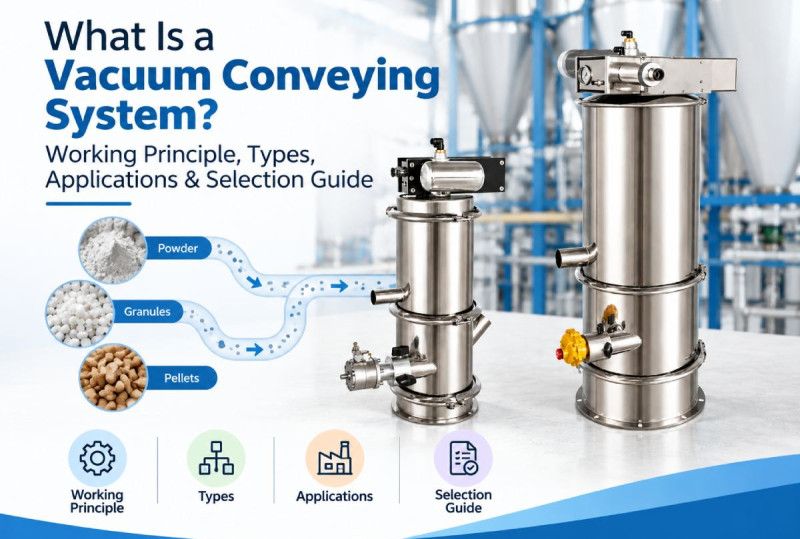
Moving powders and bulk solids between process machines looks simple until the material starts creating dust, bridging, segregating, contaminating equipment, or requiring repeated manual handling.
A vacuum conveying system addresses this by using controlled airflow and vacuum to pull material through an enclosed conveying line from a pickup point to a receiving vessel or process machine.
For applications involving powders, granules, tablets, pellets, flakes and other dry bulk solids, the attraction is not simply that the material moves from A to B. A properly designed system can also reduce open material handling, contain dust, and integrate directly with equipment such as hoppers, mixers, blenders, mills, sifters, and packaging machines.
SAN Industrial's current vacuum-conveyor range includes both SAN Pneumatic Vacuum Conveyor Systems and SAN Electric Vacuum Conveyor Systems, while its pneumatic system is specified for powders, granules, tablets, capsules, flakes, pellets, and other bulk solids.
What Is Vacuum Conveying?
Vacuum conveying is a form of pneumatic conveying in which a pressure differential is created by generating a vacuum downstream of the material pickup point. The resulting airflow carries the material through a conveying pipeline into a receiver.
In simple terms:
Material pickup → conveying line → vacuum receiver/filter → separation → discharge
Unlike manual transfer using bags, containers or scoops, the material can remain inside a closed conveying path for much of the transfer process. This makes a vacuum conveyor particularly useful where dust containment, hygiene, reduced manual handling or controlled powder transfer are important.
SAN describes its vacuum conveying system as an enclosed solution for transferring powders, granules and other dry materials, with applications extending to pharmaceutical, food and chemical powders as well as pellets and other bulk solids.
How Does a Vacuum Conveying System Work?
A typical vacuum conveyor system operates through several basic stages.
1. Material pickup
The conveying line is connected to the material source, such as a:
- Bag or container
- Hopper
- Storage vessel
- Process machine
- Silo
- Material discharge point
A pickup arrangement allows the airflow to entrain the material.
2. Vacuum generation
A vacuum source creates the pressure differential needed to draw air and material through the conveying line. Depending on the system configuration, vacuum can be generated using pneumatic or electrically driven equipment.
3. Material conveying
The pressure difference creates airflow through the pipeline. The material becomes entrained in this moving air stream and travels toward the receiving vessel.
The actual conveying behaviour depends heavily on:
- particle size,
- bulk density,
- particle shape,
- moisture,
- cohesion,
- conveying distance,
- bends,
- elevation,
- required throughput, and
- air velocity.
Therefore, a vacuum conveying system for powder should not be sized only from the desired kilograms per hour.
4. Separation in the receiver
When the material reaches the receiver, the product is separated from the conveying air. A filtration system prevents the conveyed powder from continuing into the vacuum-generation equipment.
5. Discharge
Once the conveying cycle is complete, the collected material is discharged into the downstream process.
The receiving point could be a:
- Mixer
- Blender
- Tablet press
- Sifter
- Mill
- Reactor
- Packaging machine
- Hopper
- Storage silo
SAN specifically lists these types of receiving machines for its vacuum conveyor.
Main Components of a Vacuum Conveyor
Although system designs vary, a typical powder vacuum transfer system consists of several functional elements.
|
Component |
Function |
|
Pickup point |
Introduces material into the conveying stream |
|
Conveying pipeline |
Carries material from source to receiver |
|
Vacuum source |
Creates the pressure differential and airflow |
|
Receiver |
Collects the conveyed material |
|
Filter |
Separates product from conveying air |
|
Discharge mechanism |
Releases material into the next process |
|
Controls |
Coordinates conveying, filtration and discharge cycles |
The filter is particularly important when handling fine powders. If filtration is inadequate or becomes loaded, system performance can deteriorate and the vacuum source may be exposed to unwanted product carryover.
SAN lists automatic filter cleaning and PLC automation as available features for its pneumatic vacuum conveyor system.
Why Use Vacuum Conveying for Powders and Bulk Solids?
A conventional mechanical transfer method may require operators to repeatedly open containers, lift bags or manually charge process equipment. A pneumatic vacuum system changes the material-transfer process into an enclosed operation.
Dust containment
A closed transfer route can reduce the escape of airborne powder compared with open manual handling. This is particularly relevant for fine powders and dusty materials.
Reduced manual handling
Material can be drawn directly from its source to the receiving machine, reducing repeated lifting and manual charging.
Hygienic transfer
For suitable applications, stainless-steel construction and enclosed conveying can support hygienic process layouts.
SAN's pneumatic vacuum conveyor specification includes SS304/SS316 construction and a stated GMP and food-grade design option.
Integration with process equipment
The conveyor does not need to operate as a standalone machine. It can be positioned between existing process stages.
For example:
Storage hopper → vacuum conveyor → blender
or:
Powder container → vacuum conveyor → tablet press hopper
This ability to integrate into an existing production line is often more important than the conveyor itself.
What Materials Can a Vacuum Conveyor Handle?
The suitability of a pneumatic powder transfer system depends on the material's physical characteristics and the system design.
Common materials include:
- Pharmaceutical powders
- APIs
- Food powders
- Milk powder
- Flour
- Cocoa powder
- Coffee
- Spices
- Sugar
- Chemical powders
- Pigments
- Plastic granules
- Detergent powder
- Talcum powder
- Fertilizer
- Animal feed
- Tablets
- Capsules
- Flakes
- Pellets
SAN's pneumatic vacuum conveyor page specifically lists these material categories and applications. However, "powder" is not a sufficient specification for equipment selection.
Two powders with identical throughput requirements can behave very differently if one is free-flowing while the other is cohesive, hygroscopic or prone to agglomeration.
Continuous vs Batch Vacuum Conveying
One important design consideration is how material is transferred.
Batch conveying
In batch conveying, the receiver collects a defined quantity of material before discharging it into the process. This arrangement is useful when the downstream equipment is charged in controlled quantities. It can also make the conveying sequence easier to coordinate with mixers, blenders, tablet presses, and other batch-oriented processes.
Continuous conveying
Continuous systems are designed to maintain material movement with less interruption between pickup and discharge. They are more appropriate when the downstream process requires a relatively continuous feed. The correct arrangement depends on the required throughput, receiving equipment, and process sequence.
Pneumatic vs Electric Vacuum Conveyor
SAN's current product structure separates its vacuum conveyor offering into pneumatic and electric systems. The important distinction is how the vacuum and conveying airflow are generated.
|
Factor |
Pneumatic vacuum conveyor |
Electric vacuum conveyor |
|
Primary utility |
Compressed air |
Electrical power |
|
Installation consideration |
Requires suitable compressed-air supply |
Requires electrical supply |
|
Integration |
Useful where plant air is readily available |
Useful where electrical infrastructure is preferred |
|
System selection |
Based on air availability and process requirements |
Based on electrical equipment and process requirements |
|
Best choice |
Depends on site utilities and application |
Depends on site utilities and application |
There is no universal winner. A plant with readily available compressed air may favour a pneumatic configuration. Another facility may prefer an electrically driven arrangement because of its available utilities or operating philosophy.
The comparison should therefore be made using throughput, duty cycle, utilities, installation environment, cleaning requirements and total operating cost.
What Determines Vacuum Conveyor Capacity?
One of the biggest mistakes in specifying a powder transfer system is treating capacity as a single number. Actual conveying capacity depends on the interaction between the material, system, and operating conditions.
Important factors include:
1. Bulk density
A kilogram of a dense granular material occupies a different volume from a kilogram of a low-density powder.
2. Particle size and distribution
Fine particles behave differently from larger granules or pellets.
3. Material flowability
Free-flowing materials are generally easier to convey than cohesive materials.
4. Moisture content
Moisture can increase cohesion and create flow problems.
5. Conveying distance
Longer pipelines increase system resistance.
6. Vertical lift
Lifting material vertically adds to the conveying requirement.
7. Pipeline diameter
The pipeline has to provide appropriate airflow conditions without creating unnecessary pressure losses.
8. Number of bends
Each bend contributes additional resistance to the conveying system.
9. Required throughput
The required kg/hr directly affects equipment sizing.
10. Product sensitivity
Fragile tablets, agglomerates or other materials may require gentler handling. This is why a supplier should ideally receive the material, required capacity, conveying distance, elevation, and receiving equipment before recommending a specific model.
Hygiene and Cleaning Considerations
For pharmaceutical, food and other hygiene-sensitive applications, the conveyor should be considered as part of the entire material-handling process.
Important questions include:
- What material is the product-contact surface made from?
- How easily can the receiver and pipeline be cleaned?
- Can product remain trapped in dead zones?
- How is the filter accessed?
- How frequently does the system require cleaning?
- Is cross-contamination a concern?
- Are product-contact materials suitable for the process?
SAN's pneumatic vacuum conveyor specification identifies SS304/SS316 construction, easy cleaning and maintenance, a closed hygienic system, and GMP & food-grade design among its stated features.
The exact hygienic configuration should nevertheless be selected according to the process and applicable plant requirements rather than assuming that every configuration has the same sanitary characteristics.
Dust Control and Product Containment
A major reason companies investigate industrial vacuum conveyors is control of material during transfer. Open powder handling can expose operators and surrounding equipment to dust. An enclosed transfer route provides a different containment strategy by keeping the material inside the conveying system.
SAN positions its pneumatic vacuum conveyor around dust-controlled, enclosed transfer and specifically lists dust-free operation, reduced manual handling and improved workplace safety among its stated advantages.
For very fine, hazardous or combustible powders, however, containment should be treated as one part of the overall process-safety design. Equipment construction, filtration, grounding/bonding, area classification and other safeguards need to be evaluated for the actual material and facility.
How to Select a Vacuum Conveying System
A practical selection process should begin with the process—not the catalogue.
Step 1: Define the material
Provide:
- Material name
- Bulk density
- Particle size
- Moisture content
- Flowability
- Temperature
Whether the material is fragile, abrasive, cohesive or hygroscopic
Step 2: Define required capacity
State the required:
kg/hr or other appropriate throughput Also identify whether that rate is continuous or represents a batch requirement.
Step 3: Measure conveying distance
Record:
- Horizontal distance
- Vertical lift
- Number of bends
- Pipeline routing
Step 4: Identify the receiving equipment
Is the conveyor feeding:
- A blender?
- Tablet press?
- Sifter?
- Mill?
- Reactor?
- Packing machine?
- Hopper?
- Storage silo?
The receiving equipment can influence how the conveyor needs to discharge and operate.
Step 5: Evaluate site utilities
Determine whether the plant has suitable:
- Compressed air
- Electrical supply
- Vacuum-generation infrastructure
Step 6: Define hygiene requirements
For pharmaceutical and food applications, establish the required product-contact materials, cleaning method, and hygienic design requirements.
Step 7: Consider automation
Determine whether the system should operate manually or integrate with PLC/process controls. SAN states that PLC automation is available on its pneumatic vacuum conveyor system.
SAN Vacuum Conveyor Systems
SAN Industrial currently positions its vacuum-conveyor offering around two main configurations:
- SAN Pneumatic Vacuum Conveyor Systems
- SAN Electric Vacuum Conveyor Systems
|
Model |
Capacity |
Hopper volume |
Air consumption |
Operating pressure |
|
PVC-1 |
50–300 kg/hr |
1.1 L |
180 LPM |
4–6 bar |
|
PVC-2 |
100–700 kg/hr |
6 L |
360 LPM |
4–6 bar |
|
PVC-3 |
300–1,500 kg/hr |
12 L |
720 LPM |
4–6 bar |
|
PVC-4 |
600–3,000 kg/hr |
42 L |
1,440 LPM |
4–6 bar |
|
PVC-5 |
900–6,000 kg/hr |
60 L |
2,880 LPM |
4–6 bar |
These are the currently published SAN figures, but actual achievable conveying capacity depends on the material and installation conditions.
The pneumatic system is also described as modular and configurable for integration with mixers, blenders, tablet presses, reactors, packaging machines, mills, sifters, dryers, and storage hoppers.
When Is a Vacuum Conveyor the Right Choice?
A vacuum conveying system is worth considering when your process involves:
- Frequent powder transfer
- Manual charging of process equipment
- Dust generation during material handling
- Pharmaceutical or food powders
- Enclosed material transfer requirements
- Transfer between multiple process machines
- Reduced operator handling
- Granules, pellets, tablets or flakes
- Integration with hoppers, mixers, blenders or packaging equipment
It may be less appropriate if the material cannot be reliably entrained in an air stream or if the required conveying conditions are incompatible with the product. That is why material testing and application engineering can be important for difficult products.
Frequently Asked Questions
What is a vacuum conveying system?
A vacuum conveying system is a pneumatic material-transfer system that uses a pressure differential to draw powders, granules, or other bulk solids through a pipeline into a receiving vessel.
How does vacuum conveying work?
A vacuum source creates airflow through the conveying line. Material is picked up at the source, transported through the pipeline, and separated from the conveying air at the receiver before being discharged.
What is the difference between vacuum conveying and pneumatic conveying?
Vacuum conveying is a type of pneumatic conveying. The distinction is that vacuum systems draw material toward the receiver using negative pressure, while pressure conveying pushes material away from the pressure source.
Can a vacuum conveyor transfer powder?
Yes. Vacuum conveying is commonly used for powders and other dry bulk solids, but suitability depends on particle characteristics, bulk density, flowability, conveying distance, and required capacity.
Is vacuum conveying suitable for pharmaceutical powders?
It can be, particularly where enclosed, hygienic and controlled material transfer is required. The conveyor's construction, filtration, cleaning approach and overall system design must be matched to the pharmaceutical process.
What affects vacuum conveyor capacity?
Material characteristics, required throughput, conveying distance, vertical lift, pipeline configuration, bends, airflow conditions, and receiving equipment can all affect achievable capacity.
Which is better: pneumatic or electric vacuum conveyor?
Neither is universally better. The choice depends on available utilities, required capacity, installation conditions, automation requirements, operating cost, and application requirements. SAN offers both pneumatic and electric vacuum conveyor configurations.
Final Takeaway
The purpose of a vacuum conveying system is not simply to move powder faster. The right system should move the required material at the required rate while fitting the realities of the process: material behaviour, distance, elevation, dust containment, hygiene, cleaning, utilities and downstream equipment.
For a simple installation, selecting a conveyor from a capacity table may be enough to establish an initial model range. For demanding powder applications, the material and complete conveying route should be evaluated before final sizing.
SAN's current range covers pneumatic and electric vacuum conveyor configurations, with its pneumatic system published for capacities from 50 to 6,000 kg/hr across five listed models and operating pressures of 4–6 bar.
If you are evaluating a powder transfer system, the most useful information to provide a manufacturer is:
Material + bulk density + required kg/hr + conveying distance + vertical lift + number of bends + receiving equipment + available utilities + hygiene requirements.
That gives the supplier enough information to move from a generic vacuum conveyor discussion to an application-specific system recommendation.