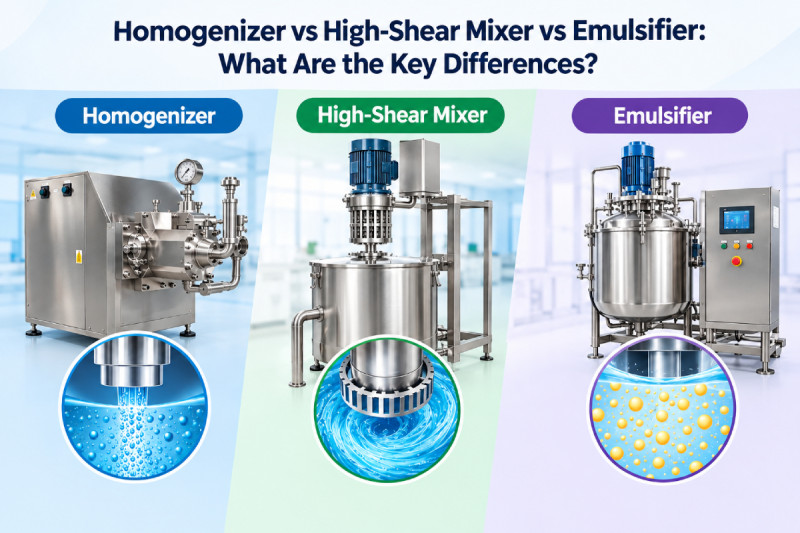
Choose an industrial homogenizer when the process needs controlled dispersion, emulsification, or particle-size reduction at production scale. A high-shear mixer is usually the better fit when the main job is fast mixing or dispersion. An emulsifier is normally built around one specific emulsification process; it is not a general name for any homogenizing machine.
Much of the confusion comes from the names. Suppliers use all three loosely. Many machines sold as a "high shear homogenizer", "homogenizing mixer" or "emulsifier machine" share the same working part, a rotor spinning inside a slotted stator. The real differences come down to three things:
- How much energy goes into a small shear zone
- How uniform the final droplet or particle size must be
- Whether the process runs in batches or continuously
So start with the end product, not the machine name. Does it need a uniform blend, a stable emulsion, or a specified droplet or particle size? The answer usually points to the right equipment. This article explains the engineering behind each option, compares them side by side, and maps typical applications to the equipment that suits them. For the fundamentals of each technology, start with what is a homogenizer.
How each machine works
In the homogenizer vs high shear mixer comparison, the difference is mainly about intensity and control, not about completely different technology. Both break down droplets and agglomerates. A homogenizer aims for a finer, more consistent result. A high-shear mixer aims for a fast, thorough mix.
High-shear mixer
A high-shear mixer uses a rotor turning at high speed inside a close-fitting stator. The rotor draws material into the head and forces it through a narrow gap and the stator's openings. This creates intense local shear and strong circulation through the rest of the batch.
High shear mixing is typically used to:
- Wet out and disperse powders without lumps
- Break up agglomerates
- Create coarse to moderately fine emulsions
- Shorten batch time compared with a conventional agitator
For comparing rotor-stator machines, tip speed is more useful than RPM: \text{Tip speed (m/s)} = \frac{\pi \times D \times \text{RPM}}{60}
In this formula, D is the rotor diameter in metres. For example, a 40 mm rotor at 15,000 RPM runs at about 31 m/s. A larger rotor reaches the same tip speed at a lower RPM. This is why RPM figures alone can mislead when you compare a lab unit with a production unit.
Homogenizer
A homogenizer is designed for particle size reduction and to more uniformly distribute droplets, particles, or agglomerates. What it can achieve depends on the homogenizer technology, head design, process conditions, and formulation. The term covers three main technologies:
- Rotor-stator (high shear) homogenizer: It works like a high-shear mixer but usually has tighter clearances, higher tip speed, and finer generator heads. Some designs use multi-stage heads. This is the most common homogenizer machine used in pharma, cosmetics, and lab work.
- High-pressure homogenizer: A pump forces the liquid through a narrow valve at high pressure. In suitable formulations, high-pressure homogenizers can achieve very fine and relatively consistent droplet sizes. That is why they are widely used in dairy processing and in some emulsion and cell-disruption processes. The trade-off is that high-pressure homogenizers generally need a pre-mixed, pumpable feed.
- Ultrasonic homogenizer: It uses cavitation from a vibrating probe and is mostly used for lab samples, cell lysis, and small batches.
We compare these technologies in more depth in high-shear vs high-pressure homogenizers and rotor-stator vs ultrasonic homogenizers.
Emulsifier
A homogenizer vs emulsifier comparison starts with the application: an emulsifier machine is equipment configured for one job, combining two liquids that don't normally mix, such as oil and water, into a stable emulsion. It usually isn't a separate mechanism.
In most cases, the homogenizer machine is a rotor-stator homogenizer combined with some of these:
- A process vessel
- A slow scraper or anchor agitator for thick products
- A heating and cooling jacket
- Vacuum, which prevents air from being drawn into creams and lotions
There is also a naming trap. In food, cosmetic, and chemical formulation, "emulsifier" also means an ingredient, a surfactant that stabilises the emulsion. Searches for "homogenizer vs emulsifier" mix both meanings. This article is about emulsification equipment, not the ingredient.
Where the three overlap
A homogenizer vs mixer comparison shows that a rotor-stator machine can mix, emulsify, and reduce particle size.
The label depends mostly on:
- How hard the machine is run
- How fine the result needs to be
- What is built around it
That is why, in a high shear mixer vs homogenizer comparison, a "homogenizing mixer" or "high shear homogenizer" usually means a rotor-stator design intended for finer results than a standard high-shear mixer.
Homogenizer vs high shear mixer vs emulsifier: comparison table
In a homogenizer vs emulsifier comparison, both can support emulsification, but they differ in how fine and consistent the result is, how they handle viscosity, and what the machine is built around.
|
Requirement |
Homogenizer |
High-shear mixer |
Emulsifier |
|
Primary objective |
Controlled size reduction and dispersion |
Mixing, dispersion and deagglomeration |
A complete system for making a specific emulsion |
|
Emulsification |
✓ |
✓ |
✓ (primary purpose) |
|
Particle size reduction |
✓; very fine results are possible with high-pressure designs, depending on the formulation |
✓, coarse to moderate |
Depends on the application |
|
Rapid mixing and powder wetting |
Depends on the application |
✓ |
Depends on the application |
|
Droplet size consistency |
Typically high |
Moderate; depends on time and number of passes |
Depends on the homogenizer head and process |
|
High-viscosity products |
Rotor-stator types can suit, with a feed pump inline; high-pressure types need a pumpable feed |
Suits many products; bulk movement may need a second agitator |
Often has a scraper or anchor agitator for thick creams |
|
Continuous processing |
✓ with inline systems |
Possible (inline rotor-stator) |
Possible |
|
Batch processing |
✓ |
✓ |
✓ |
|
Typical add-ons |
Multi-stage heads, feed pumps, recirculation loop |
Mixing stand, lifting mechanism |
Vessel, vacuum, jacket, scraper agitator |
|
Best choice depends on |
The product and process specification |
The mixing and shear requirement |
The emulsion and formulation |
Which equipment should you choose: homogenizer vs high shear mixer?
Choose a high-shear mixer when:
- The main objective is rapid mixing
- Powder wetting is the main challenge
- There is no strict droplet-size specification
- Deagglomeration is enough to meet the product requirement
Choose a homogenizer when:
- The process requires controlled reduction of particle or droplet size
- roplet-size consistency matters from batch to batch
- The process needs higher, more concentrated shear
- You need batch or inline homogenization as a defined process step
Choose an emulsifier system when:
- The product is a cream, lotion, ointment or similar formulation
- Vacuum is required to keep air out
- Heating and cooling are part of the process
- A scraper or anchor agitator is needed to move viscous material
The sections below explain how installation, industry and product requirements refine that first choice.
Batch or inline, lab or production
How the machine is installed affects the result about as much as which machine you choose.
Batch homogenizers
A batch unit, such as a top-entry homogenizer mounted on a vessel or a mixing stand, works on the whole batch in place. It is simple and flexible, and it suits plants that make many products in smaller volumes.
The limitation is that material passes through the shear head at random. Some fluid passes through many times and some only a few, so the size distribution depends on run time and on how well the batch circulates.
Inline homogenizers
An inline homogenizer sits in the pipeline, and the product is pumped through the rotor-stator head. Every part of the product passes through the shear zone a controlled number of times. As a result, inline systems usually give more repeatable droplet sizes, and they scale up by flow rate rather than vessel size.
Common set-ups:
- Single pass. The product goes through the head once on its way to the next step.
- Recirculation loop. The product runs from the vessel through the head and back, as many times as the process needs.
- Multi-stage heads. Two or more stator rings in series narrow the size distribution in one pass.
Thick products may need a separate feed pump. Most rotor-stator heads can pump thin liquids but lose throughput as viscosity rises.
Laboratory to production scale-up
A laboratory homogenizer machine is where most formulations start, whether a handheld unit, a lifting-stand model, or an ultrasonic probe. When you scale up, matching RPM is rarely enough.
To reproduce a lab result at production size, engineers usually compare:
- Tip speed
- Energy input per unit volume
- Number of passes through the shear zone
The result should then be confirmed with trials on the actual product.
Which one fits your industry?
Pharmaceutical
In pharma, the choice is driven by repeatability and cleanability as much as by shear.
- Creams, ointments, gels, and oral suspensions. Rotor-stator homogenizers, batch or inline, are commonly used for these. Calling a machine a "pharmaceutical homogenizer" describes the application, not its regulatory suitability. It disperses the API and gives consistent droplet sizes.
- Sub-micron and parenteral emulsions. These typically move to high-pressure homogenization.
Key checks:
- Sanitary product-contact design
- Surface finish
- Ease of cleaning
- Documentation you can use in validation
Confirm material certificates and compliance documents for the specific model rather than assuming them.
Cosmetics
Creams and lotions are a classic emulsification equipment application.
A cosmetic homogenizer or emulsifier machine runs in a vessel with the following:
- Vacuum, to keep air out of the product
- A heating and cooling jacket for the oil and water phases
- A scraper agitator, because the product thickens as it cools
A standalone high-shear mixer can make simple lotions. However, stiff creams usually need the full vacuum emulsifying set-up to stay smooth and air-free.
Food and beverage
Food covers the whole range of equipment:
- Sauces, dressings, mayonnaise and flavour emulsions. These are often made with rotor-stator mixers or homogenizers.
- Dairy. Milk homogenization relies on high-pressure homogenizers to reduce fat globules so they don't separate.
- Powdered ingredients. Stabilisers, proteins and sugars benefit from high shear mixing, which wets them quickly without lumps.
Hygienic design and cleaning in place matter as much as performance.
Chemical processing
Paints, coatings, inks, adhesives, agrochemical emulsions and polishes mostly need two things. The first is dispersion of pigments or fillers. The second is stable emulsions at medium to high viscosity.
An industrial homogenizer or high-shear mixer does most of this work. Inline units suit high-volume continuous lines. Check how the machine handles solvents, abrasive fillers, and viscosity changes during the batch. For flammable atmospheres, confirm the drive and area classification. Rely on explosion-protection ratings only where the specific product's documentation states them.
Laboratory and R&D
A laboratory homogenizer covers three kinds of work:
- Formulation development. Lab rotor-stator homogenizers and lifting-stand models are used across a wide range of sample volumes.
- Tissue homogenization and cell lysis. Handheld rotor-stator units and ultrasonic homogenizers suit small samples.
- Pilot batches. Small emulsifier systems produce trial batches that show how a product will behave at scale.
Choose a lab unit with a generator head design that can be matched to an industrial homogenizer at larger scale. This makes the jump to production easier.
How to choose, and where SAN's range fits
Work through these questions in order:
- What must the finished product achieve? The answer may be a uniform blend, a stable emulsion, or a specified droplet or particle size.
- What is the viscosity at the start and at the end? Many emulsions thicken as they form or cool.
- What is the batch size or flow rate?
- Batch or continuous? Consider how many products share the equipment and how often you change over.
- What are the hygiene and cleaning requirements?
- What do trials on your own product show? Emulsion behaviour depends heavily on the formulation, so testing on the real product is the most reliable way to confirm a choice.
With those answers, the table below gives a starting point. Figures are as published on SAN's product pages and vary by model.
|
Your requirement |
Equipment to investigate |
SAN product (published figures) |
|
Small samples, tissue work, quick dispersion |
Handheld rotor-stator homogenizer |
HR-6B handheld tissue homogenizer: up to 35,000 RPM, 0.2–150 ml depending on head |
|
Lab formulation and R&D batches |
Lab high shear homogenizer |
HUXI Supreme: 2,500–30,000 RPM, 0.2–15,000 ml. HR-500 series: 31,000 RPM, 7,000 ml |
|
Cell disruption, concentrated or larger lab samples |
Ultrasonic homogenizer |
HXR-2000 ultrasonic emulsifier, which combines ultrasonic and high-speed emulsifying |
|
Cosmetic creams and lotions, lab to pilot |
Emulsifier system |
1 L / 2 L vacuum emulsification reactor. JRJ300-SL cosmetic emulsifier: 15,000 RPM, 40 L |
|
Pilot-scale emulsions |
Pilot homogenizing mixer / high-shear emulsifier |
50 L pilot dispersing emulsifier: 50 L, listed for 8,000 mPa·s |
|
Production batches in a vessel |
Top-entry homogenizer |
|
|
Continuous or recirculation processing |
Inline homogenizer |
Single-stage inline homogenizer, multistage inline homogenizer and sanitary-design inline homogenizer |
|
High-viscosity inline products |
Inline homogenizer with a feed pump |
For the full range, see SAN homogenizers, laboratory homogenizers and inline homogenizers.
Common selection mistakes
- Buying on RPM alone. Tip speed, rotor-stator gap, and head design determine shear. RPM doesn't tell you enough on its own.
- In a homogenizer vs mixer comparison, specifying a homogenizer where a mixer would do. If there is no droplet-size target, a high-shear mixer is often simpler and cheaper to run.
- Using a high-shear mixer where a size specification exists. If the specification sets a tight droplet or particle size range, a mixer may struggle to hit it consistently from batch to batch.
- Ignoring viscosity changes. A product that thickens during the batch can stall circulation, and the homogenizer then works only on material near the head.
- Scaling up by matching RPM. Lab results rarely transfer that way.
- Skipping product trials. Formulation affects emulsion stability as much as the machine does.
Frequently asked questions
Homogenizer vs high shear mixer: Are they the same?
Not quite. In a high shear mixer vs homogenizer comparison, a high-shear mixer focuses on fast mixing and dispersion. A homogenizer focuses on controlled, consistent reduction of droplet or particle size. Rotor-stator machines can do both, which is why the terms overlap.
Homogenizer vs mixer: what is the difference?
In a homogenizer vs mixer comparison, a standard mixer or agitator moves and blends the bulk of the product with low shear. A homogenizer uses high energy for particle size reduction, breaking droplets and particles down to a finer, more uniform size.
What is the difference between a homogenizer and an emulsifier?
A homogenizer describes what the machine does: it homogenizes, or reduces size. An emulsifier machine is equipment configured to make emulsions. It is usually a homogenizer head combined with a vessel, agitator, vacuum, and temperature control. "Emulsifier" can also mean the chemical ingredient that stabilises an emulsion.
Can a high-shear mixer make an emulsion?
Yes. High-shear mixers routinely make emulsions such as sauces, lotions and many chemical emulsions. When the product needs finer droplets or tighter consistency, a homogenizer or a high-pressure stage is typically added.
When do I need a high-pressure homogenizer?
A high-pressure homogenizer may be appropriate when the product requires very fine or sub-micron droplet sizes and a narrow size distribution. Dairy, some nanoemulsions, and cell disruption are common examples. The final choice depends on formulation, viscosity, feed characteristics, throughput and process requirements. The feed usually needs to be pre-mixed and pumpable.
What is an inline homogenizer?
An inline homogenizer is a rotor-stator homogenizer installed in the pipeline, with the product pumped through it. It gives controlled passes through the shear zone. It suits continuous production and recirculation around a vessel.
Which homogenizer is best for a laboratory?
It depends on sample volume and purpose. Handheld rotor-stator units suit small tissue and sample work. Stand-mounted lab high shear homogenizers suit formulation work. Ultrasonic homogenizers suit cell lysis.
Next step
If you are unsure which equipment your process needs, contact SAN's team with the following details:
- Product type
- Viscosity range
- Batch size or flow rate
- Target droplet or particle size, if you have one
- Hygiene requirements
They can suggest a starting configuration for an industrial homogenizer and discuss trials.