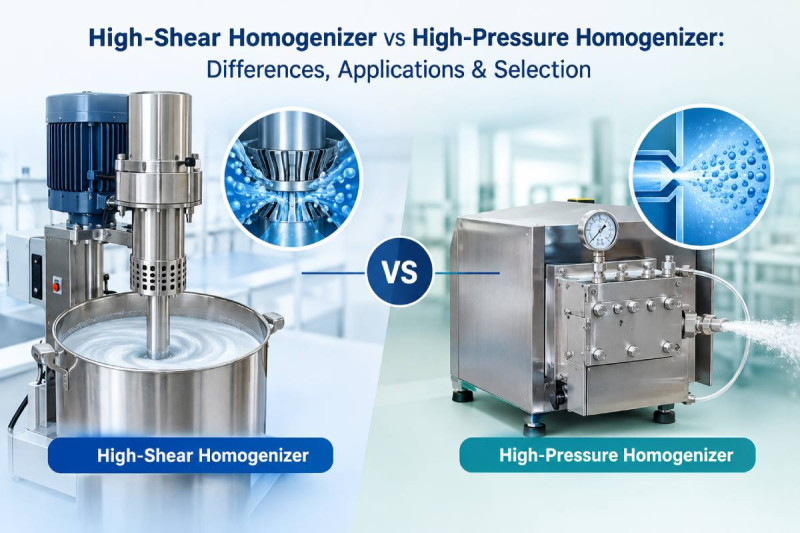
Choosing between a high shear homogenizer vs high pressure homogenizer is not simply a matter of comparing motor power or maximum pressure. The two technologies generate the forces required for homogenization in fundamentally different ways, which affects how they handle emulsification, dispersion, particle size reduction, viscosity, throughput and scale.
A high-shear homogenizer uses mechanical energy, typically a rotor-stator arrangement-to create intense shear and turbulence. A high-pressure homogenizer instead pressurizes the product and forces it through a specialized homogenizing valve or restriction, creating intense hydraulic forces. Both can be used as industrial homogenizer equipment across different homogenizer types, but they are not interchangeable for every process.
This guide compares high shear homogenizer vs high pressure homogenizer technologies, explains how each machine works, where each is commonly used, and provides a practical framework for selecting the right system among different homogenizer types.
High-Shear Homogenizer vs High-Pressure Homogenizer: Quick Answer
The fundamental difference is how processing energy is delivered to the product.
|
Factor |
High-Shear Homogenizer |
High-Pressure Homogenizer |
|
Primary mechanism |
Mechanical shear and turbulence |
Pressure-driven hydraulic forces |
|
Typical processing element |
Rotor and stator |
High-pressure homogenizing valve/restriction |
|
Processing mode |
Batch, recirculation or inline |
Generally continuous/pass-based |
|
Strong application area |
Emulsification, dispersion, deagglomeration |
Fine emulsification and particle-size reduction |
|
Typical equipment architecture |
Motor + rotor/stator |
High-pressure pump + homogenizing stage |
|
Process variable |
Rotor speed, gap, geometry, residence time |
Pressure, flow, valve configuration, passes |
|
Scale-up consideration |
Vessel geometry, power input, shear and circulation |
Pressure, flow, valve design and number of passes |
In simple terms, when comparing a high shear homogenizer vs high pressure homogenizer, choose high shear if the process requires intensive mechanical dispersion or emulsification, and investigate high pressure when pressure-driven processing is better suited to the required particle or droplet size and product characteristics. The final choice should be based on actual formulation trials and process requirements.
What Is a High-Shear Homogenizer?
A high shear homogenizer is a mechanical processing machine and one of the most widely used industrial homogenizer solutions that uses concentrated shear forces to disperse, emulsify, deagglomerate or otherwise process a product. One of the most common configurations is a rotor-stator homogenizer. The rotor rotates at high speed while the stator remains stationary. Product is drawn into the processing head and forced through the narrow region between the rotor and stator.
This creates a combination of:
- Shear
- Turbulence
- Localized velocity gradients
- Mechanical impact
- Intense circulation through the processing zone
These forces can break larger droplets or agglomerates into smaller structures and improve dispersion.
Simplified process
Product → Rotor/Stator Processing Zone → High-Shear Forces → Refined Dispersion/Emulsion The exact result depends on the formulation and machine configuration.
How Does a High-Shear Homogenizer Work?
The basic process can be broken down into four stages.
1. Product enters the homogenizing head
For a batch system, the homogenizing head may be installed inside a vessel. For an inline system, product enters through a process pipeline.
2. The rotor accelerates the product
The rotating rotor creates high local fluid velocity and draws product into the processing zone.
3. Product passes through the rotor-stator gap
The controlled gap produces high velocity gradients and mechanical shear.
The material can undergo:
- Droplet breakup
- Particle dispersion
- Agglomerate breakup
- Phase distribution
4. Processed material leaves the head
The product then returns to the vessel or continues downstream in an inline configuration. Multiple passes or recirculation may be used when the desired processing result is not achieved in a single pass.
What Is a High-Pressure Homogenizer?
A high pressure homogenizer is an industrial homogenizer that uses pressure-driven flow rather than a conventional rotor-stator head as its primary homogenization mechanism. The product is pressurized using a high-pressure pump and forced through a specialized homogenizing valve, narrow passage or restriction. As the pressurized fluid moves through this processing stage, the resulting hydraulic conditions can generate intense turbulence, shear and other disruptive forces. These forces can break down droplets or particles and produce a finer dispersion.
Simplified process
Feed → High-Pressure Pump → Homogenizing Valve → Pressure Drop / High-Energy Zone → Processed Product
The pressure and valve configuration are important process variables.
How Does a High-Pressure Homogenizer Work?
A typical process follows this sequence:
1. Product enters the feed system
The formulation is supplied continuously to the homogenizer.
2. A high-pressure pump raises the pressure
The pump provides the pressure required for the homogenization stage.
3. Product passes through the homogenizing valve
The product encounters a highly controlled restriction. The sudden change in flow conditions creates intense hydraulic processing.
4. Droplets or particles are disrupted
Depending on the formulation and operating conditions, the process can reduce droplet or particle size.
5. Product exits the homogenizer
The product may be collected after one pass or processed through additional passes if required.
High-Shear vs High-Pressure Homogenization: The Main Difference
The easiest way to understand the distinction between a high shear homogenizer vs high pressure homogenizer is to look at where the processing energy is concentrated.
High shear
Energy is concentrated mechanically through a rotor-stator assembly. Rotor → high velocity → narrow gap → shear/turbulence → dispersion
High pressure
Energy is introduced by pressurizing the fluid and forcing it through a specialized restriction. Pump → high pressure → homogenizing valve → pressure-driven disruption → dispersion
Both technologies can produce significant particle or droplet-size reduction, but the process mechanics are different.
High-Shear Homogenizer Applications
Among the various homogenizer types, High-shear homogenization is particularly useful where the process requires strong mechanical dispersion or emulsification, making it a preferred emulsification equipment option for many processing applications.
Typical applications include:
Pharmaceutical formulations
A homogenizer for pharmaceutical industry applications may be considered for:
- Emulsions
- Suspensions
- Creams
- Topical formulations
- Ingredient dispersion
- Laboratory formulation development
The actual equipment configuration must be matched to the formulation and applicable manufacturing requirements.
Cosmetic products
High shear is commonly considered for:
- Creams
- Lotions
- Serums
- Cosmetic emulsions
- Gels
Chemical products
Applications can include:
- Pigment dispersion
- Coatings
- Suspensions
- Chemical formulations
- Liquid-solid dispersion
Food processing
A homogenizer for food industry applications can be used for various emulsification and dispersion processes, depending on the formulation.
Examples include:
- Sauces
- Dressings
- Emulsions
- Ingredient dispersions
- Dairy-related formulations
The appropriate homogenization technology depends on the desired product characteristics rather than the industry name alone.
High-Pressure Homogenizer Applications
Among modern homogenizer types, high-pressure homogenization is often investigated where a process requires fine droplet or particle-size reduction through pressure-driven processing.
Potential applications include:
- Fine emulsions
- Beverage processing
- Pharmaceutical formulations
- Biotechnology processes
- Nanodispersion-related processing
- Food and dairy formulations
- Fine particle dispersions
High-pressure systems can be particularly attractive when the process is designed around continuous operation and controlled pressure. However, pressure alone does not determine final particle size. Formulation properties, pressure level, valve geometry, number of passes and operating conditions all influence the result.
High-Shear Homogenizer vs High-Pressure Homogenizer for Emulsification
Both technologies can be used as emulsification equipment, but the way they approach the emulsification process is different.
High shear for emulsification
A rotor-stator head can rapidly disperse one phase into another, which is why it is widely used as emulsification equipment for batch and inline processing. For example: Oil phase + aqueous phase → rotor/stator → smaller droplets → emulsion High shear can be particularly useful during formulation development and for batch or recirculation processes. It can also provide useful pre-emulsification before another downstream process.
High pressure for emulsification
A high-pressure homogenizer forces the formulation through a controlled high-energy zone. This can produce substantial droplet-size reduction and is often considered as emulsification equipment for continuous production where consistent processing is required.
Which is better?
There is no universal winner. If the objective is rapid batch emulsification, dispersion or deagglomeration, high shear may be the more appropriate technology to investigate. If the process requires continuous high-pressure treatment and a fine dispersion, high-pressure homogenization may be preferable. The required droplet-size distribution should ultimately determine the technology.
High-Shear vs High-Pressure for Particle Size Reduction
Particle size reduction is another area where the two technologies can overlap. High-shear equipment can break down agglomerates and disperse solids through mechanical shear and turbulence. High-pressure systems can use hydraulic forces generated during pressure-driven flow to disrupt particles or droplets. But "smaller" is not enough as a process specification.
A useful engineering specification should define:
- Starting particle size
- Target particle size
- Particle-size distribution
- Required throughput
- Product viscosity
- Number of passes
- Temperature limitations
- Stability requirements
For difficult formulations, laboratory testing is often more useful than selecting equipment based solely on catalogue specifications.
High-Shear Homogenizer vs High-Pressure Homogenizer for Viscous Products
Viscosity is an important selection variable. As viscosity increases, the behaviour of the material through the processing zone changes.
A process engineer should provide the supplier with:
- Minimum viscosity
- Normal operating viscosity
- Maximum viscosity
- Processing temperature
- Required flow rate
A high-shear system may be attractive for certain viscous batch formulations, while a pressure-driven system may be more suitable for another formulation.
There is no universal viscosity threshold at which one technology automatically becomes better. The product rheology and required process result need to be evaluated together.
Batch vs Continuous Processing
This distinction can significantly influence the choice.
High-shear homogenizer
High-shear machines can be configured for:
- Batch processing
- Recirculation
- Inline processing
A vessel-mounted rotor-stator head can process a formulation inside the tank. An inline high-shear homogenizer can instead process the material as it moves through a pipeline.
High-pressure homogenizer
High-pressure homogenization is generally designed around continuous product flow through the high-pressure processing stage.
This makes it attractive for production processes where:
- Continuous operation is preferred
- High throughput is required
- Multiple passes can be controlled
- The process is already configured around pumps and pipelines
High-Shear Homogenizer vs High-Pressure Homogenizer: Equipment Design
The difference becomes clearer when looking at the machine architecture.
High-shear system
A typical system may contain:
- Drive motor
- Shaft
- Rotor
- Stator
- Mechanical seals
- Vessel or pipeline
- Product-contact components
The critical processing variables include:
- Rotor speed
- Rotor/stator geometry
- Gap
- Processing time
- Recirculation rate
- Product viscosity
High-pressure system
A typical system may contain:
- Feed system
- High-pressure pump
- Pressure-control arrangement
- Homogenizing valve
- Product-contact components
- Cooling system where required
- Instrumentation
The critical variables include:
- Homogenization pressure
- Flow rate
- Valve configuration
- Number of passes
- Product temperature
- Product rheology
Which One Is Better for Pharmaceutical Manufacturing?
The answer depends on the pharmaceutical formulation and manufacturing process.
A homogenizer for pharmaceutical industry applications may need to satisfy additional requirements around:
- Product-contact materials
- Cleanability
- Surface finish
- Seals
- Containment
- Cleaning procedures
- Validation requirements
- Documentation
- Batch or continuous production
- Temperature control
A high-shear system can be appropriate for many emulsification, dispersion and formulation processes. A high-pressure system can be appropriate when the process specifically requires pressure-driven particle or droplet-size reduction. Neither should be selected simply because it is marketed as a "pharmaceutical homogenizer." The formulation and process requirements should drive the decision.
High-Shear Homogenizer vs High-Pressure Homogenizer for Food Processing
Food processing introduces another set of requirements.
A homogenizer for food industry applications may need to consider:
- Product viscosity
- Particle size
- Fat/oil phase
- Product temperature
- Throughput
- Cleaning requirements
- Product-contact materials
- Continuous vs batch operation
For example, a formulation requiring continuous processing at high throughput may favour an inline or high-pressure configuration. A smaller batch formulation requiring intensive dispersion may favour high shear. Again, the process determines the equipment.
Decision Table: Which Homogenizer Should You Choose?
Use the following as a starting point rather than a final equipment specification.
|
Requirement |
High-Shear Homogenizer |
High-Pressure Homogenizer |
|
Batch processing |
Strong fit |
Possible, but typically process-flow based |
|
Continuous production |
Possible/strong with inline design |
Strong fit |
|
Intensive emulsification |
Strong fit |
Strong fit |
|
Fine particle-size reduction |
Possible |
Strong candidate |
|
Deagglomeration |
Strong fit |
Possible |
|
Liquid-liquid dispersion |
Strong fit |
Strong fit |
|
Solid-liquid dispersion |
Strong fit |
Application dependent |
|
Laboratory development |
Strong fit |
Available in specialised configurations |
|
Large-scale production |
Strong fit |
Strong fit |
|
Recirculation processing |
Strong fit |
Possible |
|
Process built around high pressure |
Not primary approach |
Strong fit |
|
Simple batch formulation |
Strong fit |
Usually less direct |
|
Very fine emulsification requirement |
Application dependent |
Strong candidate |
A Practical High-Shear vs High-Pressure Selection Process
Instead of beginning with the machine, begin with the product.
Step 1: Define the process objective
Is the objective:
- Emulsification?
- Dispersion?
- Particle-size reduction?
- Deagglomeration?
- Cell disruption?
- Dissolution?
- Suspension formation?
This immediately narrows the technology options.
Step 2: Characterise the material
Determine:
- Viscosity
- Density
- Particle size
- Solid concentration
- Liquid phases
- Temperature
- Sensitivity to heat
- Sensitivity to shear
The same homogenizer can perform differently with different formulations.
Step 3: Establish the target result
Specify the desired:
- Particle size
- Droplet size
- Distribution
- Stability
- Product texture
- Dispersion quality
Without a measurable target, it is difficult to determine whether homogenization is actually successful.
Step 4: Determine production scale
Establish:
- Laboratory volume
- Pilot volume
- Batch volume
- Continuous flow rate
- Required production hours
- Required processing time
A high shear homogenizer machine used for laboratory formulation development should not automatically be scaled to production simply by installing a larger motor.
Step 5: Decide batch or continuous
If the process is fundamentally batch-based, a vessel-mounted high-shear homogenizer may be a logical starting point. If the process is continuous, investigate inline high shear or high-pressure technology.
Step 6: Evaluate heat generation
Both technologies can introduce energy into the product.
Check:
- Maximum allowable temperature
- Cooling requirements
- Processing time
- Number of passes
- Product thermal sensitivity
This can be particularly important for pharmaceutical and food formulations.
Step 7: Evaluate hygienic design
For hygienic applications, assess:
- Product-contact materials
- Surface finish
- Seal configuration
- Connections
- Cleanability
- Drainability where relevant
- Cleaning procedure
- Inspection access
Do not assume a generic "sanitary" description is sufficient. The exact equipment configuration should be reviewed against the application's requirements.
SAN Industries: High-Shear and High-Pressure Homogenization
SAN Industries has a broader homogenizer product ecosystem covering laboratory, pilot-scale, top-entry and inline homogenization equipment. Its current high-shear range includes laboratory and pilot-scale models intended for processes such as mixing, emulsification, homogenization, disintegration and dissolution. Its industrial range includes top-entry homogenizers and inline homogenizing systems.
For example, SAN's published SAN WRL Homogenizer Series covers model-dependent working-volume ranges from approximately 10–50 L through 1,500–5,000 L, with published power and speed varying by model. SAN also publishes inline homogenizing systems, including single-stage and multistage rotor-stator configurations.
This range is useful because it allows the selection discussion to move from general homogenizer technology into the actual process requirements: batch volume, flow rate, shear requirement, formulation properties and desired processing result. For a specific application, the final model should be selected using the actual product data and required process performance rather than simply choosing a machine based on nominal motor power or capacity.
Common Mistakes When Choosing Between High Shear and High Pressure
1. Choosing the highest power
More power does not automatically mean better homogenization.
2. Choosing the highest pressure
Likewise, maximum pressure does not automatically produce the required product.
3. Looking only at final particle size
The method used to reach the target can affect temperature, stability, throughput and energy consumption.
4. Ignoring viscosity
A machine's performance can change significantly as formulation viscosity changes.
5. Scaling directly from laboratory results
Laboratory and production systems operate at different scales and may have different power density, circulation and processing conditions.
6. Ignoring the number of passes
Some formulations require multiple processing passes to achieve the desired result.
7. Treating every formulation as an emulsion
A dispersion, suspension, emulsion and cell-disruption process can have very different equipment requirements.
High-Shear Homogenizer vs High-Pressure Homogenizer: Final Decision Framework
If you are still unsure which technology to investigate, use this sequence:
Need intensive mechanical dispersion or batch emulsification?
Start with high-shear homogenization.
Need continuous pressure-driven processing and fine particle/droplet reduction?
Investigate high-pressure homogenization.
Need continuous mechanical processing integrated into a process line?
Consider an inline high-shear homogenizer.
Need laboratory formulation development?
Start with a suitable laboratory homogenizer, then establish a scale-up route.
Need production-scale processing?
Evaluate both technology and configuration against actual throughput, viscosity and target product specifications.
Frequently Asked Questions
What is the difference between a high shear homogenizer and a high pressure homogenizer?
A high-shear homogenizer uses mechanical shear, usually through a rotor-stator assembly, while a high-pressure homogenizer uses pressure-driven flow through a specialized homogenizing valve or restriction.
Is high shear better than high pressure for emulsification?
Not universally. High shear can be highly effective for batch and inline emulsification, while high pressure can be advantageous for continuous processing and fine droplet-size reduction. The formulation and target result determine which is more appropriate.
Which is better for particle size reduction?
Both can reduce particle or droplet size. High-pressure homogenization is often considered when very fine size reduction is required, while high-shear equipment can effectively break agglomerates and disperse particles. Actual performance must be established for the specific material.
Which homogenizer is better for pharmaceutical applications?
Both technologies can be used in pharmaceutical processing. Selection should consider formulation properties, target particle/droplet size, throughput, temperature, cleaning, product-contact materials, containment and applicable manufacturing requirements.
Can a high-shear homogenizer replace a high-pressure homogenizer?
Not necessarily. The machines use different processing mechanisms and may produce different results for the same formulation. A process trial is often needed before treating one technology as a substitute for the other.
Is a rotor-stator homogenizer a high-shear homogenizer?
Yes. Rotor-stator systems are a common type of high-shear homogenizer, where a rotating rotor and stationary stator create an intensive mechanical processing zone.
Conclusion
The choice between a high shear homogenizer vs high pressure homogenizer should be based on process requirements rather than a simple specification comparison. A high-shear system uses a rotor-stator or similar mechanical arrangement to generate intense shear and turbulence. It can be particularly useful for batch processing, emulsification, dispersion and deagglomeration. A high-pressure homogenizer uses pressure-driven flow through a specialized homogenizing stage.
It can be attractive for continuous processing and applications requiring fine particle or droplet-size reduction. The correct selection should therefore follow: Product → Process Objective → Particle/Droplet Target → Viscosity → Batch/Continuous → Throughput → Temperature → Homogenization Technology → Equipment Configuration. For pharmaceutical, food, cosmetic or chemical production, this process-first approach is more reliable than choosing equipment based only on maximum RPM, motor power or pressure.