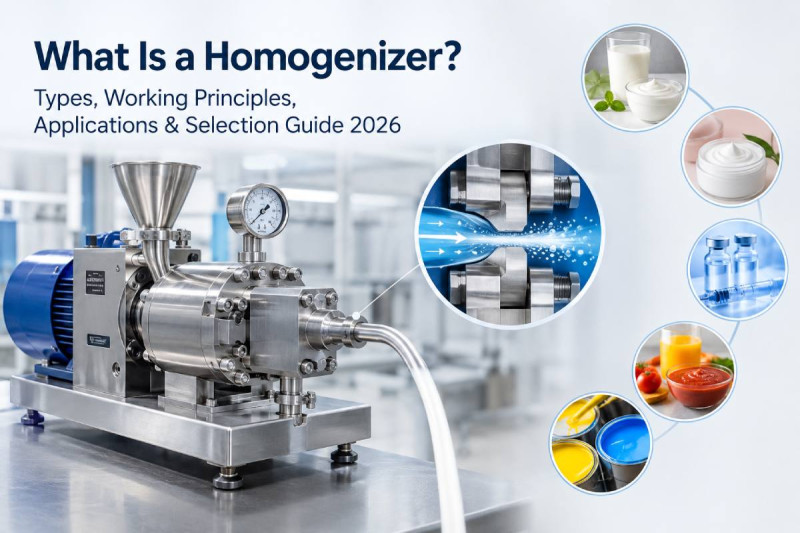
A homogenizer is a processing machine used to reduce particle or droplet size, disperse one phase into another, break down agglomerates, and produce a more uniform mixture or emulsion. Depending on the technology, homogenization can be achieved through high shear, pressure-driven flow, rotor-stator action, ultrasonic energy, or a combination of process forces.
That distinction matters because homogenizer machine is a broad term. A laboratory homogenizer used for small samples is not selected or operated in the same way as an industrial homogenizer processing hundreds or thousands of litres. The right machine depends on what the process actually needs: droplet-size reduction, particle dispersion, emulsification, cell disruption, dissolution, deagglomeration, or simply improved mixing.
SAN Industries' current homogenizer range includes top-entry homogenizers and inline homogenizers, while its high-shear range includes laboratory, pilot-scale and other models for mixing, emulsification, dispersion, disintegration and dissolution. This guide explains what a homogenizer does, how the main technologies work, how homogenization differs from ordinary mixing, and how to select a suitable system.
What Does a Homogenizer Do?
A homogenizer applies mechanical or other controlled processing forces to reduce particle or droplet size and create a more uniform dispersion, suspension or emulsion.
Depending on the equipment, those forces may include:
- Shear
- Turbulence
- Pressure drop
- Cavitation
- Impact
- Mechanical disruption
- Hydraulic forces
The objective is usually not merely to make ingredients move around a tank.
For example, if oil and water are mixed with an ordinary agitator, the two phases may eventually distribute throughout the vessel but still form relatively large droplets that separate over time. A homogenizer can apply substantially higher local energy to the material, breaking larger droplets into smaller ones and producing a finer dispersion.
This is why homogenizers are used for processes such as:
- Emulsification
- Dispersion
- Particle-size reduction
- Deagglomeration
- Suspension formation
- Disintegration
- Dissolution
- Cell disruption
- Product texture modification
The exact result depends on the homogenizer technology and process conditions.
Homogenization vs Mixing: What Is the Difference?
This is one of the most important distinctions when selecting equipment.
Mixing
A mixer primarily aims to distribute materials throughout a vessel.
Examples include:
- Blending two liquids
- Suspending solids
- Maintaining uniform concentration
- Combining ingredients
- Maintaining temperature uniformity
Homogenization
Homogenization generally involves applying more concentrated processing energy to alter the dispersion itself, for example, reducing droplet or particle size.
A useful way to think about it is: Mixing distributes material. Homogenization changes the scale and uniformity of the dispersed phase.
The two operations can overlap. A homogenizer can perform mixing, and many commercial machines are marketed for mixing, emulsification, and dispersion together. SAN's high-shear range, for example, is described for mixing, emulsification, homogenization, disintegration and dissolution. But a conventional agitator should not automatically be considered a homogenizer.
How Does a Homogenizer Work?
The exact working principle depends on the type of homogenizer.
A typical mechanical homogenization process can be understood in four stages:
1. Material enters the processing zone
The material may be inside a vessel for a top-entry machine or move continuously through an inline homogenizer.
2. Energy is introduced
The homogenizer applies a controlled processing force to the material.
- In a rotor-stator machine, this occurs as material passes through the narrow clearance between a rotating rotor and stationary stator.
- In a high-pressure homogenizer, fluid is forced through a specialized homogenizing valve or restriction under high pressure.
- In an ultrasonic homogenizer, acoustic energy creates intense localized effects within the liquid.
3. Particle or droplet structure changes
Depending on the process, the applied energy can:
- Break droplets into smaller droplets
- Disperse particles
- Break agglomerates
- Disintegrate structures
Improve suspension uniformity
4. Material exits with the required degree of processing
The result may be a finer emulsion, more uniform suspension, improved dispersion or reduced particle size. The required number of passes, residence time and energy input depend on the formulation and desired result.
Main Types of Homogenizers
There is no single "best homogenizer."
The major technologies include:
|
Homogenizer type |
Main processing mechanism |
Typical strength |
|
High-shear homogenizer |
Intense mechanical shear |
Emulsification, dispersion, deagglomeration |
|
Rotor-stator homogenizer |
Rotor/stator shear and turbulence |
Liquid-liquid and solid-liquid processing |
|
High-pressure homogenizer |
Pressure-driven flow through a homogenizing valve/restriction |
Fine emulsions and particle-size reduction |
|
Inline homogenizer |
Continuous in-line mechanical processing |
Continuous production |
|
Ultrasonic homogenizer |
High-frequency acoustic energy/cavitation |
Laboratory-scale disruption and dispersion |
|
Laboratory homogenizer |
Small-scale mechanical or ultrasonic processing |
R&D, sample preparation and formulation development |
|
Industrial homogenizer |
Production-scale processing |
Larger batches and continuous manufacturing |
These categories can overlap. For example, an inline homogenizer may use rotor-stator technology, while a laboratory homogenizer can also be a high-shear or ultrasonic device.
1. High-Shear Homogenizer
A high shear homogenizer uses intense mechanical shear to process material. A common configuration uses a rotor and stator. The rotating element creates high local velocity while the stationary element provides a controlled gap through which material passes.
This can create:
- High shear
- Turbulence
- Rapid circulation
- Droplet breakup
- Particle dispersion
- Agglomerate reduction
High-shear homogenizers are widely considered when the process requires more intensive treatment than a conventional agitator can provide.
Typical applications include:
- Emulsions
- Creams
- Lotions
- Suspensions
- Coatings
- Chemical formulations
- Pharmaceutical formulations
- Cosmetic products
- Food products
SAN currently lists laboratory and pilot-scale high-shear homogenizer models. Its published range includes the HRF-40AS, HRF-30AS, HR-25, HR-500, pilot-scale and other models.
2. Rotor-Stator Homogenizer
A rotor stator homogenizer is one of the most common mechanical approaches to high-shear processing. The rotor rotates at high speed inside or near the stator. Material is drawn into the processing head and forced through the rotor-stator gap.
A simplified flow path is: Vessel → Rotor/Stator Head → High-Shear Zone → Dispersed Material The geometry of the head, rotor speed, gap, number of stages and material properties all influence the resulting process.
Rotor-stator systems are useful for:
- Emulsification
- Dispersion
- Deagglomeration
- Solid-liquid mixing
- Liquid-liquid processing
- Particle-size reduction
One important point: rotor-stator equipment is not automatically equivalent to a high-pressure homogenizer. The two technologies use different mechanisms and should be selected according to the required process result.
3. High-Pressure Homogenizer
A high pressure homogenizer uses pressure rather than a conventional rotor-stator head as its primary means of generating the homogenization effect.
The fluid is pressurized and forced through a specialized homogenizing valve or restriction. As the fluid passes through the high-energy region, pressure reduction, turbulence, shear, and other hydraulic effects can contribute to particle or droplet disruption.
High-pressure homogenization is often considered when very fine emulsions or controlled particle-size reduction are required. However, it is a fundamentally different machine architecture from a top-entry high-shear homogenizer.
High shear vs high pressure
|
Factor |
High-shear homogenizer |
High-pressure homogenizer |
|
Main mechanism |
Mechanical shear |
Pressure-driven flow |
|
Typical configuration |
Vessel-mounted or inline |
Pump + high-pressure homogenizing stage |
|
Best suited to |
Dispersion, emulsification, deagglomeration |
Fine emulsification and particle-size reduction |
|
Processing environment |
Batch or continuous |
Usually continuous/pass-based |
|
Selection focus |
Rotor/stator, speed, geometry |
Pressure, flow, valve design, number of passes |
The right choice should be based on the target particle/droplet size and formulation, not simply on which machine has the higher advertised power.
4. Inline Homogenizer
An inline homogenizer processes material continuously as it flows through the machine. Instead of placing the homogenizing head inside a batch vessel, the processing unit becomes part of the product circulation or transfer line. A simplified process looks like: Tank → Pump → Inline Homogenizer → Process Line / Tank
This arrangement can be useful when:
- Continuous production is required
- Recirculation is desirable
- Large batch volumes need processingThe homogenizer must integrate into an existing process line
- The process requires controlled in-line treatment
SAN offers inline homogenizing pumps in its current product range. Its SAN-JZ1 single-stage system is described as an in-line continuous production emulsifying homogenizing pump using rotor and stator stages. Published specifications include maximum handling capacity of 65 m³/h and maximum power of 75 kW. SAN also lists a multistage inline homogenization using a total of 12 rotor-stator layers, with published maximum flow of 50 m³/h and maximum power of 55 kW.
5. Ultrasonic Homogenizer
An ultrasonic homogenizer uses high-frequency acoustic energy rather than mechanical rotor-stator shear as the primary processing mechanism. A probe transfers ultrasonic energy into the liquid. Under appropriate conditions, this can generate cavitation, the formation and collapse of microscopic bubbles, which produces intense localized physical effects.
Ultrasonic homogenizers are commonly considered for:
- Laboratory sample preparation
- Cell disruption
- Biological sample processing
- Emulsification
- Dispersion
- Nanoparticle processing
- Deagglomeration
They are particularly relevant when processing volumes are relatively small or when laboratory-scale experimentation is required. They should not automatically be selected for production-scale applications simply because they can achieve strong local processing effects.
6. Laboratory Homogenizer
A laboratory homogenizer is designed for small-volume processing, formulation development, research and testing. The key advantage is control at laboratory scale.
A laboratory machine can be used to evaluate:
- Formulation behaviour
- Rotor/stator configuration
- Processing speed
- Processing time
- Emulsion formation
- Dispersion performance
- Sample stability
SAN's current laboratory/high-shear range includes models with working volumes ranging from very small samples to several litres. For example, its HRF-40AS is published for capacities from 150 ml to 6 litres, while the HR-25 series lists an applicable volume range of 0.2–10,000 ml. This makes laboratory equipment useful before committing to a larger production-scale homogenizer.
7. Industrial Homogenizer
An industrial homogenizer is designed for larger processing volumes, higher throughput, and integration into production equipment.
Industrial systems may be:
- Top-entry
- Inline
- Single-stage
- Multistage
- Batch
- Continuous
The important variables include:
- Flow rate
- Batch volume
- Motor power
- Rotor speed
- Number of processing stages
Product viscosity - Required particle/droplet size
- Temperature
- Pressure
- Product-contact materials
- Required processing time
SAN's WRL range is a current example of top-entry industrial homogenizing equipment. Published variants range from 10–50 L up to 1,500–5,000 L, with listed power from 2 to 50 hp and speeds from 2,800 to 1,400 rpm depending on the model. These published figures demonstrate why homogenizer selection should be based on process volume and required processing conditions, rather than simply choosing the largest motor.
What Is a Homogenizer Used For?
A homogenizer can be used whenever the process requires more controlled dispersion or size reduction than ordinary mixing can provide.
Common applications include:
Pharmaceutical Industry
A homogenizer for pharmaceutical industry applications may be used for:
- Emulsions
- Suspensions
- Creams and topical formulations
- Liquid formulations
- Ingredient dispersion
- Product uniformity
- Laboratory formulation development
The exact equipment and configuration depend on the formulation and applicable manufacturing requirements.
Cosmetics
Homogenizers are commonly used for:
- Creams
- Lotions
- Serums
- Emulsions
- Cosmetic gels
High-shear equipment is particularly relevant where oil and water phases need intensive processing.
Food and Beverage
Potential applications include:
- Sauces
- Dressings
- Emulsions
- Dairy-related products
- Beverage formulations
- Ingredient dispersion
Chemical Processing
Homogenizers can assist with:
- Pigment dispersion
- Coatings
- Suspensions
- Chemical formulations
- Fine dispersions
Biotechnology and Laboratory Research
Depending on technology, homogenizers can be used for:
- Cell disruption
- Sample preparation
- Biological tissue processing
- Laboratory emulsification
- Experimental formulation
Homogenizer Selection Guide
Choosing the right homogenizer machine starts with the process, not the catalogue.
1. Define the objective
Ask what the machine must actually achieve.
Is the requirement:
- Mixing?
- Emulsification?
- Particle-size reduction?Deagglomeration?
- Cell disruption?
- Dissolution?
- Suspension?
- Dispersion?
If the actual requirement is only bulk blending, a conventional mixer may be more appropriate than a homogenizer.
2. Define the batch or flow volume
For batch processing, determine:
- Minimum batch
- Normal batch
- Maximum batch
- Vessel volume
- Working volume
For continuous processing, determine:
- Required flow rate
- Operating hours
- Number of passes
- Recirculation requirements
This separates the need for a laboratory homogenizer from an industrial homogenizer.
3. Understand viscosity
Viscosity can dramatically influence homogenizer performance. A machine that works effectively with a low-viscosity liquid may not provide the same result with a highly viscous formulation.
Provide the equipment supplier with:
- Minimum viscosity
- Normal viscosity
- Maximum viscosity
- Temperature at processing conditions
4. Determine the target particle or droplet size
"Homogeneous" is not a sufficiently precise process specification. Ask: What particle or droplet size must the process achieve?
Also establish:
- Distribution requirements
- Stability requirements
- Number of passes
- Processing time
- Acceptable temperature increase
This information can determine whether high shear, high pressure, ultrasonic or another technology is appropriate.
5. Decide between batch and inline processing
Choose a batch homogenizer when:
- Production is batch-oriented
- Formulation takes place inside a vessel
- Flexibility between products is important
- Processing volume varies
Choose an inline homogenizer when:
- Continuous processing is preferred
- High throughput is required
- The homogenizer can be integrated into a circulation loop
- Consistent in-line treatment is needed
6. Consider temperature
High-energy homogenization can introduce heat into the product. This matters for temperature-sensitive formulations.
The selection should therefore consider:
- Starting temperature
- Maximum allowable product temperature
- Processing duration
- Cooling capacity
- Number of passes
For some formulations, cooling may be necessary to maintain product quality.
7. Consider product-contact materials
For pharmaceutical, food, and other hygienic applications, specify:
- Product-contact material
- Surface finish
- Seal materials
- Connection type
- Cleaning requirements
SAN's current single-stage and multistage inline homogenization pages publish options including 304/316L and ASME BPE 316L materials, different surface finishes, single/double seals and thread, clamp, flange and aseptic-flange connections. The product pages also list specific certifications; those should be verified against the exact model and configuration rather than generalized to the entire SAN homogenizer range.
Top-Entry vs Inline Homogenizer
This is a practical choice for production engineers.
|
Requirement |
Top-entry homogenizer |
Inline homogenizer |
|
Processing style |
Batch |
Continuous or recirculating |
|
Installation |
Mounted into vessel |
Installed in process line |
|
Flexibility |
High for batch formulations |
High for integrated process lines |
|
Large vessel processing |
Suitable |
Suitable with appropriate flow system |
|
Continuous production |
Less direct |
Strong fit |
|
Recirculation |
Possible |
Natural configuration |
|
Process integration |
Vessel-centred |
Line-centred |
Neither configuration is universally superior. The choice depends on how the product is manufactured.
How Many Stages Does a Homogenizer Need?
More stages do not automatically mean a better product. A single-stage rotor-stator system may be sufficient for one formulation, while another application may benefit from multiple processing stages. SAN's single-stage inline homogenization uses 6-10 rotor-stator layers, while its multistage JZ3 system is published with 12 layers.
The meaningful question is: What level of processing does the formulation require? The answer should come from product trials and process requirements rather than from stage count alone.
Common Homogenizer Selection Mistakes
Choosing by motor power alone
A larger motor does not automatically produce the desired particle size or emulsion quality.
Treating all homogenizers as interchangeable
High-shear, high-pressure, ultrasonic and inline systems operate differently.
Ignoring viscosity
Processing conditions can change substantially as viscosity increases.
Selecting capacity without testing the product
A published flow rate is not necessarily the actual homogenization throughput for every formulation.
Confusing mixing with homogenization
If the process only requires bulk blending, a mixer may be the more appropriate machine.
Ignoring scale-up
A laboratory formulation that works at 1 litre does not automatically translate directly to a 1,000-litre production vessel.
Scale-up should consider geometry, power input, shear conditions, circulation and processing time.
Which Type of Homogenizer Should I Use?
There is no universal answer, but the following framework is useful:
|
Your requirement |
Technology to investigate |
|
Small laboratory sample |
Laboratory homogenizer |
|
General high-shear dispersion |
High-shear / rotor-stator |
|
Liquid-liquid emulsification |
High-shear or high-pressure, depending on target |
|
Continuous production |
Inline homogenizer |
|
Very fine emulsification / particle reduction |
High-pressure homogenizer |
|
Cell disruption / small-volume research |
Ultrasonic or suitable mechanical homogenizer |
|
Large batch processing |
Industrial top-entry homogenizer |
|
Continuous high-throughput processing |
Industrial inline homogenizer |
Final selection should be confirmed through product trials, technical data and the manufacturer's sizing recommendations.
Homogenizer FAQs
What does a homogenizer do?
A homogenizer applies controlled mechanical, hydraulic or acoustic energy to reduce particle or droplet size, disperse materials, break agglomerates or produce a more uniform emulsion or suspension.
What is a homogenizer used for?
A homogenizer is used for applications such as emulsification, dispersion, particle-size reduction, deagglomeration, dissolution and disintegration across pharmaceutical, cosmetic, food, chemical and laboratory processes.
What is the difference between a mixer and a homogenizer?
A mixer primarily distributes materials throughout a vessel, while a homogenizer applies more intensive processing forces to modify particle or droplet size and improve dispersion.
What is a high shear homogenizer?
A high shear homogenizer uses intense mechanical shear, often through a rotor-stator assembly, to process liquids, solids and liquid-liquid mixtures.
What is an inline homogenizer?
An inline homogenizer is installed in a process pipeline and homogenizes material continuously as it passes through the processing unit. It can also be used in recirculation loops.
What is a high pressure homogenizer?
A high-pressure homogenizer uses pressure-driven flow through a specialized homogenizing stage to generate intense hydraulic forces that can reduce droplet or particle size.
What is a rotor-stator homogenizer?
A rotor-stator homogenizer uses a rotating rotor and stationary stator with a controlled gap. Material passing through this high-shear zone experiences intense mechanical processing.
What is a homogenizer for laboratory applications?
A laboratory homogenizer is a smaller-scale machine used for research, formulation development, sample preparation and process evaluation before or alongside production-scale processing.
Which homogenizer is best?
The best homogenizer depends on the material, viscosity, volume, required throughput, target particle or droplet size, processing temperature, batch/continuous operation and desired outcome. There is no single homogenizer type that is best for every application.
SAN Homogenizer Range
SAN Industries currently positions its homogenizer offering around top-entry and inline homogenization, with additional laboratory and pilot-scale high-shear equipment. Its published product range covers applications involving mixing, emulsification, dispersion, disintegration, and dissolution. For production applications, the SAN WRL top-entry series covers published working-volume ranges from 10–50 L through 1,500–5,000 L, depending on model. For continuous processing, SAN's JZ1 single-stage inline homogenization is published at up to 65 m³/h, while the JZ3 multistage system is published at up to 50 m³/h.
Actual achievable process performance depends on the formulation and operating conditions. For laboratory and pilot work, SAN's current high-shear range includes equipment spanning small sample volumes through pilot-scale processing. The important selection principle is to match the homogenizer technology to the process requirement, not simply to choose the highest speed, largest motor or highest nominal capacity.
Final Takeaway
A homogenizer is a process machine designed to create a controlled level of dispersion, emulsification, particle or droplet-size reduction, or material disintegration. But "homogenizer" describes a family of technologies rather than one machine. A high shear homogenizer is fundamentally different from a high pressure homogenizer. A rotor stator homogenizer can be configured for batch or inline processing, while an ultrasonic homogenizer uses acoustic energy. A laboratory homogenizer is designed around small-scale process development, whereas an industrial homogenizer must be engineered around production volume, throughput, viscosity, heat generation, and process integration.
For that reason, the correct selection sequence is: Process objective → material properties → batch/flow volume → target particle/droplet size → viscosity → processing technology → equipment configuration → materials and hygiene → scale-up validation. That approach gives engineers a much more useful starting point than simply searching for the "best homogenizer machine."