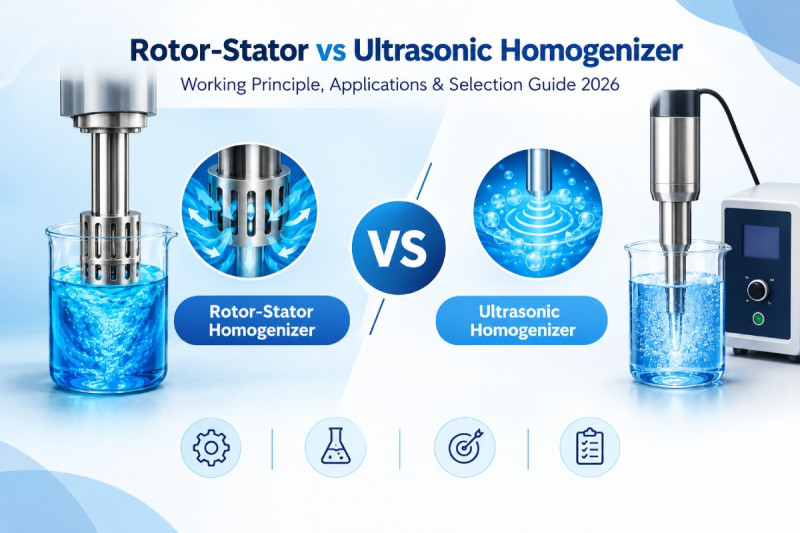
Choosing between a rotor stator homogenizer vs ultrasonic homogenizer depends less on the machine's advertised speed and more on what needs to happen to the material. Both technologies can reduce agglomerates, improve dispersion and process difficult samples, but they do it through fundamentally different mechanisms.
A rotor-stator homogenizer uses mechanical shear and turbulence, while an ultrasonic homogenizer uses high-frequency acoustic energy and cavitation. That difference becomes important when selecting equipment for emulsification, tissue homogenization, cell disruption, cell lysis, laboratory formulation, particle dispersion, or sample preparation.
A rotor-stator system may be the better choice for relatively larger sample volumes, mechanical high-shear processing, and applications that need straightforward scale-up. An ultrasonic homogenizer for laboratory use can be particularly useful for laboratory-scale processing when you need intense localized energy, cell disruption, or acoustic cavitation. There is no universal winner. The correct choice depends on the material, volume, desired result, heat sensitivity, processing time, viscosity and whether the application is laboratory or production scale.
Rotor Stator Homogenizer vs Ultrasonic Homogenizer: Quick Decision Table
|
Selection factor |
Rotor-Stator Homogenizer |
Ultrasonic Homogenizer |
|
Primary mechanism |
Mechanical shear and turbulence |
Acoustic energy and cavitation |
|
Processing element |
Rotor and stator |
Ultrasonic probe/horn |
|
Typical use |
Emulsification, dispersion, deagglomeration |
Cell disruption, lysis, dispersion, emulsification |
|
Laboratory processing |
Excellent |
Excellent |
|
Larger-volume processing |
Strong option |
More application-dependent |
|
Tissue homogenization |
Strong option |
Possible, depending on tissue and objective |
|
Cell disruption |
Possible |
Strong application |
|
Cell lysis |
Possible |
Strong application |
|
Emulsification |
Strong |
Strong for suitable small-scale applications |
|
Scale-up |
Relatively straightforward for appropriate process |
More application-dependent |
|
Heat generation |
Possible |
Can be significant in localized processing |
|
Main selection variables |
Speed, geometry, gap, time, volume |
Amplitude, pulse, time, probe size, volume |
|
Best starting point |
Mechanical dispersion and high-shear processing |
Acoustic disruption and laboratory processing |
Quick rule: If your primary requirement is mechanical high-shear dispersion, emulsification or deagglomeration, investigate a rotor stator homogenizer. If your primary requirement is intense localized processing such as laboratory cell disruption or cell lysis, investigate an ultrasonic homogenizer. The actual formulation or biological sample should determine the final choice.
What Is a Rotor-Stator Homogenizer?
A rotor stator homogenizer is a mechanical homogenizing device that uses a rotating rotor and stationary stator to generate intense shear and turbulence. The rotor rotates at high speed inside or near the stator. Material enters the processing head and is forced through the narrow region between the two components.
The resulting velocity gradients and turbulence can:
- Break down agglomerates
- Disperse particles
- Reduce droplet size
- Improve liquid-liquid mixing
- Improve solid-liquid dispersion
- Produce emulsions
- Homogenize formulations
A simplified process is: Material → Rotor/Stator Head → High-Shear Zone → Processed Material
The actual performance depends on rotor speed, head geometry, rotor-stator clearance, formulation properties, processing time and circulation.
How Does a Rotor-Stator Homogenizer Work?
The working principle can be broken down into four stages.
1. Material enters the processing zone
The material can be supplied from a laboratory vessel, process tank or pipeline. In a batch configuration, the homogenizer head is immersed directly into the material. In an inline configuration, the product flows through the homogenizing head.
2. The rotor accelerates the material
The rotating rotor creates high local velocity and draws material toward the processing head.
3. Material passes through the rotor-stator gap
The narrow gap generates intense shear and turbulence. This can break larger structures into smaller droplets or disperse solid particles more uniformly.
4. Processed material exits the head
The material can then be returned to the vessel, discharged downstream or recirculated through the homogenizer. Multiple passes may be required depending on the formulation and desired result.
What Is an Ultrasonic Homogenizer?
An ultrasonic homogenizer for laboratory applications uses high-frequency acoustic energy to process material. Instead of mechanically forcing the product through a rotor-stator gap, an ultrasonic probe transfers acoustic energy into the sample. One of the key phenomena involved is cavitation.
When sufficiently intense ultrasonic energy is introduced into a liquid, microscopic bubbles can form, grow, and collapse. The collapse of these bubbles produces highly localized physical effects that can disrupt structures within the surrounding material.
This can make an ultrasonic cell disruption homogenizer particularly useful for:
- Cell disruption
- Cell lysis
- Tissue processing
- Laboratory sample preparation
- Dispersion
- Deagglomeration
- Emulsification
- Particle processing
The technology is especially common in laboratory environments where relatively small sample volumes need intensive localized processing.
How Does an Ultrasonic Homogenizer Work?
A typical ultrasonic process follows this sequence:
1. The probe enters the sample
An ultrasonic horn or probe is positioned in the material.
2. Electrical energy is converted into mechanical vibration
The ultrasonic system generates high-frequency mechanical vibration at the probe.
3. Acoustic energy enters the liquid
The vibrating probe creates pressure variations in the surrounding material.
4. Cavitation occurs
Under appropriate conditions, microscopic bubbles form and collapse.
5. Localized forces disrupt the material
The resulting localized effects can break cellular structures, disrupt agglomerates or assist dispersion and emulsification.
The process depends strongly on:
- Amplitude
- Processing time
- Pulse cycle
- Probe diameter
- Sample volume
- Material properties
- Temperature
Rotor-Stator vs Ultrasonic: The Fundamental Difference
The key difference is mechanical shear versus acoustic cavitation.
Rotor-stator
The energy comes from a moving mechanical element.
Motor → Rotor → Rotor/Stator Gap → Shear + Turbulence → Dispersion
Ultrasonic
The energy comes from high-frequency vibration.
Generator → Transducer → Probe → Acoustic Energy → Cavitation → Disruption
Both can produce strong processing effects, but the way energy is delivered is different. That affects which technology makes sense for a particular application.
Rotor-Stator Homogenizer Applications
Rotor-stator homogenization is versatile because the mechanical processing head can be configured for different products and scales.
1. Emulsification
A rotor-stator system can disperse one liquid phase into another. For example: Oil + Water → High Shear → Smaller Droplets → Emulsion
Applications can include:
- Creams
- Lotions
- Cosmetic formulations
- Pharmaceutical formulations
- Food emulsions
- Chemical formulations
The final droplet size depends on formulation properties and processing conditions, so the machine should not be selected solely on maximum RPM.
2. Dispersion
A rotor-stator homogenizer can help distribute solid particles through a liquid.
This is relevant for:
- Pigments
- Powders
- Fillers
- Pharmaceutical ingredients
- Cosmetic ingredients
- Chemical formulations
The objective is often to break agglomerates and produce a more uniform dispersion.
3. Deagglomeration
Powder particles can form larger agglomerates during storage or handling. A can help break these structures and distribute the particles through the liquid phase. The effectiveness depends on particle properties, formulation viscosity and the strength of the agglomerates.
4. Tissue Homogenization
A tissue homogenizer is used to disrupt biological tissue and produce a more uniform sample. Rotor-stator systems can provide mechanical disruption through contact with the homogenizing head.
The appropriate configuration depends on:
- Tissue type
- Sample mass
- Required degree of disruption
- Temperature sensitivity
- Downstream analytical method
Ultrasonic Homogenizer Applications
Ultrasonic systems have a particularly strong position in laboratory processing.
1. Cell Disruption
A cell disruption homogenizer is used when biological cells need to be physically disrupted. Ultrasonic energy can produce cavitation effects that damage cellular structures. This can be useful when the process objective is to release intracellular material.
2. Cell Lysis
A cell lysis homogenizer is commonly used in laboratory workflows where cells need to be broken open before downstream analysis.
Applications may include research involving:
- Proteins
- Enzymes
- Nucleic acids
- Cellular components
- Biological samples
The exact ultrasonic conditions need to be established for the cell type and downstream objective.
3. Laboratory Dispersion
Ultrasonic energy can help a homogenizer for laboratory dispersion distribute particles that are difficult to process using conventional stirring.
This makes ultrasonic homogenization useful for certain:
- Nanoparticle dispersions
- Suspensions
- Laboratory formulations
- Research samples
4. Laboratory Emulsification
Ultrasonic energy can also produce emulsification in appropriate formulations. This is particularly relevant where sample volumes are small and a highly localized processing zone is useful.
Rotor Stator Homogenizer vs Ultrasonic Homogenizer for Tissue Homogenization
Both technologies can be used for biological sample processing, but the choice depends on the sample and desired result. A rotor-stator tissue homogenizer mechanically disrupts tissue through direct interaction with the homogenizing head. An ultrasonic homogenizer uses acoustic energy and cavitation.
Consider rotor-stator when:
- Mechanical disruption is appropriate
- The sample volume is relatively larger
- You need a repeatable mechanical process
- You want a technology that can potentially scale into larger processing equipment
Consider ultrasonic when:
- Sample volumes are relatively small
- Cell disruption is a major objective
- Localized acoustic energy is useful
- The laboratory workflow is already based around sonication
The biological material should determine the method. Different tissues and cells can respond very differently to mechanical and ultrasonic processing.
Rotor Stator homogenizer vs Ultrasonic homogenizer for Cell Disruption
This is one area where a cell disruption homogenizer can have a clear practical advantage. A cell lysis homogenizer can generate intense localized cavitation that disrupts cellular structures. However, more ultrasonic energy is not automatically better. Excessive processing can increase sample temperature and potentially affect temperature-sensitive biological material.
Important variables include:
- Amplitude
- Pulse duration
- Total processing time
- Sample volume
- Cooling
- Probe position
- Sample concentration
A controlled pulse-and-cooling strategy may therefore be more appropriate than continuous maximum-power operation.
Heat Generation: An Important Selection Factor
Both technologies can generate heat. This is particularly important for laboratory and biological applications.
Rotor-stator heat
Mechanical energy introduced into the product can ultimately become heat.
Heat generation can increase with:
- Higher speed
- Longer processing time
- Higher viscosity
- Repeated passes
- Increased mechanical loading
Ultrasonic heat
Ultrasonic processing can generate substantial localized heating, particularly during prolonged or high-amplitude operation. For biological samples, temperature control may therefore become an important part of the process.
Possible approaches include:
- Pulsed operation
- Cooling baths
- Jacketed vessels
- Shorter processing intervals
- Temperature monitoring
The acceptable temperature range depends on the sample.
Sample Volume: Which Technology Is Better?
Sample volume is another important differentiator.
Ultrasonic homogenizer
An ultrasonic homogenizer for laboratory samples is particularly useful for relatively small sample volumes. The probe size and power must be matched to the sample volume. A probe designed for a small sample should not automatically be assumed to work efficiently for a much larger volume.
Rotor-stator homogenizer
Rotor-stator equipment can cover a broader range of volumes, from laboratory processing to pilot and industrial applications, depending on configuration. This makes rotor-stator technology attractive when the same basic processing mechanism needs to move from laboratory development toward larger-scale production.
Laboratory vs Industrial Homogenization
A major difference between these technologies becomes apparent when moving from laboratory work to production.
Laboratory homogenizer
A laboratory homogenizer mixer is generally selected around:
- Small sample volume
- Experimental flexibility
- Processing time
- Reproducibility
- Sample temperature
Required disruption - Ease of cleaning
The machine should allow researchers to control the variables that matter to the experiment.
Industrial homogenizer
An industrial system has additional requirements:
- Throughput
- Continuous or batch processing
- Production volume
- Process integration
- Mechanical durability
- Product-contact materials
- Cleaning
- Automation
- Temperature control
- Scale-up
A laboratory result is useful for understanding the process, but it should not be treated as a direct guarantee of production-scale performance.
Can an Ultrasonic Homogenizer Be Scaled to Industrial Production?
Sometimes, but scale-up is not always straightforward. Ultrasonic processing depends on the relationship between acoustic energy, probe geometry, sample volume, and energy distribution. Increasing the size of the vessel does not necessarily produce the same processing conditions as a larger ultrasonic probe.
This is different from simply increasing the dimensions of a rotor-stator system. Therefore, if a process starts with ultrasonic homogenization in the laboratory, the production-scale process should be evaluated separately.
Can a Rotor-Stator Homogenizer Be Used at Industrial Scale?
Yes.
Rotor-stator technology can be implemented in:
- Laboratory systems
- Pilot systems
- Batch homogenizers
- Inline homogenizers
- Industrial homogenizers
This makes it particularly useful where the process needs a pathway from formulation development to production. However, scale-up still requires engineering evaluation.
Important variables include:
- Rotor diameter
- Rotor speed
- Tip speed
- Processing gap
- Power input
- Vessel geometry
- Circulation
- Residence time
- Product viscosity
The objective is to reproduce the required process conditions, not simply install a physically larger version of the laboratory machine.
Rotor-Stator vs Ultrasonic for Emulsification
Both methods can produce emulsions, but a high shear homogenizer may be better suited to certain scales and process conditions.
Rotor-stator advantages
A rotor-stator homogenizer can be attractive for:
- Batch emulsification
- Larger volumes
- Recirculation
- Inline processing
- Industrial production
- High-shear dispersion
Ultrasonic advantages
An ultrasonic homogenizer can be attractive for:
- Laboratory formulation work
- Small-volume emulsification
- Experimental formulations
- Research requiring localized high-energy processing
For production-scale emulsification, mechanical high-shear or high-pressure technologies are often more practical to evaluate than laboratory ultrasonic equipment.
Rotor-Stator vs Ultrasonic for Particle Size Reduction
Both technologies can contribute to particle size reduction, but "particle size reduction" should be defined carefully.
Ask:
- What is the initial particle size?
- What is the target?
- Is the material a true solid particle or an agglomerate?
- What particle-size distribution is acceptable?
- Is the product temperature-sensitive?
- What throughput is required?
Rotor-stator systems are particularly useful for breaking agglomerates and producing dispersions. Ultrasonic systems can be useful for laboratory-scale particle dispersion and deagglomeration. The best technology should be established through testing with the actual material.
Cleaning and Contamination Considerations
Cleaning becomes more important when a laboratory homogenizer or production system is used for multiple products.
Rotor-stator
Evaluate:
- Rotor/stator accessibility
- Product-contact surfaces
- Shaft and seals
- Vessel geometry
- Disassembly requirements
- Cleaning procedure
Ultrasonic
Evaluate:
- Probe material
- Probe geometry
- Sample-contact area
- Probe cleaning
- Cross-contamination between samples
For pharmaceutical or other hygienic applications, equipment materials, surface finish, cleaning methods and documentation should be specified according to the actual process requirements. Neither technology should automatically be described as compliant with a particular regulation or certification without documentation for the exact equipment configuration.
How to Choose Between Rotor-Stator and Ultrasonic Homogenization
Use this selection sequence.
1. Define the processing objective
Is the main requirement:
- Emulsification?
- Dispersion?
- Deagglomeration?
- Tissue homogenization?
- Cell disruption?
- Cell lysis?
- Particle-size reduction?
- Sample preparation?
This is the first decision point.
2. Define the sample volume
Determine:
- Minimum volume
- Typical volume
- Maximum volume
- Batch size
- Required throughput
Small laboratory samples may favour ultrasonic equipment, while larger batch or production volumes may favour rotor-stator technology.
3. Define the material
For liquids and formulations, establish:
- Viscosity
- Density
- Solid concentration
- Phase composition
- Temperature sensitivity
For biological material, also consider:
- Cell type
- Tissue type
- Sample concentration
Desired degree of disruption - Sensitivity to heat or mechanical damage
4. Define the required result
Specify measurable results such as:
- Particle size
- Droplet size
- Degree of dispersion
- Cell disruption percentage
- Extraction yield
- Product uniformity
"Homogenized" is not itself a sufficient process specification.
5. Evaluate heat sensitivity
If the material is temperature-sensitive, include temperature control in the equipment selection from the beginning.
6. Consider scale-up
If laboratory development is expected to become commercial production, consider the future process before choosing the laboratory technology. Rotor-stator systems can offer a relatively direct mechanical scale-up pathway in suitable applications. Ultrasonic processing may require more specialised scale-up evaluation.
Rotor Stator Homogenizer vs Ultrasonic Homogenizer: Practical Decision Matrix
|
Application |
Rotor-Stator |
Ultrasonic |
|
Laboratory sample preparation |
Excellent |
Excellent |
|
Tissue homogenization |
Strong option |
Strong option |
|
Cell disruption |
Strong option |
Strong option |
|
Cell lysis |
Possible |
Strong option |
|
Batch emulsification |
Strong option |
Strong option |
|
Industrial emulsification |
Strong option |
Application dependent |
|
High-shear dispersion |
Strong option |
Strong option |
|
Deagglomeration |
Strong option |
Strong option |
|
Large-volume processing |
Strong option |
More application dependent |
|
Inline processing |
Strong option |
Application dependent |
|
Production scale-up |
Strong option |
Requires specific evaluation |
|
Small-volume intensive processing |
Strong |
Strong option |
SAN Industries and Rotor-Stator Homogenization
SAN Industries' homogenizer ecosystem includes high-shear, top-entry and inline homogenizing equipment. Its published high shear homogenizer range includes laboratory and pilot-scale equipment intended for applications including mixing, emulsification, homogenization, disintegration, and dissolution. For larger processing requirements, SAN also offers industrial homogenizer configurations, including top-entry systems and inline rotor-stator homogenizers.
This distinction is important when evaluating rotor stator homogenizer vs ultrasonic homogenizer technology. A laboratory ultrasonic unit and an industrial rotor-stator system are not simply two different brands of the same machine. They represent different processing approaches and different scale-up considerations. For a specific SAN application, the appropriate machine should be selected using the actual material, required volume, viscosity, target particle or droplet size, processing time and temperature limits.
Common Mistakes When Selecting a Homogenizer
Choosing based only on RPM
High RPM does not automatically mean better homogenization. Rotor geometry and processing conditions matter.
Choosing based only on ultrasonic power
Higher ultrasonic power does not automatically produce a better biological or formulation result. Excess energy can increase heating and potentially damage sensitive samples.
Ignoring sample volume
Probe size, processing head geometry and power input must correspond to the actual volume.
Confusing mixing with homogenization
A laboratory homogenizer is not simply a faster laboratory mixer. The intended process result should determine the equipment.
Ignoring scale-up
A result obtained at 50 ml or 1 litre cannot automatically be translated into a production vessel.
Failing to define the endpoint
Particle size, droplet size, cell disruption or dispersion quality should be measurable wherever possible.
Frequently Asked Questions
What is the difference between a rotor stator homogenizer vs ultrasonic homogenizer?
A rotor-stator homogenizer uses mechanical shear and turbulence generated by a rotating rotor and stationary stator. An ultrasonic homogenizer uses high-frequency acoustic energy and cavitation to disrupt or disperse material.
Is a rotor-stator homogenizer better than an ultrasonic homogenizer?
Neither is universally better. A homogenizer for laboratory applications can be selected according to whether the requirement is mechanical high-shear processing, emulsification, dispersion or smaller-volume processing. Ultrasonic systems are particularly useful for certain laboratory-scale processes, including cell disruption and cell lysis.
Which homogenizer is better for cell lysis?
A cell disruption homogenizer is often a strong choice for laboratory cell lysis because acoustic cavitation can disrupt cellular structures. The appropriate settings depend on cell type, volume, temperature sensitivity and downstream analysis.
Which is better for tissue homogenization?
Both rotor-stator and ultrasonic systems can be used for tissue processing. The choice depends on tissue type, sample volume, desired degree of disruption, temperature sensitivity and downstream analysis.
Can an ultrasonic homogenizer be used for emulsification?
Yes. Ultrasonic homogenization can produce emulsification in suitable formulations, particularly at laboratory scale. Whether it is appropriate for production depends on volume, throughput, formulation properties and required droplet-size distribution.
Can a rotor-stator homogenizer reduce particle size?
Yes. A rotor-stator system can reduce agglomerates and improve particle dispersion through mechanical shear and turbulence. The achievable result depends on the material and processing conditions.
Which is better for laboratory applications?
Both a laboratory homogenizer mixer and ultrasonic equipment are widely useful in laboratories. A rotor-stator system is attractive for mechanical high-shear processing and applications that may later require scale-up, while ultrasonic equipment is particularly useful for small-volume acoustic processing, cell disruption and cell lysis.
Does ultrasonic homogenization generate heat?
Yes. Ultrasonic energy can produce heat, particularly during prolonged or high-amplitude processing. Temperature monitoring and pulsed operation or cooling may be required for heat-sensitive samples.
Final Verdict: Rotor-Stator or Ultrasonic?
The right choice depends on what you need the homogenizer to accomplish.
Choose a rotor stator homogenizer when the priority is:
- Mechanical high shear
- Emulsification
- Liquid-liquid dispersion
- Solid-liquid dispersion
- Deagglomeration
- Larger laboratory or production volumes
- Batch processing
- Inline processing
A practical path toward industrial scale
Consider an ultrasonic homogenizer when the priority is:
- Small-volume laboratory processing
- Cell disruption
- Cell lysis
- Tissue/sample processing
- Acoustic cavitation
- Laboratory dispersion
- Experimental emulsification
For pharmaceutical, biotechnology, food, cosmetic and chemical applications, the selection should ultimately be based on material behaviour and measurable process requirements, not on the machine type alone.
The best selection workflow is:
Process objective → Material/sample → Volume → Target result → Temperature sensitivity → Processing technology → Equipment configuration → Scale-up requirements
That approach makes the comparison between rotor-stator and ultrasonic homogenization much more useful than simply asking which machine is "more powerful."