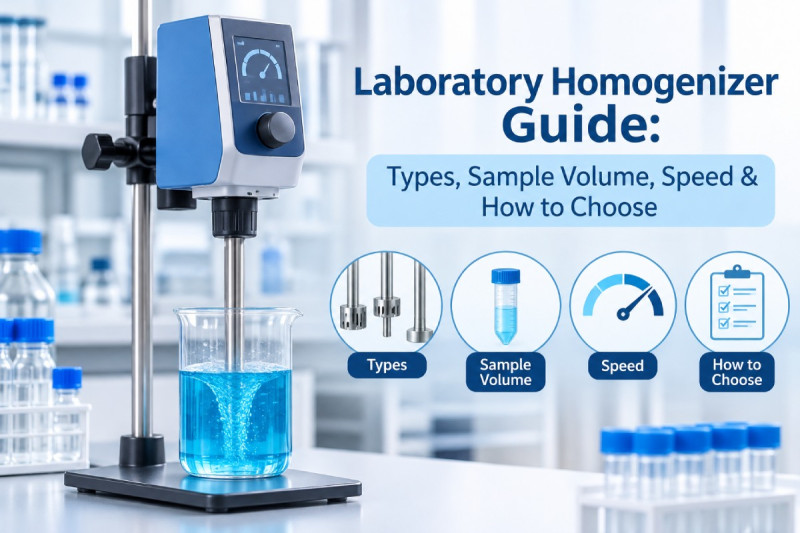
To choose the right homogenizer for laboratory work, start with three things: sample volume, sample type, and the result you need. Sample types include liquids, emulsions, tissue, and cell suspensions. The result might be a dispersion, an emulsion, or disrupted tissue or cells.
Those three answers usually point to one of three types:
- A handheld rotor-stator homogenizer for small samples
- A stand-mounted high shear homogenizer for formulation batches
- An ultrasonic homogenizer for cell lysis and very fine dispersion
A suitable homogenizer machine for laboratory applications should provide consistent results while supporting the sample preparation and processing requirements of your research.
A laboratory homogenizer is often the first piece of process equipment a formulation sees. The result in the lab sets expectations for pilot and production scale, so the lab unit should be chosen with scale-up in mind, not just price.
Types of laboratory homogenizers
Handheld (portable) rotor-stator homogenizer
A handheld homogenizer has a compact motor and a slim rotor-stator probe, called a generator, that dips into the sample tube or beaker. This type of portable homogenizer is suitable for processing small samples directly in laboratory containers.
Choosing a homogenizer for laboratory applications requires understanding differences in processing technology, sample capacity, and the required shear level.
- Typical uses: A tissue homogenizer machine is useful for tissue homogenization, sample preparation in microbiology and biology labs, and quick dispersions in millilitre volumes.
- Why labs choose it: It is fast to set up, easy to clean between samples, and works directly in the sample container.
- Limitations: it is not designed for long runs or larger batches. Heat builds up in very small volumes, so keep run times short and cool the sample where needed.
Stand-mounted high shear homogenizer
A bench homogenizer mounted on a stand, sometimes with electric lifting, handles larger volumes, from tens of millilitres up to many litres. It typically offers digital speed control and interchangeable heads.
- Typical uses: formulation development for creams, lotions, suspensions, sauces, and chemical emulsions; batch trials before pilot scale.
- Why labs choose it: it gives a repeatable speed and run time across a wide volume range, which is what scale-up needs.
Ultrasonic homogenizer
An ultrasonic homogenizer, also called a sonicator, uses a vibrating probe to create cavitation in the liquid.
- Typical uses: A cell lysis homogenizer is used for cell disruption, DNA shearing, nanoemulsions, and de-agglomerating nanoparticles.
- Limitations: It is less suited to viscous products or larger volumes, and the sample needs temperature control because cavitation generates heat.
For a deeper comparison, see rotor-stator vs ultrasonic homogenizers.
How to choose a lab homogenizer
When selecting a homogenizer for laboratory applications, consider the sample processing requirements, operating capacity, and the consistency needed for repeatable experiments.
1. Sample volume
Volume is the first filter. Match the generator head to the vessel. A probe that is too small for the beaker leaves material untreated. A probe that is too large in a small tube splashes and overheats the sample.
|
Sample volume |
Usually suits |
|
Microlitres to about 150 ml (tubes, small beakers) |
Handheld rotor-stator homogenizer with a small generator |
|
About 100 ml to several litres |
Stand-mounted high shear homogenizer |
|
Several litres to tens of litres (pilot) |
Larger high shear dispersing emulsifier or pilot unit |
|
Cell suspensions, small volumes |
Ultrasonic homogenizer |
A lab scale homogenizer should accommodate your current sample volume while allowing room for future formulation trials and larger experimental batches.
2. Speed and tip speed
Lab homogenizers often quote very high RPM, sometimes over 30,000 RPM. A small rotor needs that speed to reach a useful tip speed: rotor circumference × RPM.
When comparing units or planning scale-up, compare tip speed and run time rather than RPM. Variable speed is useful because tissue, emulsions, and powders each need different settings. When evaluating a homogenizer for laboratory use, consider how rotor speed and tip speed affect particle size reduction and processing consistency
3. Sample type
- Soft tissue and cell suspensions: A tissue homogenizer machine or ultrasonic homogenizer can be selected depending on the sample structure and required degree of disruption.
- Tough or fibrous tissue: a rotor-stator generator with suitable cutting geometry; mechanical pre-cutting may help.
- Emulsions and creams: a stand-mounted high shear homogenizer, often with a fine emulsifying head.
- Powder dispersion into liquid: a high shear head with good circulation; add powder gradually.
- Viscous products: check the viscosity rating and whether the vessel needs a separate stirrer to keep the batch moving.
In a homogenizer in microbiology lab applications, probe selection and processing conditions are particularly important for achieving consistent sample preparation while avoiding cross-contamination.
4. Generator probes and cleaning
Check which generator sizes are available. The ability to swap heads lets one drive serve tissue, emulsions, and powders. Also check that the probe can be dismantled and cleaned or autoclaved between samples, to avoid cross-contamination, which matters most in microbiology and pharma labs. For laboratories handling biological samples, a suitable handheld homogenizer with interchangeable probes can simplify sample processing across different tube and vessel sizes.
5. Heat, noise and duty
High speed in a small volume heats the sample quickly. For heat-sensitive samples, use short bursts, an ice bath, or a jacketed vessel. Check whether the unit is rated for longer runs if you will homogenize for extended periods. A suitable homogenizer for laboratory applications should offer reliable temperature management and an operating duty cycle that matches your experimental requirements.
6. Scale-up path
If the formulation will go to production, choose a lab scale homogenizer whose head design has larger equivalents to support consistent processing during scale-up. Record tip speed, run time, and number of passes, not just RPM, so the result can be reproduced on a pilot or inline homogenizer.
What affects laboratory homogenizer price?
The laboratory homogenizer price depends on the equipment configuration, processing capacity, motor specifications, and accessories required for your application.
- Motor power and speed range. Higher power and wider ranges cost more.
- Volume capacity and stand type. A manual stand costs less than electric lifting.
- Digital speed control and display.
- Number and type of generator probes included.
- Wetted materials and cleanability.
- Ultrasonic power, for sonicators.
When comparing laboratory homogenizer price options, consider the complete configuration, including the motor, generator probes, stand and additional accessories. For a fair comparison, price the configuration you actually need: drive, probes and stand.
SAN laboratory homogenizers
SAN's range of homogenizer for laboratory applications covers handheld, stand-mounted, ultrasonic, and pilot-scale units for different sample processing requirements. The figures below are as published by SAN and vary by model and head. Whether you need a portable homogenizer for small samples or a high-capacity system for formulation development, selecting the right configuration helps achieve consistent processing results.
|
Need |
SAN option |
Published figures |
|
Tissue and small-sample work |
Up to 35,000 RPM; about 0.2–150 mL depending on head |
|
|
Wide-range formulation work |
2,500–30,000 RPM; 0.2–15,000 ml |
|
|
Larger lab batches |
HR-500 series |
31,000 RPM; 7,000 ml |
|
Emulsifying and dispersing on a stand |
HRF-40AS emulsifying and dispersing homogenizer |
150 ml to 6 L |
|
Cell disruption and concentrated samples |
HXR-2000 ultrasonic emulsifier |
Combines ultrasonic and high-speed emulsifying |
|
Pilot batches |
50 L pilot high shear dispersing emulsifier |
50 L; listed for 8,000 mPa·s |
These options allow laboratories to select a homogenizer machine for laboratory applications based on sample volume, processing requirements, and the desired level of dispersion or homogenization. See also the portable homogenizer and electric lifting homogenizer categories.
Common mistakes
- Buying on maximum RPM. Compare tip speed, head design, and the volume range you will actually use.
- Using one probe for every volume. Match the generator to the vessel.
- Ignoring heat. Small samples heat quickly at high speed.
- Forgetting scale-up. A lab result is only useful if it can be reproduced at larger scale.
Selecting the right homogenizer for laboratory work also means considering future research requirements, sample compatibility, and the availability of suitable generator heads.
Frequently asked questions
What is a laboratory homogenizer used for?
A laboratory homogenizer breaks down and evenly distributes particles, droplets or tissue in a sample. Common uses are tissue homogenization, cell lysis, emulsion and cream development, powder dispersion, and sample preparation for analysis. A homogenizer in microbiology lab applications is also used for preparing biological samples, processing tissues, and obtaining consistent suspensions for analysis.
Which homogenizer is best for tissue samples?
For most tissue samples, a handheld homogenizer with a generator sized to the tube is a practical choice. A tissue homogenizer machine with suitable cutting geometry can help process tougher samples, while ultrasonic homogenizers are often preferred for cell lysis in suspension.
Is a lab mixer the same as a lab homogenizer?
No. A lab mixer blends materials through stirring, whereas a lab mixer homogenizer uses high shear to break down particles and droplets. The right equipment depends on whether the application requires simple mixing, dispersion, or finer homogenization.
What speed does a lab homogenizer need?
It depends on the rotor size and the sample. Small lab rotors often run between several thousand and over 30,000 RPM. Tip speed is the better basis for comparison.
Can a lab homogenizer predict production results?
Yes, if you record the conditions properly: tip speed, run time, volume, and temperature. Production equipment with a comparable head design helps the result transfer.
What is the difference between a lab scale homogenizer and a production homogenizer?
A lab scale homogenizer is designed for small sample volumes, research and formulation development. Production homogenizers handle larger batches and continuous processing requirements. Laboratory trials help establish processing conditions before scaling up.
What is a cell lysis homogenizer?
A cell lysis homogenizer is equipment used to break open cells and release their internal contents for laboratory analysis. Ultrasonic and rotor-stator homogenizers can be selected depending on the cell type, sample volume, and processing requirements.
How do I choose a lab mixer homogenizer?
A lab mixer homogenizer should be selected based on sample viscosity, processing volume, required shear intensity, and the desired final consistency. Check its speed range, interchangeable heads, and operating capacity before purchasing.
Next step
Send SAN's team your sample type, volume range, and target result. They can suggest a laboratory homogenizer and generator set, and the scale-up route if you need one.