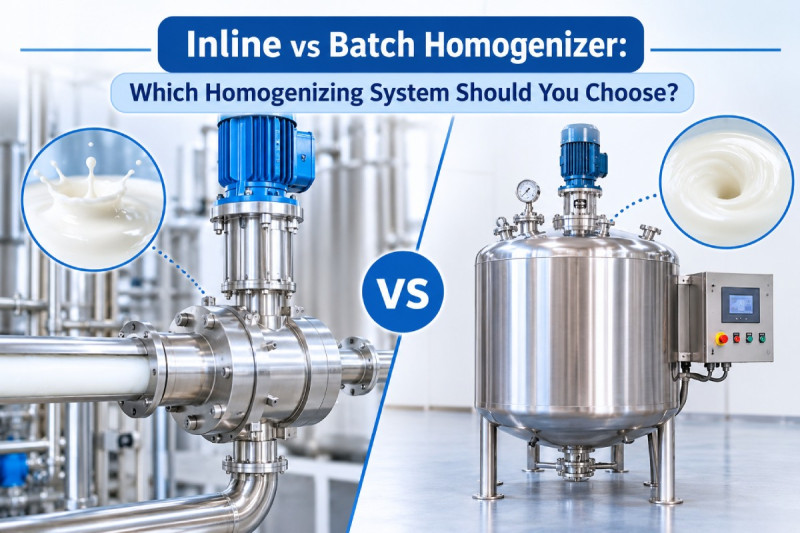
The choice between an inline vs batch homogenizer comes down to how the product is made, the required production capacity, and the level of processing consistency.
- Choose a batch homogenizer when the product is made in a vessel, the plant runs many products or recipes, and flexibility matters more than throughput.
- Choose an inline homogenizer when the product flows through a pipeline, volumes are higher or continuous, or every part of the product must see the same shear a controlled number of times.
Both types usually use the same rotor-stator principle. The difference is where the homogenizing head sits, which changes how evenly the product is treated, how the process scales, and how it fits into the line.
- Batch homogenizer: the head goes into the tank.
- Inline homogenizer: the product is pumped through the head.
Many plants use both, for example, a batch vessel with an inline homogenizer in a recirculation loop. This guide compares the inline homogenizer vs batch homogenizer options, explains the advantages of each homogenizing system, and shows how SAN's top-entry and inline ranges fit different production requirements. If you are still deciding between a homogenizer and a mixer, start with homogenizer vs high-shear mixer vs emulsifier.
What is a batch homogenizer?
A batch homogenizer works on a fixed quantity of product held in a vessel or tank. The homogenizing head, usually a high shear rotor-stator, is mounted from the top or bottom of the vessel or lowered in on a stand. This batch homogenizing system runs until the whole batch reaches the required droplet or particle size.
It is particularly useful for manufacturers handling different formulations, smaller production volumes, and frequent recipe changes. For the technologies behind these heads, see what is a homogenizer. The head draws product in, shears it in the narrow rotor-stator gap, and pushes it back out into the vessel. The batch is homogenized by repeated circulation through that zone.
How evenly that happens depends on three things:
- Vessel shape and size
- Product viscosity
- Run time
Where a batch homogenizing system fits
- Multi-product plants: A batch homogenizing system is suitable for facilities where recipes, batch sizes, and product formulations change frequently.
- Products made in the vessel: Phases are added, heated, cooled or adjusted during the run.
- Smaller volumes: Batch volumes are small to medium, and throughput is not the main constraint.
- Development and scale-up: Batch steps are easier to adjust and repeat.
Production considerations
- Uneven exposure: Material near the head is sheared more often than material far from it. Large or viscous batches may need longer run times or a second agitator to keep the batch turning over.
- Run time sets cycle time: Batch time grows with batch volume, so very large vessels can become slow to process.
- Air entrapment: A head working near the surface can draw air into the product. Head position, immersion depth, and, for creams, vacuum all matter.
- Cleaning: It is relatively simple: a top-entry head lifts out or is cleaned with the vessel.
What is an inline homogenizer?
An inline homogenizer is a rotor-stator homogenizer installed in a pipeline. The product is pumped or drawn through the head, so every part of it passes through the shear zone. An inline homogenizing system is therefore a common choice for continuous processing, where manufacturers require consistent treatment and controlled product flow. It can also operate as a continuous homogenizer within an automated production line.
There are three common arrangements:
- Single pass: Product passes through the head once on its way from one vessel or process step to the next. This works when one pass achieves the required result.
- Recirculation loop: Product runs from a vessel through the inline head and back again, for as many passes as the process needs. This combines batch flexibility with inline treatment.
- Multi-stage heads: Two or more rotor-stator stages in series give a finer, tighter size distribution in a single pass.
Integration into production lines
An inline homogenizing system sits between pumps, vessels, heat exchangers, and filling lines. It can be fed directly from upstream equipment and can feed downstream equipment without an intermediate tank. It can be fed directly from upstream equipment and can feed downstream equipment without an intermediate tank. Some inline designs also draw powder into the liquid stream, so powders are wetted and dispersed in the line instead of being tipped into a tank.
Flow considerations
- Flow rate sets residence time: Faster flow means less time in the shear zone and less work done on each portion of product. Slower flow means more.
- Viscosity limits self-pumping: Many rotor-stator heads can pump thin liquids, but a thicker product usually needs a feed pump, such as a lobe or other positive-displacement pump, to keep the head fed.
- Temperature rise: Energy put into the product appears as heat. In multi-pass or high-energy duties, plan for product temperature and cooling.
- Seals and hygiene: The head has a shaft seal in the product line, so seal type and cleanability matter, especially in food and pharma.
Inline vs batch homogenizer: detailed comparison
When evaluating an inline homogenizer vs batch homogenizer, the main difference is how the product moves through the processing equipment. A batch homogenizer treats the product inside a vessel, while an inline unit processes material as it flows through the rotor-stator head. This difference affects production capacity, consistency, process control, and equipment integration.
|
Factor |
Inline homogenizer |
Batch homogenizer |
|
Processing mode |
Continuous, single pass or recirculation |
Batch, in a vessel |
|
Where shear happens |
In a head in the pipeline; all product passes through it |
In a head inside the vessel; product circulates past it |
|
Treatment uniformity |
Controlled number of passes; typically more even |
Depends on circulation, run time and vessel design |
|
Production integration |
High; fits between pumps, vessels and filling lines |
Tank-based; one vessel per batch |
|
Throughput |
Depends on the application; scales with flow rate |
Depends on the batch; limited by batch size and cycle time |
|
Process control |
Flow rate, speed and number of passes; suits automation |
Run time, speed and head position |
|
Scale-up |
Depends on the line and process; often by flow rate or a larger head |
Depends on the vessel and process; geometry changes with size |
|
Viscous products |
Usually needs a feed pump as viscosity rises |
Needs good bulk circulation; may need an anchor or scraper agitator |
|
Powder incorporation |
Possible inline with suitable designs |
Powder added to the vessel surface or under the surface |
|
Air entrapment |
Generally lower in a closed pipeline |
Possible if the head runs near the surface; vacuum vessels help |
|
Cleaning |
Cleaned in place with the line; seal design matters |
Head lifted out, or cleaned with the vessel |
|
Flexibility |
Best for longer runs of fewer products |
Best for frequent changeovers and many recipes |
|
Best suited for |
Continuous or high-volume production |
Batch production, multi-product plants, development |
Which one should you use?
Which homogenizer is better for high-volume production?
For high or continuous production volumes, an inline homogenizer is usually the stronger option. When comparing inline vs batch homogenizer configurations, inline processing offers advantages in production capacity, controlled product treatment, and automation. Its capacity scales with flow rate, and every part of the product passes through the shear zone.
A batch homogenizer can still handle large volumes, but cycle time and uniformity become harder to manage as vessels grow. A continuous homogenizer is particularly suitable for manufacturers operating long production campaigns.
Which is better for formulation development?
For formulation development, a batch homogenizer is usually more practical. It lets you adjust speed, time, and additions in the vessel and repeat small trials quickly. Lab and pilot work typically starts in batch. The process can then move inline once the formulation and target result are fixed. A batch homogenizing system also makes it easier to test different ingredient combinations before transferring the formulation to an inline production setup.
When should you use an inline homogenizer?
- Production is continuous or in long campaigns.
- Batch-to-batch consistency is critical and needs a controlled number of passes.
- Powders must be dispersed into liquid quickly and without lumps.
- The process must link directly to upstream and downstream equipment.
- An existing batch vessel needs better uniformity. An inline unit in a recirculation loop can help.
When is a top-entry or batch homogenizer more appropriate?
- The plant makes many recipes in varied batch sizes.
- Phases are added, heated, or adjusted in the vessel during the run.
- The batch volume is moderate, and the vessel already exists.
- Simplicity and quick changeover matter more than maximum throughput.
By industry
Homogenizer for pharmaceutical industry applications
Creams, ointments, suspensions and syrups are often made in batches because recipes, validation requirements and smaller production volumes favour vessel-based processing. A homogenizer for pharmaceutical industry production should offer suitable cleanability, seal design and documentation. Inline or recirculation homogenizers are also useful where consistent processing and closed production systems matter.
Homogenizer for food industry applications
Sauces, dressings, dairy blends, beverages and products containing dissolved powders often use inline processing at higher volumes. A homogenizer for food industry production should support consistent product quality, hygienic operation, and efficient processing. Batch systems remain suitable for smaller runs and frequent recipe changes.
Cosmetic homogenizer
Creams and lotions are commonly made in vacuum batch vessels with a homogenizer and scraper agitator. A cosmetic homogenizer can also be integrated into an inline recirculation loop to improve uniformity and shorten batch processing time.
Sizing factors: capacity, viscosity and rotor-stator configuration
What determines homogenizer capacity?
Selecting an industrial homogenizer requires more than checking its maximum processing capacity. Homogenizer capacity depends on how much shear the product needs, how often it needs it, and how easily it flows. The correct sizing also depends on the formulation, target particle size, and operating conditions.
- Target result: A finer droplet or particle size needs more energy per litre, which means more passes, more time or a finer head.
- Head size and speed: A larger rotor and higher tip speed handle more product and do more work per pass.
- Viscosity: As viscosity rises, a head moves less product, so throughput and circulation fall.
- Number of passes or turnovers: Inline systems are sized on flow rate and passes. Batch systems are sized on vessel volume and run time.
- Temperature limits: Heat from the shear zone may limit how long or how hard the product can be worked.
For a recirculation loop, a quick check is: passes ≈ (flow rate × time) ÷ batch volume. For example, a 2,000 L batch recirculated through an inline head at 10 m³/h for 60 minutes sees about 10,000 ÷ 2,000 = 5 passes on average.
Published maximum flow rates are best-case figures, usually for thin, water-like products. Real capacity for a specific formulation should be confirmed by a trial.
How do viscosity and formulation affect selection?
|
Product behaviour |
Batch homogenizer |
Inline homogenizer |
|
Thin liquids |
Circulates well; straightforward |
The head may pump the product itself; straightforward |
|
Medium viscosity |
May need longer run times or a second agitator |
Usually needs a feed pump |
|
High viscosity or thickening during the batch |
Needs an anchor or scraper agitator for bulk movement |
Needs a positive-displacement feed pump and checks on pressure and heat |
|
Heavy powder additions |
Risk of lumps and floating powder |
Powder induction designs can wet powder in the line |
Formulation also matters:
- Phase ratio: The proportion of dispersed phase affects how easily a stable emulsion forms.
- Emulsifiers and stabilisers: These determine how stable the droplets stay once formed.
- Order of addition: The sequence in which ingredients go in changes the result.
- Process temperature: It changes viscosity and emulsion behaviour.
The same machine can give very different results on two formulations, which is why trials matter. These factors should be evaluated before selecting an inline vs batch homogenizer, as the same machine configuration may perform differently with products of varying viscosity and composition.
What rotor-stator configuration is required?
The generator head should match the job.
- Coarser slotted heads move more product and suit powder dispersion and pre-mixing.
- Finer heads (finer slots, more rows of teeth) give smaller droplets and suit emulsions.
- Multi-stage heads pass product through several rotor-stator rings in series, narrowing the size distribution in one pass. They are common in inline designs.
- Abrasive solids call for attention to wear on the rotor, stator, and seal.
Tip speed (rotor circumference × RPM) is the usual way to compare shear intensity between heads of different sizes. The formula and a worked example are in homogenizer vs high-shear mixer.
SAN inline and top-entry homogenizers
SAN's homogenizer range covers both architectures: top-entry homogenizers for batch vessels and inline homogenizers for continuous and recirculation applications. Manufacturers can choose an industrial homogenizer based on production volume, formulation requirements, and processing conditions. The figures below are as published by SAN; maximums apply to the largest model in each series.
Inline homogenizers
|
Series |
Configuration |
Published capacity |
Published power |
Best fit |
|
SAN JZ1 single-stage homogenizing pump |
Single-stage rotor-stator, trolley-mounted |
Up to 65 m³/h |
Up to 75 kW |
General inline homogenizing and recirculation |
|
SAN SHEAR JZ3 multistage inline homogenizer |
12 layers of rotor and stator |
Up to 50 m³/h |
Up to 55 kW |
Finer, tighter size distribution in one pass |
|
SAN SHEAR PM series homogeneous mixing pump |
Inline mixing, shearing and emulsifying with powder handling |
Up to 9,000 kg/h powder; up to 3,000 kg/h thickeners, depending on viscosity and concentration |
Not published |
Powder and thickener dispersion into liquid |
Across these series, SAN lists the following options:
- Contact materials: 304/316L, including an ASME BPE 316L option
- Surface finish: down to Ra 0.4 µm
- Seals: single or double mechanical seals
- Connections: thread, clamp, flange or aseptic flange
- Maximum temperature: 130–140 °C, depending on series
For thicker products, SAN also offers an inline homogenizer with lobe pumps.
Top-entry batch homogenizers
The SAN WRL homogenizer series is a top-entry design for emulsification in vessels.
|
Model |
Batch volume (L) |
Power rating (as published) |
Speed (RPM) |
|
SAN WRL-90 |
10–50 |
2 |
2,800 |
|
SAN WRL-100 |
50–100 |
3 |
2,800 |
|
SAN WRL-120 |
100–300 |
5 |
2,800 |
|
SAN WRL-140 |
300–800 |
10 |
2,800 |
|
SAN WRL-160 |
500–1,500 |
15 |
2,800 |
|
SAN WRL-180 |
600–2,000 |
25 |
2,800 |
|
SAN WRL-200 |
800–2,500 |
30 |
1,400 |
|
SAN WRL-220 |
1,000–3,500 |
40 |
1,400 |
|
SAN WRL-240 |
1,500–5,000 |
50 |
1,400 |
The largest WRL models run at a lower speed on a larger head. RPM alone is not a measure of shear; tip speed is.
Matching the range to the requirement
|
Your requirement |
Start with |
|
Batch emulsions in vessels from about 10 L to 5,000 L |
WRL top-entry series, sized to vessel volume |
|
Continuous production or a recirculation loop on an existing vessel |
JZ1 single-stage inline |
|
Tighter droplet distribution in a single pass |
JZ3 multistage inline |
|
Fast powder or thickener dispersion into liquid |
PM series mixing pump |
|
Viscous products that need a positive feed |
Inline homogenizer with lobe pumps |
|
Lab or pilot trials before scale-up |
Laboratory homogenizers |
Common selection mistakes
- Sizing an inline unit on its maximum flow rate. The published maximum is a best case; viscous or demanding products need lower flow or more passes.
- Sizing a batch head on vessel volume alone. Viscosity, the target size, and vessel geometry decide how long the batch takes and how even it is.
- Ignoring the feed pump. Thick products rarely feed an inline head on their own.
- Forgetting heat. High-energy or multi-pass homogenizing raises product temperature.
- Treating RPM as shear. Compare tip speed and head design, not RPM, especially between different sizes.
- Skipping trials. Formulation drives the result as much as the machine. Testing the product using the selected homogenizer machine is the most reliable way to confirm processing performance before full-scale production.
Frequently asked questions
What is the difference between an inline vs batch homogenizer?
An inline vs batch homogenizer comparison mainly comes down to how the product is processed. A batch homogenizer works inside a vessel and treats the product as it circulates past the head. An inline homogenizer sits in a pipeline, where all the product passes through the rotor-stator head. Inline systems typically provide more controlled treatment and suit continuous production, while batch systems offer flexibility for multi-product manufacturing.
Is an inline homogenizer the same as a continuous homogenizer?
A continuous homogenizer is particularly useful when production requires a consistent flow of material and integration with automated equipment. In practice, mostly yes. An inline homogenizer is the usual form of a continuous homogenizer, because product flows through it without stopping. It can also run on a recirculation loop around a batch vessel, so "inline" does not always mean the whole process is continuous.
Is an inline high shear homogenizer better than a batch high shear homogenizer?
Not in every case. An inline high shear homogenizer provides controlled, repeatable passes and integrates easily into a production line. A batch high shear homogenizer is simpler and more flexible for changing recipes. The right choice depends on production volume, product range, viscosity, and the consistency required.
Can I add an inline homogenizer to an existing batch vessel?
Yes. A recirculation loop from the vessel, through an inline homogenizer, and back is a common upgrade. It can improve uniformity and shorten batch time without replacing the vessel. Check that the vessel outlet, pipework, and any feed pump suit the product's viscosity.
How do I size an industrial homogenizer?
Choosing the right homogenizer machine depends on your product formulation, production capacity, viscosity, and required processing results.
To size an industrial homogenizer, start with five inputs:
- Product and viscosity range
- Target droplet or particle size
- Batch volume or required flow rate
- Number of passes or run time
- Temperature limits
Use these to choose the configuration and head, then confirm with a trial. These details help determine whether an inline homogenizer vs batch homogenizer configuration is more appropriate for your production requirements.
Which homogenizer machine is best for creams and lotions?
For creams and lotions, a homogenizer machine in a vacuum batch vessel, with a scraper or anchor agitator, is a common setup. A cosmetic homogenizer with an inline recirculation loop can also improve consistency when processing larger volumes.
Next step
To get a recommendation, send SAN's team the following:
- Your product
- Viscosity range
- Batch volume or flow rate
- Target result
- Hygiene requirements
They can suggest whether a top-entry, inline, or combined system suits the process, and which model to trial.